

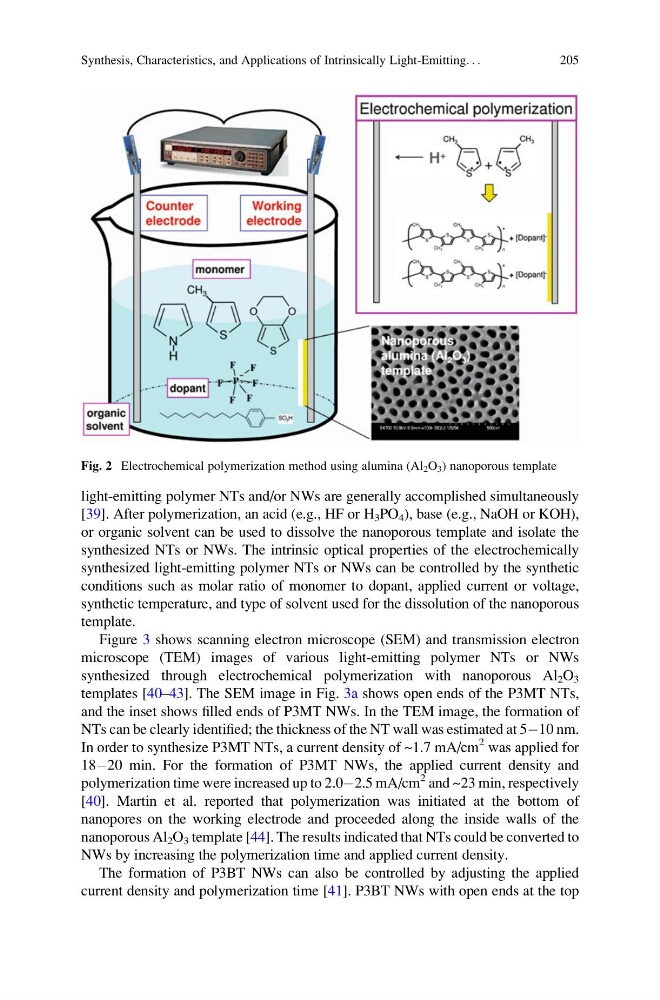
light-emitting polymer NTs and/or NWs are generally accomplished simultaneously
[39]. After polymerization, an acid (e.g., HF or H 3 PO 4 ), base (e.g., NaOH or KOH),
or organic solvent can be used to dissolve the nanoporous template and isolate the
synthesized NTs or NWs. The intrinsic optical properties of the electrochemically
synthesized light-emitting polymer NTs or NWs can be controlled by the synthetic
conditions such as molar ratio of monomer to dopant, applied current or voltage,
synthetic temperature, and type of solvent used for the dissolution of the nanoporous
template.
Figure 3 shows scanning electron microscope (SEM) and transmission electron
microscope (TEM) images of various light-emitting polymer NTs or NWs
synthesized through electrochemical polymerization with nanoporous Al 2 O 3
templates [40–43]. The SEM image in Fig. 3a shows open ends of the P3MT NTs,
and the inset shows filled ends of P3MT NWs. In the TEM image, the formation of
NTs can be clearly identified; the thickness of the NT wall was estimated at 5À10 nm.
In order to synthesize P3MT NTs, a current density of ~1.7 mA/cm
2 was applied for
18À20 min. For the formation of P3MT NWs, the applied current density and
polymerization time were increased up to 2.0À2.5 mA/cm
2 and ~23 min, respectively
[40]. Martin et al. reported that polymerization was initiated at the bottom of
nanopores on the working electrode and proceeded along the inside walls of the
nanoporous Al 2 O 3 template [44]. The results indicated that NTs could be converted to
NWs by increasing the polymerization time and applied current density.
The formation of P3BT NWs can also be controlled by adjusting the applied
current density and polymerization time [41]. P3BT NWs with open ends at the top
Fig. 2 Electrochemical polymerization method using alumina (Al 2 O 3 ) nanoporous template
Synthesis, Characteristics, and Applications of Intrinsically Light-Emitting. . .
205
[39]. After polymerization, an acid (e.g., HF or H 3 PO 4 ), base (e.g., NaOH or KOH),
or organic solvent can be used to dissolve the nanoporous template and isolate the
synthesized NTs or NWs. The intrinsic optical properties of the electrochemically
synthesized light-emitting polymer NTs or NWs can be controlled by the synthetic
conditions such as molar ratio of monomer to dopant, applied current or voltage,
synthetic temperature, and type of solvent used for the dissolution of the nanoporous
template.
Figure 3 shows scanning electron microscope (SEM) and transmission electron
microscope (TEM) images of various light-emitting polymer NTs or NWs
synthesized through electrochemical polymerization with nanoporous Al 2 O 3
templates [40–43]. The SEM image in Fig. 3a shows open ends of the P3MT NTs,
and the inset shows filled ends of P3MT NWs. In the TEM image, the formation of
NTs can be clearly identified; the thickness of the NT wall was estimated at 5À10 nm.
In order to synthesize P3MT NTs, a current density of ~1.7 mA/cm
2 was applied for
18À20 min. For the formation of P3MT NWs, the applied current density and
polymerization time were increased up to 2.0À2.5 mA/cm
2 and ~23 min, respectively
[40]. Martin et al. reported that polymerization was initiated at the bottom of
nanopores on the working electrode and proceeded along the inside walls of the
nanoporous Al 2 O 3 template [44]. The results indicated that NTs could be converted to
NWs by increasing the polymerization time and applied current density.
The formation of P3BT NWs can also be controlled by adjusting the applied
current density and polymerization time [41]. P3BT NWs with open ends at the top
Fig. 2 Electrochemical polymerization method using alumina (Al 2 O 3 ) nanoporous template
Synthesis, Characteristics, and Applications of Intrinsically Light-Emitting. . .
205