

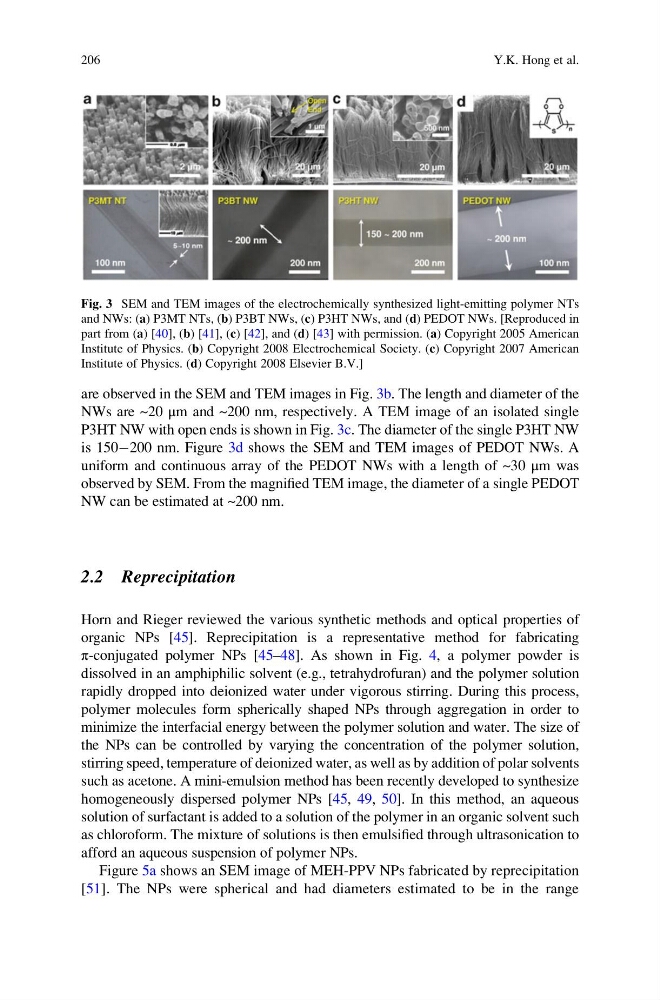
are observed in the SEM and TEM images in Fig. 3b. The length and diameter of the
NWs are ~20 μm and ~200 nm, respectively. A TEM image of an isolated single
P3HT NW with open ends is shown in Fig. 3c. The diameter of the single P3HT NW
is 150À200 nm. Figure 3d shows the SEM and TEM images of PEDOT NWs. A
uniform and continuous array of the PEDOT NWs with a length of ~30 μm was
observed by SEM. From the magnified TEM image, the diameter of a single PEDOT
NW can be estimated at ~200 nm.
2.2 Reprecipitation
Horn and Rieger reviewed the various synthetic methods and optical properties of
organic NPs [45]. Reprecipitation is a representative method for fabricating
π-conjugated polymer NPs [45–48]. As shown in Fig. 4, a polymer powder is
dissolved in an amphiphilic solvent (e.g., tetrahydrofuran) and the polymer solution
rapidly dropped into deionized water under vigorous stirring. During this process,
polymer molecules form spherically shaped NPs through aggregation in order to
minimize the interfacial energy between the polymer solution and water. The size of
the NPs can be controlled by varying the concentration of the polymer solution,
stirring speed, temperature of deionized water, as well as by addition of polar solvents
such as acetone. A mini-emulsion method has been recently developed to synthesize
homogeneously dispersed polymer NPs [45, 49, 50]. In this method, an aqueous
solution of surfactant is added to a solution of the polymer in an organic solvent such
as chloroform. The mixture of solutions is then emulsified through ultrasonication to
afford an aqueous suspension of polymer NPs.
Figure 5a shows an SEM image of MEH-PPV NPs fabricated by reprecipitation
[51]. The NPs were spherical and had diameters estimated to be in the range
Fig. 3 SEM and TEM images of the electrochemically synthesized light-emitting polymer NTs
and NWs: (a) P3MT NTs, (b) P3BT NWs, (c) P3HT NWs, and (d) PEDOT NWs. [Reproduced in
part from (a) [40], (b) [41], (c) [42], and (d) [43] with permission. (a) Copyright 2005 American
Institute of Physics. (b) Copyright 2008 Electrochemical Society. (c) Copyright 2007 American
Institute of Physics. (d) Copyright 2008 Elsevier B.V.]
206
Y.K. Hong et al.
NWs are ~20 μm and ~200 nm, respectively. A TEM image of an isolated single
P3HT NW with open ends is shown in Fig. 3c. The diameter of the single P3HT NW
is 150À200 nm. Figure 3d shows the SEM and TEM images of PEDOT NWs. A
uniform and continuous array of the PEDOT NWs with a length of ~30 μm was
observed by SEM. From the magnified TEM image, the diameter of a single PEDOT
NW can be estimated at ~200 nm.
2.2 Reprecipitation
Horn and Rieger reviewed the various synthetic methods and optical properties of
organic NPs [45]. Reprecipitation is a representative method for fabricating
π-conjugated polymer NPs [45–48]. As shown in Fig. 4, a polymer powder is
dissolved in an amphiphilic solvent (e.g., tetrahydrofuran) and the polymer solution
rapidly dropped into deionized water under vigorous stirring. During this process,
polymer molecules form spherically shaped NPs through aggregation in order to
minimize the interfacial energy between the polymer solution and water. The size of
the NPs can be controlled by varying the concentration of the polymer solution,
stirring speed, temperature of deionized water, as well as by addition of polar solvents
such as acetone. A mini-emulsion method has been recently developed to synthesize
homogeneously dispersed polymer NPs [45, 49, 50]. In this method, an aqueous
solution of surfactant is added to a solution of the polymer in an organic solvent such
as chloroform. The mixture of solutions is then emulsified through ultrasonication to
afford an aqueous suspension of polymer NPs.
Figure 5a shows an SEM image of MEH-PPV NPs fabricated by reprecipitation
[51]. The NPs were spherical and had diameters estimated to be in the range
Fig. 3 SEM and TEM images of the electrochemically synthesized light-emitting polymer NTs
and NWs: (a) P3MT NTs, (b) P3BT NWs, (c) P3HT NWs, and (d) PEDOT NWs. [Reproduced in
part from (a) [40], (b) [41], (c) [42], and (d) [43] with permission. (a) Copyright 2005 American
Institute of Physics. (b) Copyright 2008 Electrochemical Society. (c) Copyright 2007 American
Institute of Physics. (d) Copyright 2008 Elsevier B.V.]
206
Y.K. Hong et al.