

Fig. 26d, the width and screw pitch of the assemblies are similar to those observed
in SEM images. The orientation of the height contour indicates that these superhelices have a right-handed sense. Many possible interactions, including hydrophobic, dipolar π–π interactions, and ordered packing tendency of α-helical polypeptide
segments, are believed to be responsible for the formation of super-helical
structures.
Usually, hierarchical structure-forming systems contain complex interactions,
thus it is a daunting task to understand exactly how the observed structures were
formed. Computer simulation is a useful tool for investigating multicomponent
self-assembly systems and elucidating the supramolecular structures. Cai et al. also
carried out a BD simulation on a model rod–coil block copolymer/rigid homopolymer binary system. From the simulation results, it was found that the
homopolymers and block copolymers formed ordered structures with different
scales. The polypeptide homopolymers packed side-by-side to form bundles; the
block copolymers were helically wrapped on the homopolymer bundles; and the
packing mode of block PBLG rods exhibited characteristics of the cholesteric LC
structure. In such a structure, there exist two levels of polypeptide chain ordering.
The interplay of these two level orderings has an important role in determining the
final structures.
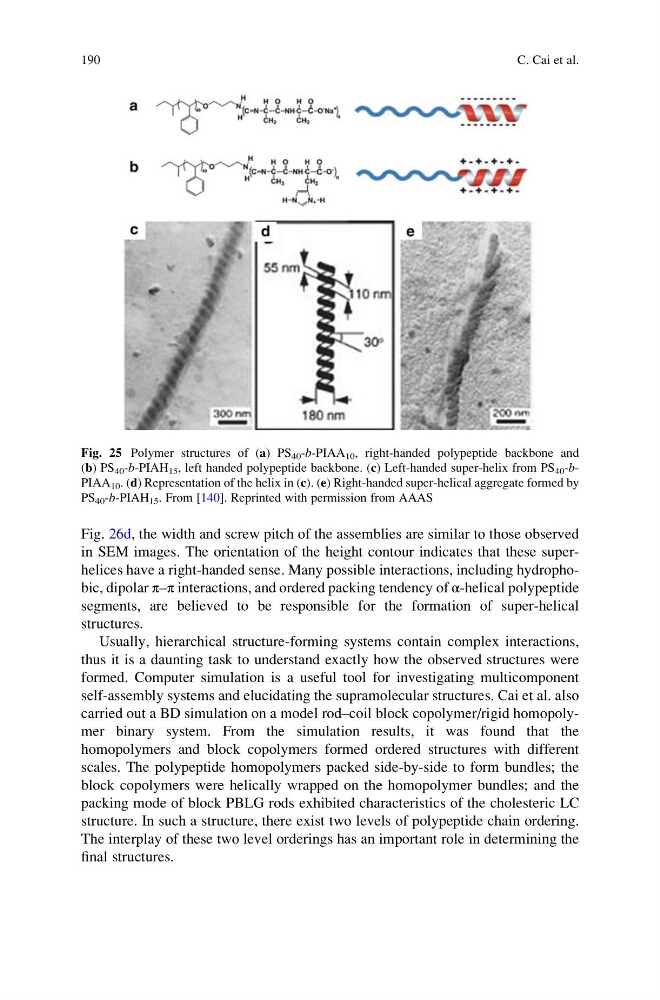
Fig. 25 Polymer structures of (a) PS 40 -b-PIAA 10 , right-handed polypeptide backbone and
(b) PS 40 -b-PIAH 15 , left handed polypeptide backbone. (c) Left-handed super-helix from PS 40 -bPIAA 10 . (d) Representation of the helix in (c). (e) Right-handed super-helical aggregate formed by
PS 40 -b-PIAH 15 . From [140]. Reprinted with permission from AAAS
190
C. Cai et al.
in SEM images. The orientation of the height contour indicates that these superhelices have a right-handed sense. Many possible interactions, including hydrophobic, dipolar π–π interactions, and ordered packing tendency of α-helical polypeptide
segments, are believed to be responsible for the formation of super-helical
structures.
Usually, hierarchical structure-forming systems contain complex interactions,
thus it is a daunting task to understand exactly how the observed structures were
formed. Computer simulation is a useful tool for investigating multicomponent
self-assembly systems and elucidating the supramolecular structures. Cai et al. also
carried out a BD simulation on a model rod–coil block copolymer/rigid homopolymer binary system. From the simulation results, it was found that the
homopolymers and block copolymers formed ordered structures with different
scales. The polypeptide homopolymers packed side-by-side to form bundles; the
block copolymers were helically wrapped on the homopolymer bundles; and the
packing mode of block PBLG rods exhibited characteristics of the cholesteric LC
structure. In such a structure, there exist two levels of polypeptide chain ordering.
The interplay of these two level orderings has an important role in determining the
final structures.
Fig. 25 Polymer structures of (a) PS 40 -b-PIAA 10 , right-handed polypeptide backbone and
(b) PS 40 -b-PIAH 15 , left handed polypeptide backbone. (c) Left-handed super-helix from PS 40 -bPIAA 10 . (d) Representation of the helix in (c). (e) Right-handed super-helical aggregate formed by
PS 40 -b-PIAH 15 . From [140]. Reprinted with permission from AAAS
190
C. Cai et al.