

4.3 Complex Structures Self-Assembled from Polypeptide
Copolymers
In addition to the cylindrical micelles and vesicles, the ordering of polypeptide
chains also contributes to the formation of complex structures with hierarchical
feature [140–142]. For example, Nolte et al. found that the polypeptide-based block
copolymers of polystyrene with poly(isocyano-L-alanine-L-alanine) and poly
(isocyano-L-alanine-L-histidine), PS 40 -b-PIAA 10 (Fig. 25a) and PS 40 -b-PIAH 15
(Fig. 25b), are able to self-assemble into super-helical structures in a sodium acetate
buffer of pH 5.6 (0.2 mM) [140]. Structures with two length-scales are involved in
such super-helices: fiber-like whole structures and screws of the super-helices. As
shown in Fig. 25c–e, the super-helices have an opposite chirality to that of the
constituent polypeptide segments of building block copolymers. Since the polypeptide chains take rigid α-helix conformation and the chirality of the formed superhelices is related to the handedness of the building polypeptides, it can be deduced
that the ordering of polypeptide rods is an important factor in determining the
formation of these hierarchical structures.
As reported by Cai et al., virus-like right-handed super-helical fibers and rings
can be self-assembled from a binary system consisting of rod–coil PBLG-b-PEG
block copolymers and PBLG rigid homopolymers [141]. The hierarchical
structures are formed with PBLG bundles as the core wrapped by PBLG-b-PEG
block copolymers. They revealed that the high molecular weight of PBLG homopolymer is crucial for the construction of the super-helical structures. For the
mixture system containing low molecular weight PBLG homopolymers
(PBLG 40000 ), spheres are observed (Fig. 26a). With increasing molecular weight
of the PBLG homopolymers (PBLG 110000 ), super-helical rods start to appear
(Fig. 26b). With further increase in the molecular weight of homo-PBLG
(PBLG 520000 ), long super-helical fibers and rings with uniform diameter of
140 nm and screw-pitch of 80 nm are obtained (Fig. 26c). The detailed surface
profile of the super-helices was examined using AFM analysis. As shown in
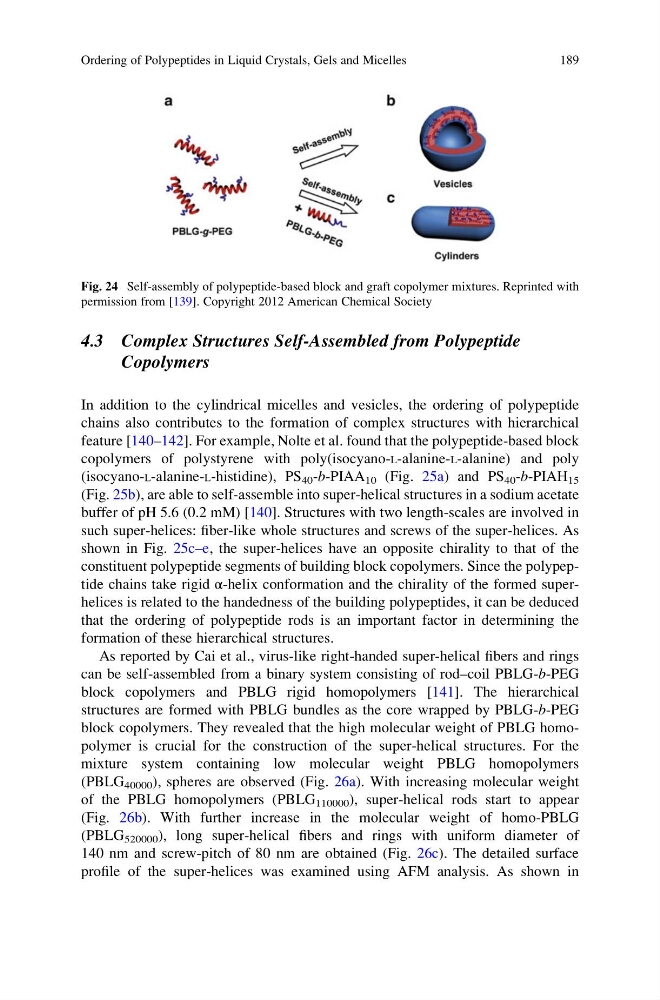
Fig. 24 Self-assembly of polypeptide-based block and graft copolymer mixtures. Reprinted with
permission from [139]. Copyright 2012 American Chemical Society
Ordering of Polypeptides in Liquid Crystals, Gels and Micelles
189
Copolymers
In addition to the cylindrical micelles and vesicles, the ordering of polypeptide
chains also contributes to the formation of complex structures with hierarchical
feature [140–142]. For example, Nolte et al. found that the polypeptide-based block
copolymers of polystyrene with poly(isocyano-L-alanine-L-alanine) and poly
(isocyano-L-alanine-L-histidine), PS 40 -b-PIAA 10 (Fig. 25a) and PS 40 -b-PIAH 15
(Fig. 25b), are able to self-assemble into super-helical structures in a sodium acetate
buffer of pH 5.6 (0.2 mM) [140]. Structures with two length-scales are involved in
such super-helices: fiber-like whole structures and screws of the super-helices. As
shown in Fig. 25c–e, the super-helices have an opposite chirality to that of the
constituent polypeptide segments of building block copolymers. Since the polypeptide chains take rigid α-helix conformation and the chirality of the formed superhelices is related to the handedness of the building polypeptides, it can be deduced
that the ordering of polypeptide rods is an important factor in determining the
formation of these hierarchical structures.
As reported by Cai et al., virus-like right-handed super-helical fibers and rings
can be self-assembled from a binary system consisting of rod–coil PBLG-b-PEG
block copolymers and PBLG rigid homopolymers [141]. The hierarchical
structures are formed with PBLG bundles as the core wrapped by PBLG-b-PEG
block copolymers. They revealed that the high molecular weight of PBLG homopolymer is crucial for the construction of the super-helical structures. For the
mixture system containing low molecular weight PBLG homopolymers
(PBLG 40000 ), spheres are observed (Fig. 26a). With increasing molecular weight
of the PBLG homopolymers (PBLG 110000 ), super-helical rods start to appear
(Fig. 26b). With further increase in the molecular weight of homo-PBLG
(PBLG 520000 ), long super-helical fibers and rings with uniform diameter of
140 nm and screw-pitch of 80 nm are obtained (Fig. 26c). The detailed surface
profile of the super-helices was examined using AFM analysis. As shown in
Fig. 24 Self-assembly of polypeptide-based block and graft copolymer mixtures. Reprinted with
permission from [139]. Copyright 2012 American Chemical Society
Ordering of Polypeptides in Liquid Crystals, Gels and Micelles
189