

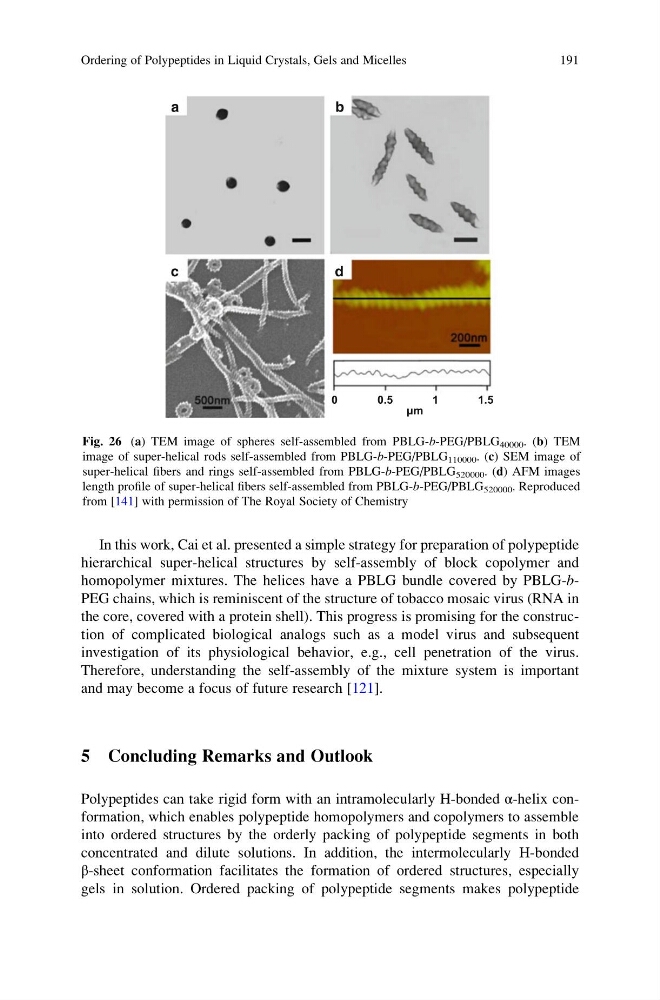
In this work, Cai et al. presented a simple strategy for preparation of polypeptide
hierarchical super-helical structures by self-assembly of block copolymer and
homopolymer mixtures. The helices have a PBLG bundle covered by PBLG-bPEG chains, which is reminiscent of the structure of tobacco mosaic virus (RNA in
the core, covered with a protein shell). This progress is promising for the construction of complicated biological analogs such as a model virus and subsequent
investigation of its physiological behavior, e.g., cell penetration of the virus.
Therefore, understanding the self-assembly of the mixture system is important
and may become a focus of future research [121].
5 Concluding Remarks and Outlook
Polypeptides can take rigid form with an intramolecularly H-bonded α-helix conformation, which enables polypeptide homopolymers and copolymers to assemble
into ordered structures by the orderly packing of polypeptide segments in both
concentrated and dilute solutions. In addition, the intermolecularly H-bonded
β-sheet conformation facilitates the formation of ordered structures, especially
gels in solution. Ordered packing of polypeptide segments makes polypeptide
0
0.5
1
1.5
μm
a
b
d
c
Fig. 26 (a) TEM image of spheres self-assembled from PBLG-b-PEG/PBLG 40000 . (b) TEM
image of super-helical rods self-assembled from PBLG-b-PEG/PBLG 110000 . (c) SEM image of
super-helical fibers and rings self-assembled from PBLG-b-PEG/PBLG 520000 . (d) AFM images
length profile of super-helical fibers self-assembled from PBLG-b-PEG/PBLG 520000 . Reproduced
from [141] with permission of The Royal Society of Chemistry
Ordering of Polypeptides in Liquid Crystals, Gels and Micelles
191
hierarchical super-helical structures by self-assembly of block copolymer and
homopolymer mixtures. The helices have a PBLG bundle covered by PBLG-bPEG chains, which is reminiscent of the structure of tobacco mosaic virus (RNA in
the core, covered with a protein shell). This progress is promising for the construction of complicated biological analogs such as a model virus and subsequent
investigation of its physiological behavior, e.g., cell penetration of the virus.
Therefore, understanding the self-assembly of the mixture system is important
and may become a focus of future research [121].
5 Concluding Remarks and Outlook
Polypeptides can take rigid form with an intramolecularly H-bonded α-helix conformation, which enables polypeptide homopolymers and copolymers to assemble
into ordered structures by the orderly packing of polypeptide segments in both
concentrated and dilute solutions. In addition, the intermolecularly H-bonded
β-sheet conformation facilitates the formation of ordered structures, especially
gels in solution. Ordered packing of polypeptide segments makes polypeptide
0
0.5
1
1.5
μm
a
b
d
c
Fig. 26 (a) TEM image of spheres self-assembled from PBLG-b-PEG/PBLG 40000 . (b) TEM
image of super-helical rods self-assembled from PBLG-b-PEG/PBLG 110000 . (c) SEM image of
super-helical fibers and rings self-assembled from PBLG-b-PEG/PBLG 520000 . (d) AFM images
length profile of super-helical fibers self-assembled from PBLG-b-PEG/PBLG 520000 . Reproduced
from [141] with permission of The Royal Society of Chemistry
Ordering of Polypeptides in Liquid Crystals, Gels and Micelles
191