

larger than that from THF/water system. As illustrated in Fig. 21c, polypeptide
chains in the vesicle wall take the side-by-side packing mode. Because the dipole
moment of DMF is larger than that of THF, when DMF is the initial solvent, the
side chain of PZLys possesses a greater dimension, which induces a looser packing
of PZLys chains. As a result, the size of the vesicles prepared with DMF as initial
solvent is much larger than those prepared with THF.
Deming’s group reported a series of work on the polypeptide vesicles formed by
copolypeptide amphiphiles of PLL 60 -b-PLeu 20 , PLGA 60 -b-PLeu 20 , and PArg 60 -bPLeu 20 in aqueous solution [46, 137]. For these block copolymers, PLeu is hydrophobic, whereas PLL, PLGA, and PArg are hydrophilic. Vesicle formation is due to
a combination of the α-helical hydrophobic segments that favor formation of flat
membranes and the highly charged hydrophilic segments that impart solubility and
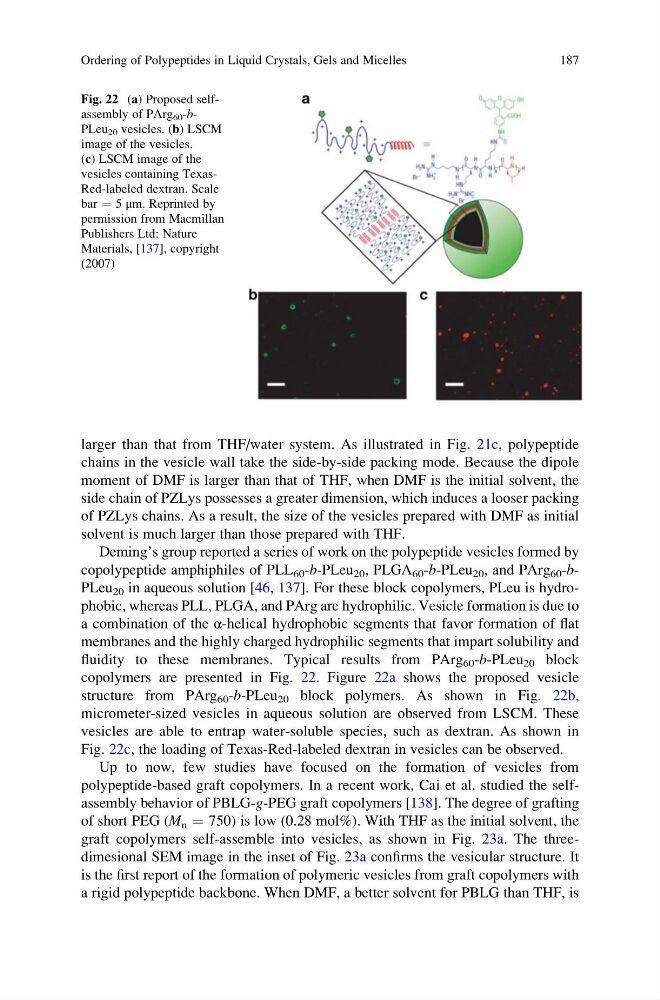
fluidity to these membranes. Typical results from PArg 60 -b-PLeu 20 block
copolymers are presented in Fig. 22. Figure 22a shows the proposed vesicle
structure from PArg 60 -b-PLeu 20 block polymers. As shown in Fig. 22b,
micrometer-sized vesicles in aqueous solution are observed from LSCM. These
vesicles are able to entrap water-soluble species, such as dextran. As shown in
Fig. 22c, the loading of Texas-Red-labeled dextran in vesicles can be observed.
Up to now, few studies have focused on the formation of vesicles from
polypeptide-based graft copolymers. In a recent work, Cai et al. studied the selfassembly behavior of PBLG-g-PEG graft copolymers [138]. The degree of grafting
of short PEG (M n ¼ 750) is low (0.28 mol%). With THF as the initial solvent, the
graft copolymers self-assemble into vesicles, as shown in Fig. 23a. The threedimesional SEM image in the inset of Fig. 23a confirms the vesicular structure. It
is the first report of the formation of polymeric vesicles from graft copolymers with
a rigid polypeptide backbone. When DMF, a better solvent for PBLG than THF, is
Fig. 22 (a) Proposed selfassembly of PArg 60 -bPLeu 20 vesicles. (b) LSCM
image of the vesicles.
(c) LSCM image of the
vesicles containing TexasRed-labeled dextran. Scale
bar ¼ 5 μm. Reprinted by
permission from Macmillan
Publishers Ltd: Nature
Materials, [137], copyright
(2007)
Ordering of Polypeptides in Liquid Crystals, Gels and Micelles
187
chains in the vesicle wall take the side-by-side packing mode. Because the dipole
moment of DMF is larger than that of THF, when DMF is the initial solvent, the
side chain of PZLys possesses a greater dimension, which induces a looser packing
of PZLys chains. As a result, the size of the vesicles prepared with DMF as initial
solvent is much larger than those prepared with THF.
Deming’s group reported a series of work on the polypeptide vesicles formed by
copolypeptide amphiphiles of PLL 60 -b-PLeu 20 , PLGA 60 -b-PLeu 20 , and PArg 60 -bPLeu 20 in aqueous solution [46, 137]. For these block copolymers, PLeu is hydrophobic, whereas PLL, PLGA, and PArg are hydrophilic. Vesicle formation is due to
a combination of the α-helical hydrophobic segments that favor formation of flat
membranes and the highly charged hydrophilic segments that impart solubility and
fluidity to these membranes. Typical results from PArg 60 -b-PLeu 20 block
copolymers are presented in Fig. 22. Figure 22a shows the proposed vesicle
structure from PArg 60 -b-PLeu 20 block polymers. As shown in Fig. 22b,
micrometer-sized vesicles in aqueous solution are observed from LSCM. These
vesicles are able to entrap water-soluble species, such as dextran. As shown in
Fig. 22c, the loading of Texas-Red-labeled dextran in vesicles can be observed.
Up to now, few studies have focused on the formation of vesicles from
polypeptide-based graft copolymers. In a recent work, Cai et al. studied the selfassembly behavior of PBLG-g-PEG graft copolymers [138]. The degree of grafting
of short PEG (M n ¼ 750) is low (0.28 mol%). With THF as the initial solvent, the
graft copolymers self-assemble into vesicles, as shown in Fig. 23a. The threedimesional SEM image in the inset of Fig. 23a confirms the vesicular structure. It
is the first report of the formation of polymeric vesicles from graft copolymers with
a rigid polypeptide backbone. When DMF, a better solvent for PBLG than THF, is
Fig. 22 (a) Proposed selfassembly of PArg 60 -bPLeu 20 vesicles. (b) LSCM
image of the vesicles.
(c) LSCM image of the
vesicles containing TexasRed-labeled dextran. Scale
bar ¼ 5 μm. Reprinted by
permission from Macmillan
Publishers Ltd: Nature
Materials, [137], copyright
(2007)
Ordering of Polypeptides in Liquid Crystals, Gels and Micelles
187