

In addition to capturing the feature of experimental results, the computer
simulations should serve as a tool to give information beyond the experimental
observations.
In the above experiments, the simulation results supply missing information like
the packing of rigid PBLG and therefore are of significance. However, some aspects
of the models were coarse-grained, such as the polydispersity of the polymers and
the chiral characteristic of the PBLG. These facts may play an important role in
determining the self-assembly behaviors of the present systems, for example, if the
chirality of PBLG is incorporated into the model, morphologies with chiral nature
would be simulated. This would be an interesting topic for further simulation of the
polypeptide systems.
4.2 Vesicles Self-Assembled from Polypeptide Copolymers
Amphiphilic copolymers can self-assemble into vesicles. Polypeptide vesicles have
attracted considerable attention due to their large loading capacity and similarity to
living cells [10, 132, 133]. The ordered packing of polypeptide chains has also been
observed in polypeptide vesicles in which hydrophobic polypeptide chains form the
vesicle wall [37, 134–136]. For example, Chang et al. studied the self-assembly
behavior of PNIPAm-b-PZLys rod–coil block copolymers [37]. They found that by
varying the polymer composition and the helicogenic common solvents, these
amphiphilic block copolymers were able to form universal aggregate morphologies
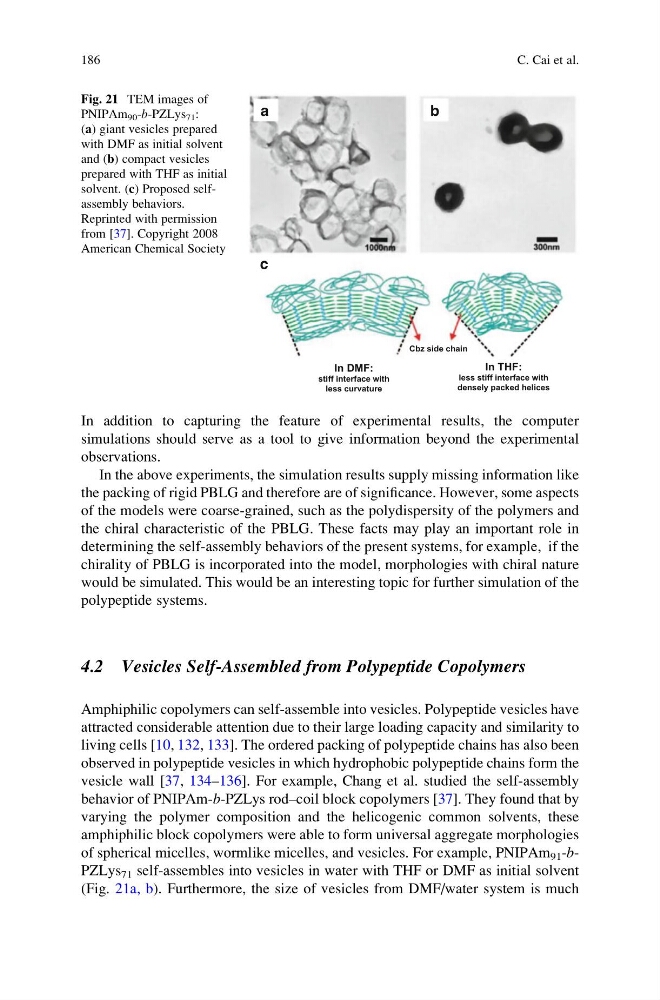
of spherical micelles, wormlike micelles, and vesicles. For example, PNIPAm 91 -bPZLys 71 self-assembles into vesicles in water with THF or DMF as initial solvent
(Fig. 21a, b). Furthermore, the size of vesicles from DMF/water system is much
In DMF:
stiff interface with
less curvature
In THF:
less stiff interface with
densely packed helices
Cbz side chain
a
c
b
Fig. 21 TEM images of
PNIPAm 90 -b-PZLys 71 :
(a) giant vesicles prepared
with DMF as initial solvent
and (b) compact vesicles
prepared with THF as initial
solvent. (c) Proposed selfassembly behaviors.
Reprinted with permission
from [37]. Copyright 2008
American Chemical Society
186
C. Cai et al.
simulations should serve as a tool to give information beyond the experimental
observations.
In the above experiments, the simulation results supply missing information like
the packing of rigid PBLG and therefore are of significance. However, some aspects
of the models were coarse-grained, such as the polydispersity of the polymers and
the chiral characteristic of the PBLG. These facts may play an important role in
determining the self-assembly behaviors of the present systems, for example, if the
chirality of PBLG is incorporated into the model, morphologies with chiral nature
would be simulated. This would be an interesting topic for further simulation of the
polypeptide systems.
4.2 Vesicles Self-Assembled from Polypeptide Copolymers
Amphiphilic copolymers can self-assemble into vesicles. Polypeptide vesicles have
attracted considerable attention due to their large loading capacity and similarity to
living cells [10, 132, 133]. The ordered packing of polypeptide chains has also been
observed in polypeptide vesicles in which hydrophobic polypeptide chains form the
vesicle wall [37, 134–136]. For example, Chang et al. studied the self-assembly
behavior of PNIPAm-b-PZLys rod–coil block copolymers [37]. They found that by
varying the polymer composition and the helicogenic common solvents, these
amphiphilic block copolymers were able to form universal aggregate morphologies
of spherical micelles, wormlike micelles, and vesicles. For example, PNIPAm 91 -bPZLys 71 self-assembles into vesicles in water with THF or DMF as initial solvent
(Fig. 21a, b). Furthermore, the size of vesicles from DMF/water system is much
In DMF:
stiff interface with
less curvature
In THF:
less stiff interface with
densely packed helices
Cbz side chain
a
c
b
Fig. 21 TEM images of
PNIPAm 90 -b-PZLys 71 :
(a) giant vesicles prepared
with DMF as initial solvent
and (b) compact vesicles
prepared with THF as initial
solvent. (c) Proposed selfassembly behaviors.
Reprinted with permission
from [37]. Copyright 2008
American Chemical Society
186
C. Cai et al.