

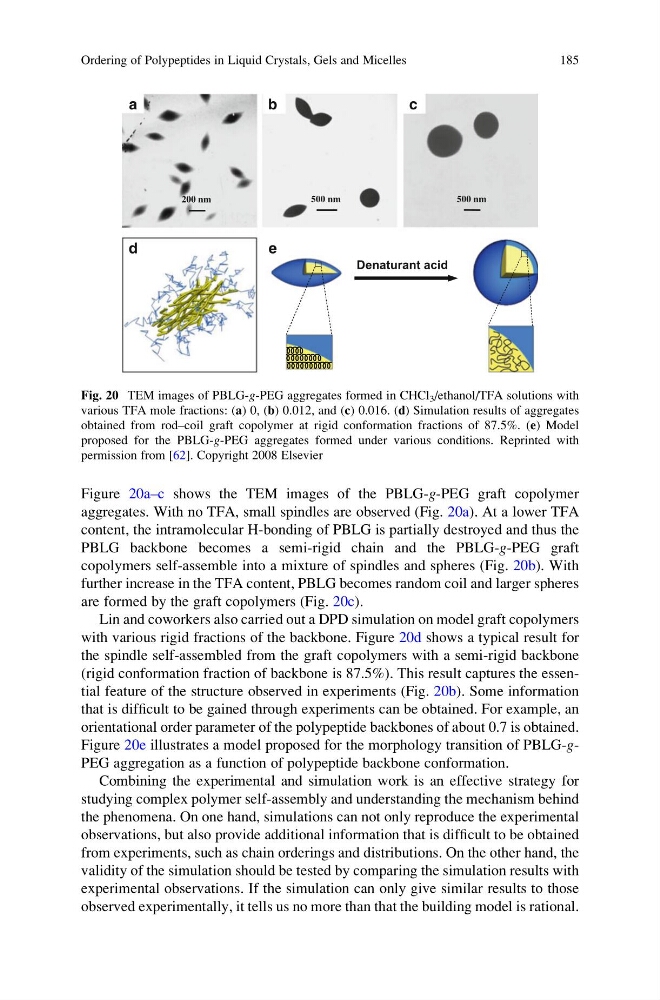
Figure 20a–c shows the TEM images of the PBLG-g-PEG graft copolymer
aggregates. With no TFA, small spindles are observed (Fig. 20a). At a lower TFA
content, the intramolecular H-bonding of PBLG is partially destroyed and thus the
PBLG backbone becomes a semi-rigid chain and the PBLG-g-PEG graft
copolymers self-assemble into a mixture of spindles and spheres (Fig. 20b). With
further increase in the TFA content, PBLG becomes random coil and larger spheres
are formed by the graft copolymers (Fig. 20c).
Lin and coworkers also carried out a DPD simulation on model graft copolymers
with various rigid fractions of the backbone. Figure 20d shows a typical result for
the spindle self-assembled from the graft copolymers with a semi-rigid backbone
(rigid conformation fraction of backbone is 87.5%). This result captures the essential feature of the structure observed in experiments (Fig. 20b). Some information
that is difficult to be gained through experiments can be obtained. For example, an
orientational order parameter of the polypeptide backbones of about 0.7 is obtained.
Figure 20e illustrates a model proposed for the morphology transition of PBLG-gPEG aggregation as a function of polypeptide backbone conformation.
Combining the experimental and simulation work is an effective strategy for
studying complex polymer self-assembly and understanding the mechanism behind
the phenomena. On one hand, simulations can not only reproduce the experimental
observations, but also provide additional information that is difficult to be obtained
from experiments, such as chain orderings and distributions. On the other hand, the
validity of the simulation should be tested by comparing the simulation results with
experimental observations. If the simulation can only give similar results to those
observed experimentally, it tells us no more than that the building model is rational.
200 nm
500 nm
500 nm
Denaturant acid
a
d
e
b
c
Fig. 20 TEM images of PBLG-g-PEG aggregates formed in CHCl 3 /ethanol/TFA solutions with
various TFA mole fractions: (a) 0, (b) 0.012, and (c) 0.016. (d) Simulation results of aggregates
obtained from rod–coil graft copolymer at rigid conformation fractions of 87.5%. (e) Model
proposed for the PBLG-g-PEG aggregates formed under various conditions. Reprinted with
permission from [62]. Copyright 2008 Elsevier
Ordering of Polypeptides in Liquid Crystals, Gels and Micelles
185
aggregates. With no TFA, small spindles are observed (Fig. 20a). At a lower TFA
content, the intramolecular H-bonding of PBLG is partially destroyed and thus the
PBLG backbone becomes a semi-rigid chain and the PBLG-g-PEG graft
copolymers self-assemble into a mixture of spindles and spheres (Fig. 20b). With
further increase in the TFA content, PBLG becomes random coil and larger spheres
are formed by the graft copolymers (Fig. 20c).
Lin and coworkers also carried out a DPD simulation on model graft copolymers
with various rigid fractions of the backbone. Figure 20d shows a typical result for
the spindle self-assembled from the graft copolymers with a semi-rigid backbone
(rigid conformation fraction of backbone is 87.5%). This result captures the essential feature of the structure observed in experiments (Fig. 20b). Some information
that is difficult to be gained through experiments can be obtained. For example, an
orientational order parameter of the polypeptide backbones of about 0.7 is obtained.
Figure 20e illustrates a model proposed for the morphology transition of PBLG-gPEG aggregation as a function of polypeptide backbone conformation.
Combining the experimental and simulation work is an effective strategy for
studying complex polymer self-assembly and understanding the mechanism behind
the phenomena. On one hand, simulations can not only reproduce the experimental
observations, but also provide additional information that is difficult to be obtained
from experiments, such as chain orderings and distributions. On the other hand, the
validity of the simulation should be tested by comparing the simulation results with
experimental observations. If the simulation can only give similar results to those
observed experimentally, it tells us no more than that the building model is rational.
200 nm
500 nm
500 nm
Denaturant acid
a
d
e
b
c
Fig. 20 TEM images of PBLG-g-PEG aggregates formed in CHCl 3 /ethanol/TFA solutions with
various TFA mole fractions: (a) 0, (b) 0.012, and (c) 0.016. (d) Simulation results of aggregates
obtained from rod–coil graft copolymer at rigid conformation fractions of 87.5%. (e) Model
proposed for the PBLG-g-PEG aggregates formed under various conditions. Reprinted with
permission from [62]. Copyright 2008 Elsevier
Ordering of Polypeptides in Liquid Crystals, Gels and Micelles
185