

of L-PA transforms to β-sheet. Further increase of the polymer concentration results
in nanofibrous rod formation through the packing of the β-sheet in a
one-dimensional manner. Such a nanostructural growth can be stabilized by the
hydrophilic PEG blocks (Fig. 14a). As the temperature increases, the PEG blocks
are partially dehydrated and the sol-to-gel transition occurs by the further aggregation of preassembled PEG-b-L-PA aggregates at high concentrations of polymer
(Fig. 14b). As a controlled experiment, they also studied the gelation behavior of
PEG-b-DL-PA block copolymers in the same conditions. Poly(DL-alanine) (DL-PA)
always takes random coil conformation. With increasing polymer concentration,
the PEG-DL-PA cannot form specific nanostructures. Therefore, PEG-b-DL-PA
shows a sol-to-gel transition at much higher concentrations and temperatures.
3.3.2 Hydrogels Based on α-Helix Polypeptide Copolymers
There are a few reports focused on hydrogels from block copolymers consisting of
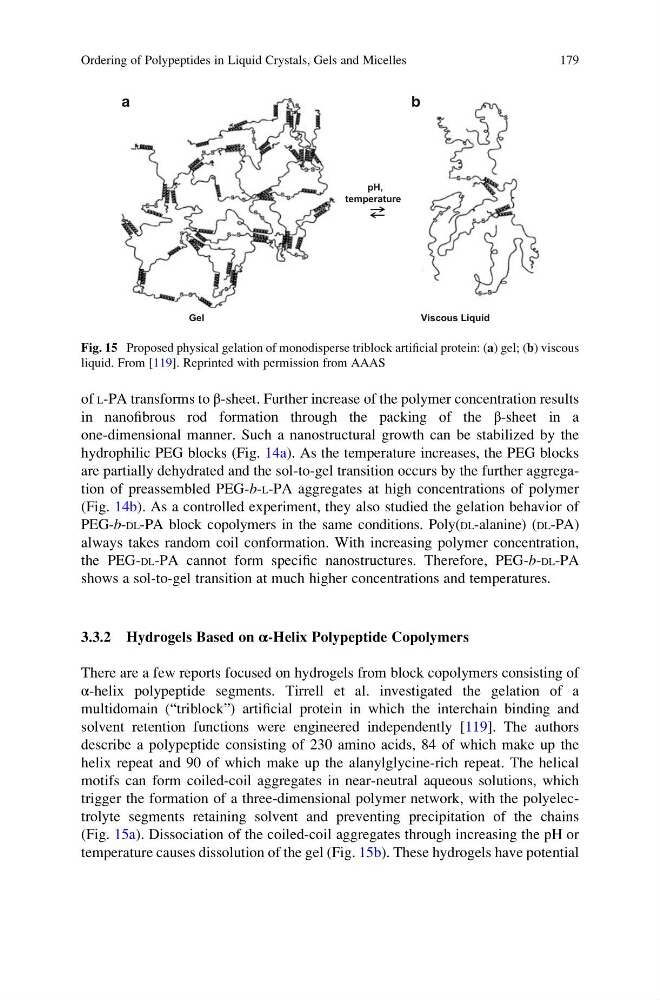
α-helix polypeptide segments. Tirrell et al. investigated the gelation of a
multidomain (“triblock”) artificial protein in which the interchain binding and
solvent retention functions were engineered independently [119]. The authors
describe a polypeptide consisting of 230 amino acids, 84 of which make up the
helix repeat and 90 of which make up the alanylglycine-rich repeat. The helical
motifs can form coiled-coil aggregates in near-neutral aqueous solutions, which
trigger the formation of a three-dimensional polymer network, with the polyelectrolyte segments retaining solvent and preventing precipitation of the chains
(Fig. 15a). Dissociation of the coiled-coil aggregates through increasing the pH or
temperature causes dissolution of the gel (Fig. 15b). These hydrogels have potential
pH,
temperature
Gel
Viscous Liquid
a
b
Fig. 15 Proposed physical gelation of monodisperse triblock artificial protein: (a) gel; (b) viscous
liquid. From [119]. Reprinted with permission from AAAS
Ordering of Polypeptides in Liquid Crystals, Gels and Micelles
179
in nanofibrous rod formation through the packing of the β-sheet in a
one-dimensional manner. Such a nanostructural growth can be stabilized by the
hydrophilic PEG blocks (Fig. 14a). As the temperature increases, the PEG blocks
are partially dehydrated and the sol-to-gel transition occurs by the further aggregation of preassembled PEG-b-L-PA aggregates at high concentrations of polymer
(Fig. 14b). As a controlled experiment, they also studied the gelation behavior of
PEG-b-DL-PA block copolymers in the same conditions. Poly(DL-alanine) (DL-PA)
always takes random coil conformation. With increasing polymer concentration,
the PEG-DL-PA cannot form specific nanostructures. Therefore, PEG-b-DL-PA
shows a sol-to-gel transition at much higher concentrations and temperatures.
3.3.2 Hydrogels Based on α-Helix Polypeptide Copolymers
There are a few reports focused on hydrogels from block copolymers consisting of
α-helix polypeptide segments. Tirrell et al. investigated the gelation of a
multidomain (“triblock”) artificial protein in which the interchain binding and
solvent retention functions were engineered independently [119]. The authors
describe a polypeptide consisting of 230 amino acids, 84 of which make up the
helix repeat and 90 of which make up the alanylglycine-rich repeat. The helical
motifs can form coiled-coil aggregates in near-neutral aqueous solutions, which
trigger the formation of a three-dimensional polymer network, with the polyelectrolyte segments retaining solvent and preventing precipitation of the chains
(Fig. 15a). Dissociation of the coiled-coil aggregates through increasing the pH or
temperature causes dissolution of the gel (Fig. 15b). These hydrogels have potential
pH,
temperature
Gel
Viscous Liquid
a
b
Fig. 15 Proposed physical gelation of monodisperse triblock artificial protein: (a) gel; (b) viscous
liquid. From [119]. Reprinted with permission from AAAS
Ordering of Polypeptides in Liquid Crystals, Gels and Micelles
179