

in bioengineering applications that require the encapsulation or controlled release
of molecular and cellular species.
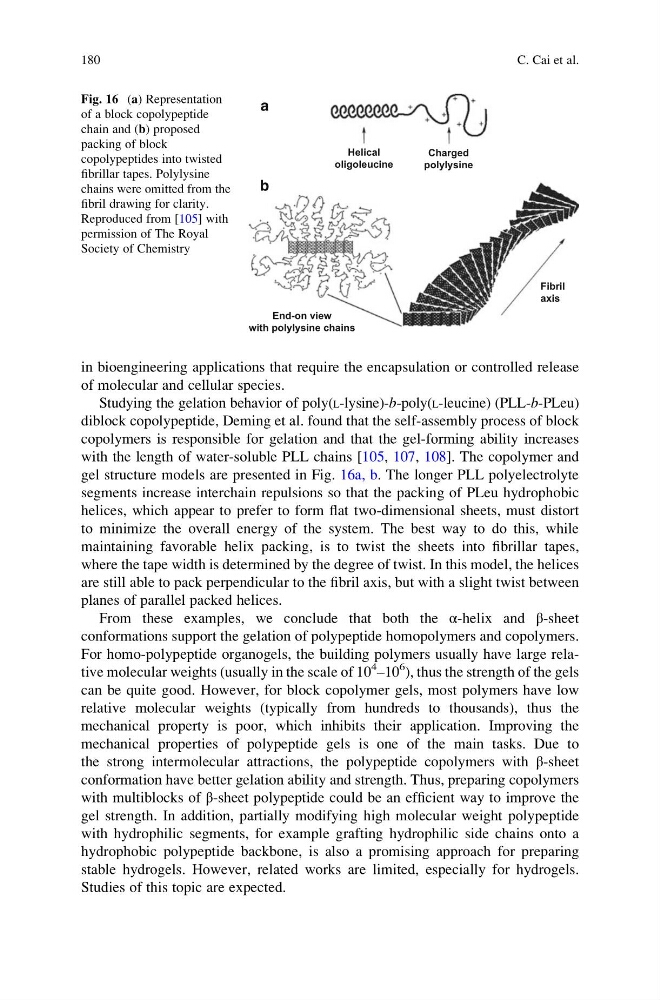
Studying the gelation behavior of poly(L-lysine)-b-poly(L-leucine) (PLL-b-PLeu)
diblock copolypeptide, Deming et al. found that the self-assembly process of block
copolymers is responsible for gelation and that the gel-forming ability increases
with the length of water-soluble PLL chains [105, 107, 108]. The copolymer and
gel structure models are presented in Fig. 16a, b. The longer PLL polyelectrolyte
segments increase interchain repulsions so that the packing of PLeu hydrophobic
helices, which appear to prefer to form flat two-dimensional sheets, must distort
to minimize the overall energy of the system. The best way to do this, while
maintaining favorable helix packing, is to twist the sheets into fibrillar tapes,
where the tape width is determined by the degree of twist. In this model, the helices
are still able to pack perpendicular to the fibril axis, but with a slight twist between
planes of parallel packed helices.
From these examples, we conclude that both the α-helix and β-sheet
conformations support the gelation of polypeptide homopolymers and copolymers.
For homo-polypeptide organogels, the building polymers usually have large relative molecular weights (usually in the scale of 10
4
–10
6 ), thus the strength of the gels
can be quite good. However, for block copolymer gels, most polymers have low
relative molecular weights (typically from hundreds to thousands), thus the
mechanical property is poor, which inhibits their application. Improving the
mechanical properties of polypeptide gels is one of the main tasks. Due to
the strong intermolecular attractions, the polypeptide copolymers with β-sheet
conformation have better gelation ability and strength. Thus, preparing copolymers
with multiblocks of β-sheet polypeptide could be an efficient way to improve the
gel strength. In addition, partially modifying high molecular weight polypeptide
with hydrophilic segments, for example grafting hydrophilic side chains onto a
hydrophobic polypeptide backbone, is also a promising approach for preparing
stable hydrogels. However, related works are limited, especially for hydrogels.
Studies of this topic are expected.
Helical
oligoleucine
Charged
polylysine
End-on view
with polylysine chains
Fibril
axis
a
b
Fig. 16 (a) Representation
of a block copolypeptide
chain and (b) proposed
packing of block
copolypeptides into twisted
fibrillar tapes. Polylysine
chains were omitted from the
fibril drawing for clarity.
Reproduced from [105] with
permission of The Royal
Society of Chemistry
180
C. Cai et al.
of molecular and cellular species.
Studying the gelation behavior of poly(L-lysine)-b-poly(L-leucine) (PLL-b-PLeu)
diblock copolypeptide, Deming et al. found that the self-assembly process of block
copolymers is responsible for gelation and that the gel-forming ability increases
with the length of water-soluble PLL chains [105, 107, 108]. The copolymer and
gel structure models are presented in Fig. 16a, b. The longer PLL polyelectrolyte
segments increase interchain repulsions so that the packing of PLeu hydrophobic
helices, which appear to prefer to form flat two-dimensional sheets, must distort
to minimize the overall energy of the system. The best way to do this, while
maintaining favorable helix packing, is to twist the sheets into fibrillar tapes,
where the tape width is determined by the degree of twist. In this model, the helices
are still able to pack perpendicular to the fibril axis, but with a slight twist between
planes of parallel packed helices.
From these examples, we conclude that both the α-helix and β-sheet
conformations support the gelation of polypeptide homopolymers and copolymers.
For homo-polypeptide organogels, the building polymers usually have large relative molecular weights (usually in the scale of 10
4
–10
6 ), thus the strength of the gels
can be quite good. However, for block copolymer gels, most polymers have low
relative molecular weights (typically from hundreds to thousands), thus the
mechanical property is poor, which inhibits their application. Improving the
mechanical properties of polypeptide gels is one of the main tasks. Due to
the strong intermolecular attractions, the polypeptide copolymers with β-sheet
conformation have better gelation ability and strength. Thus, preparing copolymers
with multiblocks of β-sheet polypeptide could be an efficient way to improve the
gel strength. In addition, partially modifying high molecular weight polypeptide
with hydrophilic segments, for example grafting hydrophilic side chains onto a
hydrophobic polypeptide backbone, is also a promising approach for preparing
stable hydrogels. However, related works are limited, especially for hydrogels.
Studies of this topic are expected.
Helical
oligoleucine
Charged
polylysine
End-on view
with polylysine chains
Fibril
axis
a
b
Fig. 16 (a) Representation
of a block copolypeptide
chain and (b) proposed
packing of block
copolypeptides into twisted
fibrillar tapes. Polylysine
chains were omitted from the
fibril drawing for clarity.
Reproduced from [105] with
permission of The Royal
Society of Chemistry
180
C. Cai et al.