

water, it is difficult for the copolymers bearing high molecular weight hydrophobic
polypeptide blocks to form hydrogels. On the other hand, hydrophilic polypeptides
usually adopt a random coil conformation, which does not support the formation of
gel containing ordered structures. As a result, polypeptide hydrogels are usually
formed by copolymers consisting of low molecular weight polypeptides. This
section discusses the formation of polypeptide copolymer hydrogels based on
both β-sheet and α-helix polypeptide blocks.
3.3.1 Hydrogels Based on β-Sheet Polypeptide Copolymers
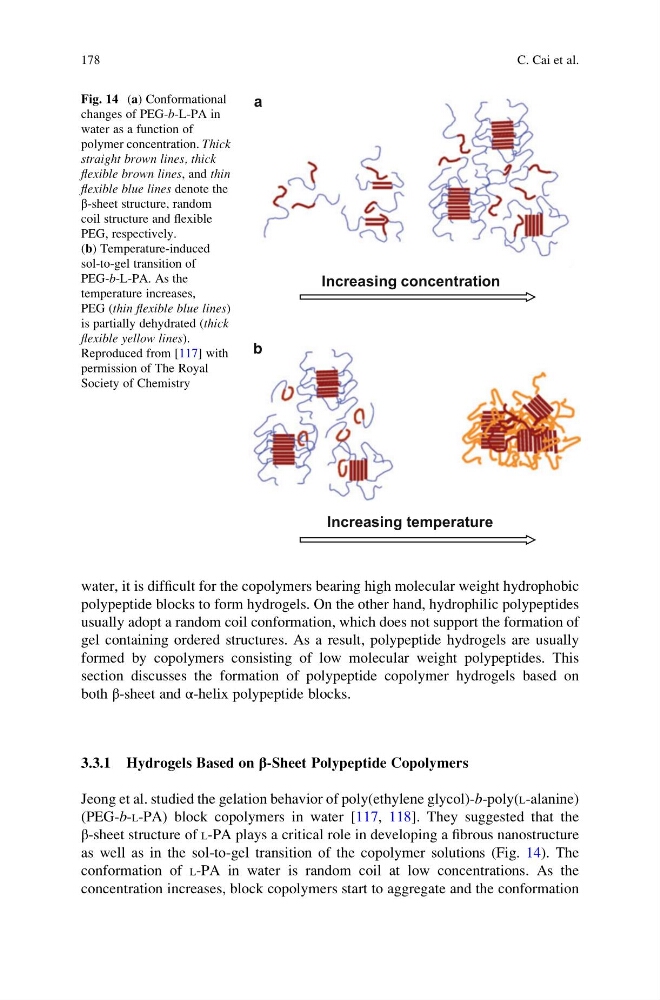
Jeong et al. studied the gelation behavior of poly(ethylene glycol)-b-poly(L-alanine)
(PEG-b-L-PA) block copolymers in water [117, 118]. They suggested that the
β-sheet structure of L-PA plays a critical role in developing a fibrous nanostructure
as well as in the sol-to-gel transition of the copolymer solutions (Fig. 14). The
conformation of L-PA in water is random coil at low concentrations. As the
concentration increases, block copolymers start to aggregate and the conformation
Increasing concentration
Increasing temperature
a
b
Fig. 14 (a) Conformational
changes of PEG-b-L-PA in
water as a function of
polymer concentration. Thick
straight brown lines, thick
flexible brown lines, and thin
flexible blue lines denote the
β-sheet structure, random
coil structure and flexible
PEG, respectively.
(b) Temperature-induced
sol-to-gel transition of
PEG-b-L-PA. As the
temperature increases,
PEG (thin flexible blue lines)
is partially dehydrated (thick
flexible yellow lines).
Reproduced from [117] with
permission of The Royal
Society of Chemistry
178
C. Cai et al.
polypeptide blocks to form hydrogels. On the other hand, hydrophilic polypeptides
usually adopt a random coil conformation, which does not support the formation of
gel containing ordered structures. As a result, polypeptide hydrogels are usually
formed by copolymers consisting of low molecular weight polypeptides. This
section discusses the formation of polypeptide copolymer hydrogels based on
both β-sheet and α-helix polypeptide blocks.
3.3.1 Hydrogels Based on β-Sheet Polypeptide Copolymers
Jeong et al. studied the gelation behavior of poly(ethylene glycol)-b-poly(L-alanine)
(PEG-b-L-PA) block copolymers in water [117, 118]. They suggested that the
β-sheet structure of L-PA plays a critical role in developing a fibrous nanostructure
as well as in the sol-to-gel transition of the copolymer solutions (Fig. 14). The
conformation of L-PA in water is random coil at low concentrations. As the
concentration increases, block copolymers start to aggregate and the conformation
Increasing concentration
Increasing temperature
a
b
Fig. 14 (a) Conformational
changes of PEG-b-L-PA in
water as a function of
polymer concentration. Thick
straight brown lines, thick
flexible brown lines, and thin
flexible blue lines denote the
β-sheet structure, random
coil structure and flexible
PEG, respectively.
(b) Temperature-induced
sol-to-gel transition of
PEG-b-L-PA. As the
temperature increases,
PEG (thin flexible blue lines)
is partially dehydrated (thick
flexible yellow lines).
Reproduced from [117] with
permission of The Royal
Society of Chemistry
178
C. Cai et al.