

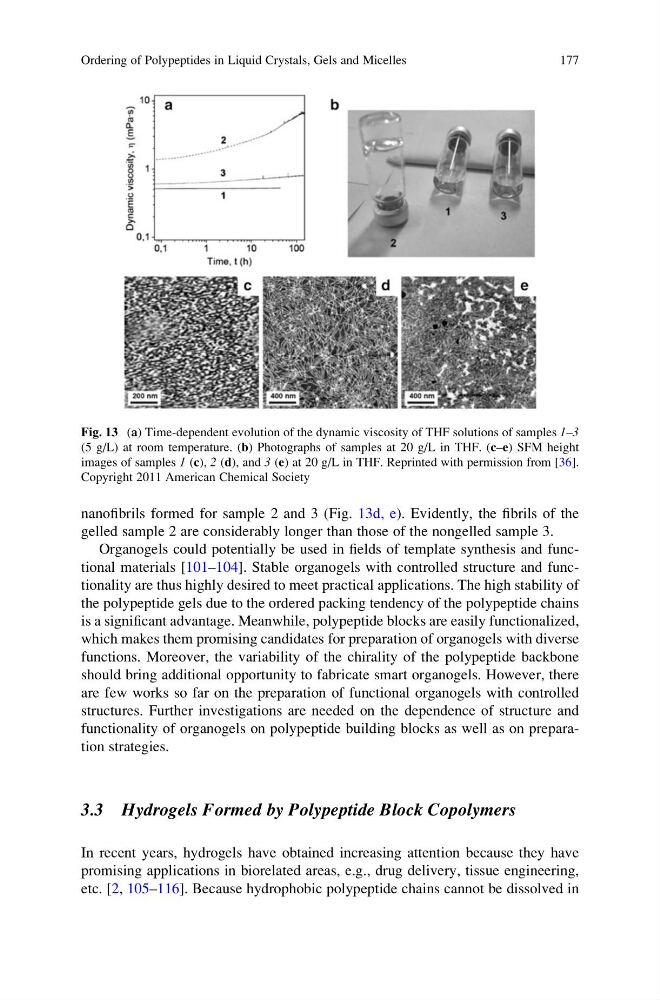
nanofibrils formed for sample 2 and 3 (Fig. 13d, e). Evidently, the fibrils of the
gelled sample 2 are considerably longer than those of the nongelled sample 3.
Organogels could potentially be used in fields of template synthesis and functional materials [101–104]. Stable organogels with controlled structure and functionality are thus highly desired to meet practical applications. The high stability of
the polypeptide gels due to the ordered packing tendency of the polypeptide chains
is a significant advantage. Meanwhile, polypeptide blocks are easily functionalized,
which makes them promising candidates for preparation of organogels with diverse
functions. Moreover, the variability of the chirality of the polypeptide backbone
should bring additional opportunity to fabricate smart organogels. However, there
are few works so far on the preparation of functional organogels with controlled
structures. Further investigations are needed on the dependence of structure and
functionality of organogels on polypeptide building blocks as well as on preparation strategies.
3.3 Hydrogels Formed by Polypeptide Block Copolymers
In recent years, hydrogels have obtained increasing attention because they have
promising applications in biorelated areas, e.g., drug delivery, tissue engineering,
etc. [2, 105–116]. Because hydrophobic polypeptide chains cannot be dissolved in
Fig. 13 (a) Time-dependent evolution of the dynamic viscosity of THF solutions of samples 1–3
(5 g/L) at room temperature. (b) Photographs of samples at 20 g/L in THF. (c–e) SFM height
images of samples 1 (c), 2 (d), and 3 (e) at 20 g/L in THF. Reprinted with permission from [36].
Copyright 2011 American Chemical Society
Ordering of Polypeptides in Liquid Crystals, Gels and Micelles
177
gelled sample 2 are considerably longer than those of the nongelled sample 3.
Organogels could potentially be used in fields of template synthesis and functional materials [101–104]. Stable organogels with controlled structure and functionality are thus highly desired to meet practical applications. The high stability of
the polypeptide gels due to the ordered packing tendency of the polypeptide chains
is a significant advantage. Meanwhile, polypeptide blocks are easily functionalized,
which makes them promising candidates for preparation of organogels with diverse
functions. Moreover, the variability of the chirality of the polypeptide backbone
should bring additional opportunity to fabricate smart organogels. However, there
are few works so far on the preparation of functional organogels with controlled
structures. Further investigations are needed on the dependence of structure and
functionality of organogels on polypeptide building blocks as well as on preparation strategies.
3.3 Hydrogels Formed by Polypeptide Block Copolymers
In recent years, hydrogels have obtained increasing attention because they have
promising applications in biorelated areas, e.g., drug delivery, tissue engineering,
etc. [2, 105–116]. Because hydrophobic polypeptide chains cannot be dissolved in
Fig. 13 (a) Time-dependent evolution of the dynamic viscosity of THF solutions of samples 1–3
(5 g/L) at room temperature. (b) Photographs of samples at 20 g/L in THF. (c–e) SFM height
images of samples 1 (c), 2 (d), and 3 (e) at 20 g/L in THF. Reprinted with permission from [36].
Copyright 2011 American Chemical Society
Ordering of Polypeptides in Liquid Crystals, Gels and Micelles
177