

(PEO-b-PZLys) block copolymers (samples 1, 2 and 3) with various polypeptide
conformations were synthesized. All the polypeptide blocks consisted of 18 ZLys
peptide segments with D and L configurations of predefined stereosequences. In
sample 1, D and L configuration peptide units are randomly polymerized (L 10 -co-D 8 )
and the polypeptide conformation is random coil. In sample 2, D and L configuration
peptide units link in a manner similar to that of a triblock copolymer (L 7 D 4 L 7 ) and
the polypeptide conformation is β-sheet. In sample 3, all the peptide segments are
in the L configuration (L 18 ) and thus the polypeptide adopts α-helix conformation.
From the time-dependent evolution of the dynamic viscosity of THF solutions
of the samples (shown in Fig. 13a), it was found that the tendency for gelation
in THF increases in the order of the polypeptide conformation of random coil <
α-helix < β-sheet. For example, at the concentration of 20 g/L, samples 1 and 3 are
liquids and sample 2 is a gel (Fig. 13b). From the set of SFM images shown in
Fig. 13c–e, one can see that sample 1 formed spherical micelles (Fig. 13c) whereas
DP=24, α-helical content = 61 %
DP=43, α-helical content = 64 %
DP=120, α-helical content = 75 %
7 nm
9 nm
6-8 nm
f f PBLG
a
b
c
d
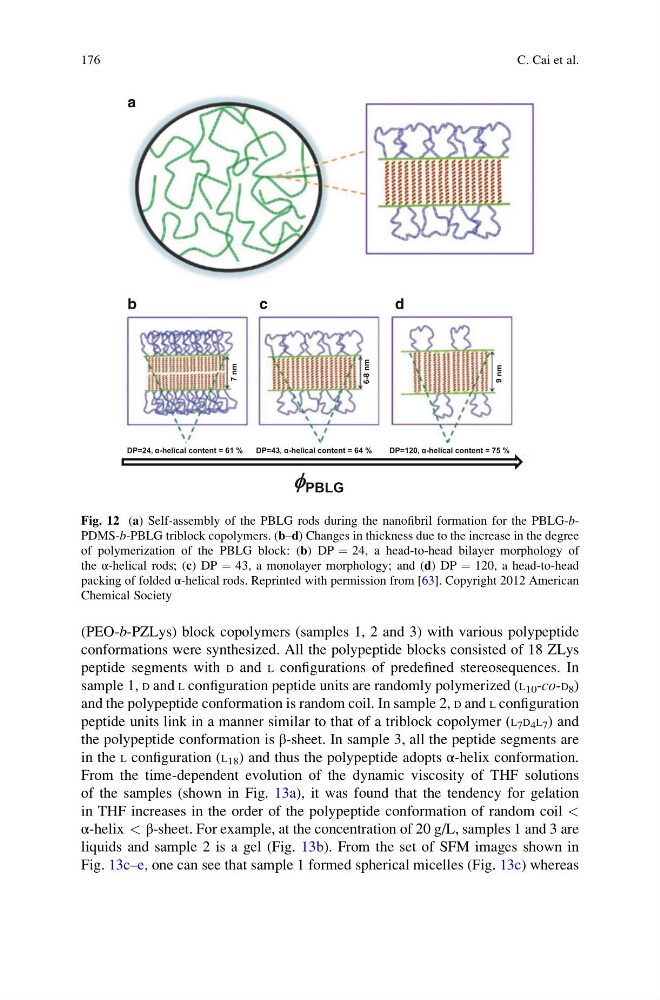
Fig. 12 (a) Self-assembly of the PBLG rods during the nanofibril formation for the PBLG-bPDMS-b-PBLG triblock copolymers. (b–d) Changes in thickness due to the increase in the degree
of polymerization of the PBLG block: (b) DP ¼ 24, a head-to-head bilayer morphology of
the α-helical rods; (c) DP ¼ 43, a monolayer morphology; and (d) DP ¼ 120, a head-to-head
packing of folded α-helical rods. Reprinted with permission from [63]. Copyright 2012 American
Chemical Society
176
C. Cai et al.
conformations were synthesized. All the polypeptide blocks consisted of 18 ZLys
peptide segments with D and L configurations of predefined stereosequences. In
sample 1, D and L configuration peptide units are randomly polymerized (L 10 -co-D 8 )
and the polypeptide conformation is random coil. In sample 2, D and L configuration
peptide units link in a manner similar to that of a triblock copolymer (L 7 D 4 L 7 ) and
the polypeptide conformation is β-sheet. In sample 3, all the peptide segments are
in the L configuration (L 18 ) and thus the polypeptide adopts α-helix conformation.
From the time-dependent evolution of the dynamic viscosity of THF solutions
of the samples (shown in Fig. 13a), it was found that the tendency for gelation
in THF increases in the order of the polypeptide conformation of random coil <
α-helix < β-sheet. For example, at the concentration of 20 g/L, samples 1 and 3 are
liquids and sample 2 is a gel (Fig. 13b). From the set of SFM images shown in
Fig. 13c–e, one can see that sample 1 formed spherical micelles (Fig. 13c) whereas
DP=24, α-helical content = 61 %
DP=43, α-helical content = 64 %
DP=120, α-helical content = 75 %
7 nm
9 nm
6-8 nm
f f PBLG
a
b
c
d
Fig. 12 (a) Self-assembly of the PBLG rods during the nanofibril formation for the PBLG-bPDMS-b-PBLG triblock copolymers. (b–d) Changes in thickness due to the increase in the degree
of polymerization of the PBLG block: (b) DP ¼ 24, a head-to-head bilayer morphology of
the α-helical rods; (c) DP ¼ 43, a monolayer morphology; and (d) DP ¼ 120, a head-to-head
packing of folded α-helical rods. Reprinted with permission from [63]. Copyright 2012 American
Chemical Society
176
C. Cai et al.