

PDMS coils remain exposed to the toluene. They found that the thickness of the
nanofibrils changes little with the DP of PBLG blocks. As shown in Fig. 12b, for the
sample with the shortest PBLG block (DP ¼ 24), PBLG rods assembled into a
bilayer morphology with 7 nm thickness. Increasing the DP to 43, a monolayer
morphology with 6–8 nm thickness is observed (Fig. 12c). Interestingly, for the
sample with the longest PBLG block (DP ¼ 120), PBLG rods are packed with a
folded manner to produce 9-nm thick fibrils (Fig. 12d).
3.2.2 Organic Gels from Polypeptide Copolymer with β-Sheet
Conformation
Strong interchain attractions between polypeptides with β-sheet conformation
enable polypeptide chains to pack in an orderly manner, which facilities the
formation of gels. Furthermore, these polypeptide gels are more stable because
the interchain attractions between β-sheets are much stronger than those between
helix–helix pairs. Schlaad and coworkers have investigated the effects of the
secondary structure of polypeptides on the gelation of polypeptide-based organogelators in THF [36]. Three poly(ethylene oxide)-b-poly(ε-carbobenzoxy L-lysine)
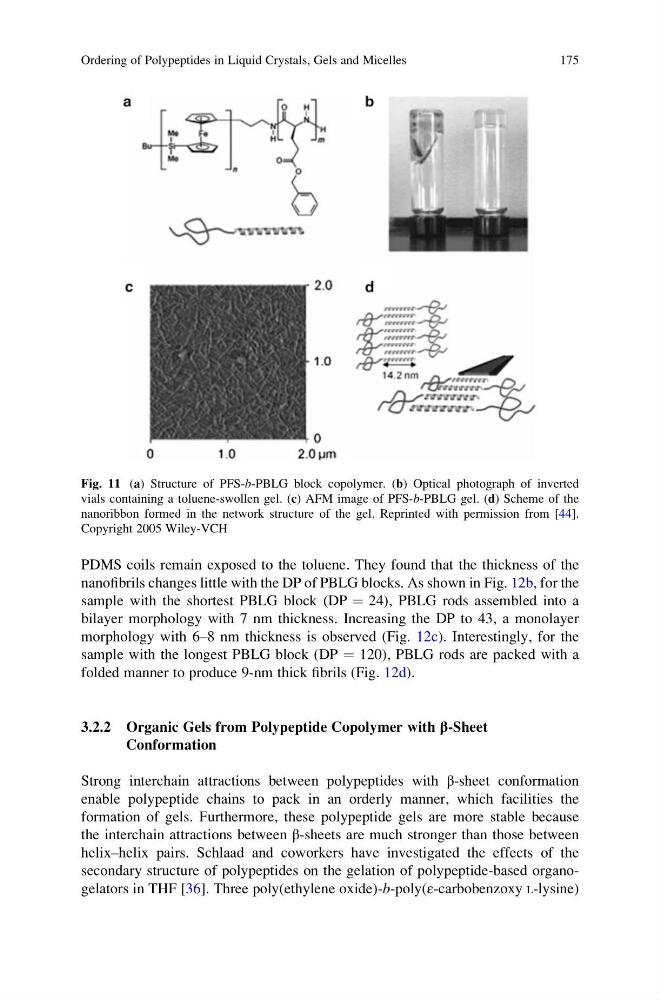
Fig. 11 (a) Structure of PFS-b-PBLG block copolymer. (b) Optical photograph of inverted
vials containing a toluene-swollen gel. (c) AFM image of PFS-b-PBLG gel. (d) Scheme of the
nanoribbon formed in the network structure of the gel. Reprinted with permission from [44].
Copyright 2005 Wiley-VCH
Ordering of Polypeptides in Liquid Crystals, Gels and Micelles
175
nanofibrils changes little with the DP of PBLG blocks. As shown in Fig. 12b, for the
sample with the shortest PBLG block (DP ¼ 24), PBLG rods assembled into a
bilayer morphology with 7 nm thickness. Increasing the DP to 43, a monolayer
morphology with 6–8 nm thickness is observed (Fig. 12c). Interestingly, for the
sample with the longest PBLG block (DP ¼ 120), PBLG rods are packed with a
folded manner to produce 9-nm thick fibrils (Fig. 12d).
3.2.2 Organic Gels from Polypeptide Copolymer with β-Sheet
Conformation
Strong interchain attractions between polypeptides with β-sheet conformation
enable polypeptide chains to pack in an orderly manner, which facilities the
formation of gels. Furthermore, these polypeptide gels are more stable because
the interchain attractions between β-sheets are much stronger than those between
helix–helix pairs. Schlaad and coworkers have investigated the effects of the
secondary structure of polypeptides on the gelation of polypeptide-based organogelators in THF [36]. Three poly(ethylene oxide)-b-poly(ε-carbobenzoxy L-lysine)
Fig. 11 (a) Structure of PFS-b-PBLG block copolymer. (b) Optical photograph of inverted
vials containing a toluene-swollen gel. (c) AFM image of PFS-b-PBLG gel. (d) Scheme of the
nanoribbon formed in the network structure of the gel. Reprinted with permission from [44].
Copyright 2005 Wiley-VCH
Ordering of Polypeptides in Liquid Crystals, Gels and Micelles
175