

attractions are responsible for the formation of stable gels. Due to the good
solubility of polypeptide in diverse solvents, organogels can be easily prepared at
the proper concentration and temperature. In the following section, we discuss the
formation of organic gels from polypeptide block copolymers with both α-helix and
β-sheet conformations.
3.2.1 Organic Gels from Polypeptide Copolymer with α-Helix
Conformation
Polypeptides with α-helix conformation prefer to take ordered packing in solutions
and thus induce the formation of LCs and gels. Similar to LC structures formed by
bulky group-capped polypeptide homopolymers, as described in the Sect. 2.3, the
smectic-like rather than nematic ordering of polypeptide rods is preferred for
polypeptide block copolymers. In the polypeptide copolymer gels, the long axis
of the polypeptide rods is usually perpendicular to the long axis of gel fiber. Winnik
et al. reported, for the first time, thermoreversible gelation of polypeptide block
copolymers in organic solvent [44]. In their work, poly(ferrocenylsilane)-b-PBLG
(PFS-b-PBLG) block copolymers (Fig. 11a) were first dissolved in hot toluene.
Upon cooling to ambient temperature, optically transparent gels were formed
(Fig. 11b). Fibrous nanoribbons can be observed in the AFM image shown in
Fig. 11c. For these gels, the strong dipolar interactions between the PBLG helices
are proposed to stabilize the stacked structure, where the PFS blocks protrude
outside of the ribbon into the toluene-rich environment, thereby preventing aggregation of the nanoribbons. The gel structure is illustrated in Fig. 11d. As can be
seen, PBLG rods assembled in one-dimensional antiparallel stacking of the building
blocks in a monolayer fashion, and the flexible PFS blocks extended off the fibers.
In a recent work, Mezzenga et al. synthesized PBLG-b-PDMS-b-PBLG triblock
copolymers with DP of PBLG blocks from 24 to 120. For these block copolymers,
the conformation of the PBLG blocks is mainly α-helix. Thermoreversible gels
were prepared in toluene [63]. The gel structure is illustrated in Fig. 12a and shows
that PBLG rods are confined within the core of the nanofibrils, whereas the soluble
LC director
Gel formed by α-helices
Gel formed by random coils
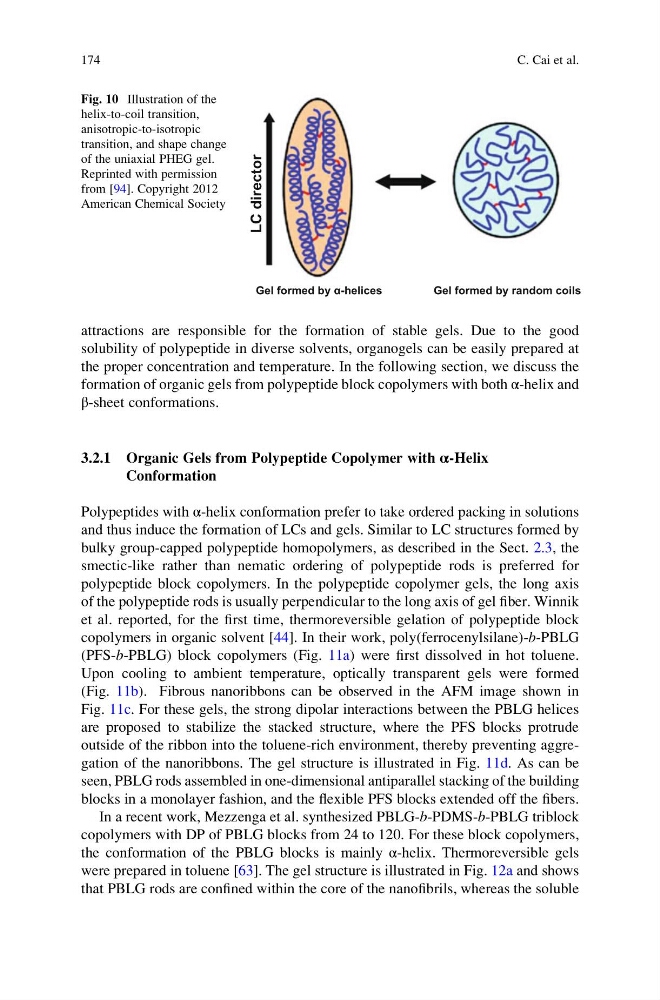
Fig. 10 Illustration of the
helix-to-coil transition,
anisotropic-to-isotropic
transition, and shape change
of the uniaxial PHEG gel.
Reprinted with permission
from [94]. Copyright 2012
American Chemical Society
174
C. Cai et al.
solubility of polypeptide in diverse solvents, organogels can be easily prepared at
the proper concentration and temperature. In the following section, we discuss the
formation of organic gels from polypeptide block copolymers with both α-helix and
β-sheet conformations.
3.2.1 Organic Gels from Polypeptide Copolymer with α-Helix
Conformation
Polypeptides with α-helix conformation prefer to take ordered packing in solutions
and thus induce the formation of LCs and gels. Similar to LC structures formed by
bulky group-capped polypeptide homopolymers, as described in the Sect. 2.3, the
smectic-like rather than nematic ordering of polypeptide rods is preferred for
polypeptide block copolymers. In the polypeptide copolymer gels, the long axis
of the polypeptide rods is usually perpendicular to the long axis of gel fiber. Winnik
et al. reported, for the first time, thermoreversible gelation of polypeptide block
copolymers in organic solvent [44]. In their work, poly(ferrocenylsilane)-b-PBLG
(PFS-b-PBLG) block copolymers (Fig. 11a) were first dissolved in hot toluene.
Upon cooling to ambient temperature, optically transparent gels were formed
(Fig. 11b). Fibrous nanoribbons can be observed in the AFM image shown in
Fig. 11c. For these gels, the strong dipolar interactions between the PBLG helices
are proposed to stabilize the stacked structure, where the PFS blocks protrude
outside of the ribbon into the toluene-rich environment, thereby preventing aggregation of the nanoribbons. The gel structure is illustrated in Fig. 11d. As can be
seen, PBLG rods assembled in one-dimensional antiparallel stacking of the building
blocks in a monolayer fashion, and the flexible PFS blocks extended off the fibers.
In a recent work, Mezzenga et al. synthesized PBLG-b-PDMS-b-PBLG triblock
copolymers with DP of PBLG blocks from 24 to 120. For these block copolymers,
the conformation of the PBLG blocks is mainly α-helix. Thermoreversible gels
were prepared in toluene [63]. The gel structure is illustrated in Fig. 12a and shows
that PBLG rods are confined within the core of the nanofibrils, whereas the soluble
LC director
Gel formed by α-helices
Gel formed by random coils
Fig. 10 Illustration of the
helix-to-coil transition,
anisotropic-to-isotropic
transition, and shape change
of the uniaxial PHEG gel.
Reprinted with permission
from [94]. Copyright 2012
American Chemical Society
174
C. Cai et al.