

structure of the gels can be recovered by reversing the solution conditions. An
example is crosslinked “LC gel.” The LC polypeptide gels are usually prepared by
crosslinking the LC polypeptides (typically using diamines) and subsequently
lowering the solution temperature [92–94]. Very recently, Inomata et al. reported
a preparation of uniaxially oriented PBLG LC gels by crosslinking the lyotropic LC
PBLG through pentaethylenehexamine in a magnetic field. Meanwhile, the PBLG
was converted to PHEG by side chain aminolysis [94]. The obtained PHEG
gel retains the LC structure when immersed in ethylene glycol, which is an
α-helix-supporting solvent. By the addition of water into the immersion solvent,
conformational transition of PHEG from α-helix to random coil occurs and the
optical anisotropy of the gel disappears. With this helix-to-coil transition of PHEG,
the gel is swollen in the direction perpendicular to the orientational axis of PHEG
and is shrunk in the parallel direction. Such a reverse gel shape transition from
cylindrical to isotropic with the change of the solvent from helix-supporting
ethylene glycol to coil-supporting water is shown in Fig. 10. The original cylindrical shape in the LC state changes to the more isotropic shape as a result of the helixto-coil transition of PHEG. Because the gel is crosslinked, not only the position but
also the orientational order of the rodlike polypeptide chains is fixed. This anisotropic feature characteristic of polypeptide gels may be useful in shape-memory
applications, in contrast to conventional stimuli-sensitive polymer gels that are in
the disordered isotropic state.
3.2 Ordering of Polypeptides in Copolymer Organogels
Polypeptide copolymers can assemble into gels in organic solvent through ordered
packing of polypeptide blocks with conformations of both α-helix and β-sheet
[44, 48, 53, 54, 95–100]. For copolymers with α-helix polypeptides, the side-byside packing of the polypeptide rods in a smectic fashion has been commonly
observed. For the copolymers with β-sheet polypeptides, the strong intermolecular
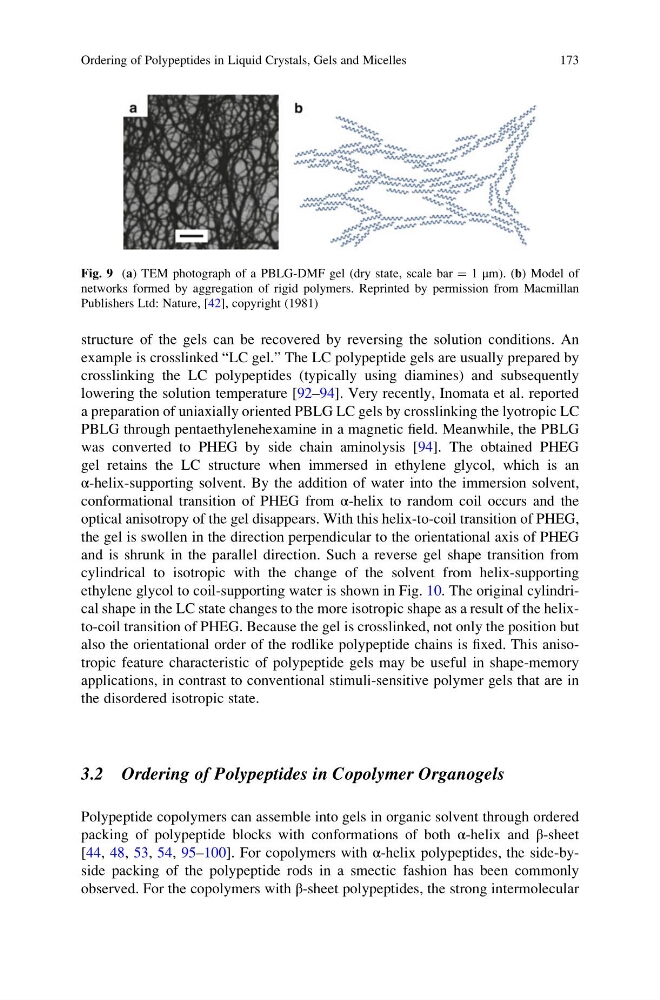
Fig. 9 (a) TEM photograph of a PBLG-DMF gel (dry state, scale bar ¼ 1 μm). (b) Model of
networks formed by aggregation of rigid polymers. Reprinted by permission from Macmillan
Publishers Ltd: Nature, [42], copyright (1981)
Ordering of Polypeptides in Liquid Crystals, Gels and Micelles
173
example is crosslinked “LC gel.” The LC polypeptide gels are usually prepared by
crosslinking the LC polypeptides (typically using diamines) and subsequently
lowering the solution temperature [92–94]. Very recently, Inomata et al. reported
a preparation of uniaxially oriented PBLG LC gels by crosslinking the lyotropic LC
PBLG through pentaethylenehexamine in a magnetic field. Meanwhile, the PBLG
was converted to PHEG by side chain aminolysis [94]. The obtained PHEG
gel retains the LC structure when immersed in ethylene glycol, which is an
α-helix-supporting solvent. By the addition of water into the immersion solvent,
conformational transition of PHEG from α-helix to random coil occurs and the
optical anisotropy of the gel disappears. With this helix-to-coil transition of PHEG,
the gel is swollen in the direction perpendicular to the orientational axis of PHEG
and is shrunk in the parallel direction. Such a reverse gel shape transition from
cylindrical to isotropic with the change of the solvent from helix-supporting
ethylene glycol to coil-supporting water is shown in Fig. 10. The original cylindrical shape in the LC state changes to the more isotropic shape as a result of the helixto-coil transition of PHEG. Because the gel is crosslinked, not only the position but
also the orientational order of the rodlike polypeptide chains is fixed. This anisotropic feature characteristic of polypeptide gels may be useful in shape-memory
applications, in contrast to conventional stimuli-sensitive polymer gels that are in
the disordered isotropic state.
3.2 Ordering of Polypeptides in Copolymer Organogels
Polypeptide copolymers can assemble into gels in organic solvent through ordered
packing of polypeptide blocks with conformations of both α-helix and β-sheet
[44, 48, 53, 54, 95–100]. For copolymers with α-helix polypeptides, the side-byside packing of the polypeptide rods in a smectic fashion has been commonly
observed. For the copolymers with β-sheet polypeptides, the strong intermolecular
Fig. 9 (a) TEM photograph of a PBLG-DMF gel (dry state, scale bar ¼ 1 μm). (b) Model of
networks formed by aggregation of rigid polymers. Reprinted by permission from Macmillan
Publishers Ltd: Nature, [42], copyright (1981)
Ordering of Polypeptides in Liquid Crystals, Gels and Micelles
173