

molecular weight distribution control can be attained even at À25
C. It is important
to note that very low temperatures such as À78
C, which might be an obstacle to
industrial-scale applications, are not required.
One of the advantages of controlled/living polymerization is that the method
allows flexible synthesis of structurally defined block copolymers composed of
different monomers, offering greater opportunities for synthesis of organic
materials with interesting properties.
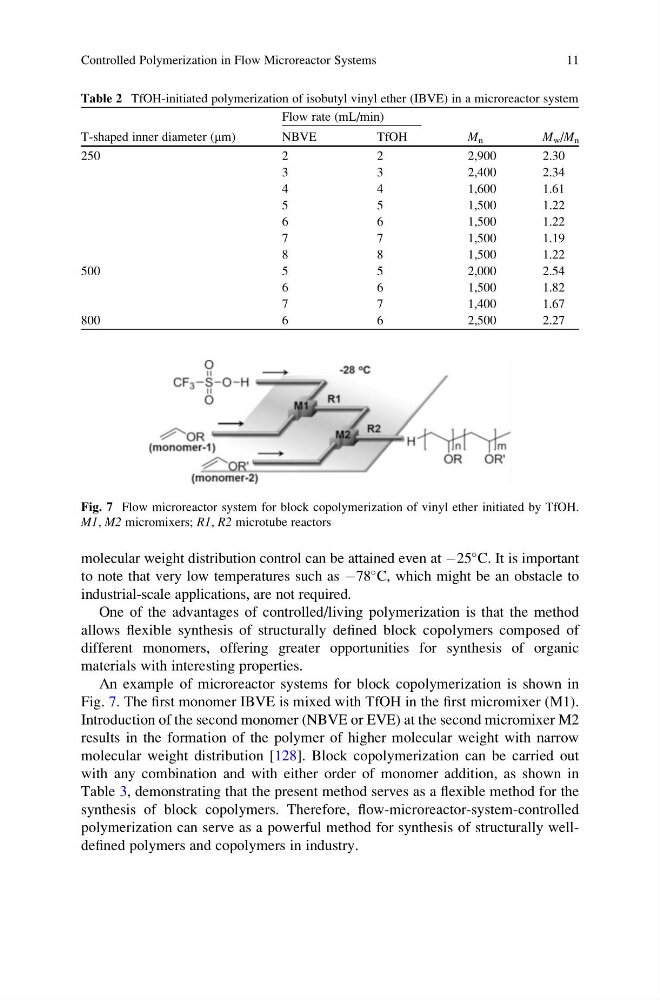
An example of microreactor systems for block copolymerization is shown in
Fig. 7. The first monomer IBVE is mixed with TfOH in the first micromixer (M1).
Introduction of the second monomer (NBVE or EVE) at the second micromixer M2
results in the formation of the polymer of higher molecular weight with narrow
molecular weight distribution [128]. Block copolymerization can be carried out
with any combination and with either order of monomer addition, as shown in
Table 3, demonstrating that the present method serves as a flexible method for the
synthesis of block copolymers. Therefore, flow-microreactor-system-controlled
polymerization can serve as a powerful method for synthesis of structurally welldefined polymers and copolymers in industry.
Table 2 TfOH-initiated polymerization of isobutyl vinyl ether (IBVE) in a microreactor system
T-shaped inner diameter (mm)
Flow rate (mL/min)
M n
M w /M n
NBVE
TfOH
250
2
2
2,900
2.30
3
3
2,400
2.34
4
4
1,600
1.61
5
5
1,500
1.22
6
6
1,500
1.22
7
7
1,500
1.19
8
8
1,500
1.22
500
5
5
2,000
2.54
6
6
1,500
1.82
7
7
1,400
1.67
800
6
6
2,500
2.27
Fig. 7 Flow microreactor system for block copolymerization of vinyl ether initiated by TfOH.
M1, M2 micromixers; R1, R2 microtube reactors
Controlled Polymerization in Flow Microreactor Systems
11
C. It is important
to note that very low temperatures such as À78
C, which might be an obstacle to
industrial-scale applications, are not required.
One of the advantages of controlled/living polymerization is that the method
allows flexible synthesis of structurally defined block copolymers composed of
different monomers, offering greater opportunities for synthesis of organic
materials with interesting properties.
An example of microreactor systems for block copolymerization is shown in
Fig. 7. The first monomer IBVE is mixed with TfOH in the first micromixer (M1).
Introduction of the second monomer (NBVE or EVE) at the second micromixer M2
results in the formation of the polymer of higher molecular weight with narrow
molecular weight distribution [128]. Block copolymerization can be carried out
with any combination and with either order of monomer addition, as shown in
Table 3, demonstrating that the present method serves as a flexible method for the
synthesis of block copolymers. Therefore, flow-microreactor-system-controlled
polymerization can serve as a powerful method for synthesis of structurally welldefined polymers and copolymers in industry.
Table 2 TfOH-initiated polymerization of isobutyl vinyl ether (IBVE) in a microreactor system
T-shaped inner diameter (mm)
Flow rate (mL/min)
M n
M w /M n
NBVE
TfOH
250
2
2
2,900
2.30
3
3
2,400
2.34
4
4
1,600
1.61
5
5
1,500
1.22
6
6
1,500
1.22
7
7
1,500
1.19
8
8
1,500
1.22
500
5
5
2,000
2.54
6
6
1,500
1.82
7
7
1,400
1.67
800
6
6
2,500
2.27
Fig. 7 Flow microreactor system for block copolymerization of vinyl ether initiated by TfOH.
M1, M2 micromixers; R1, R2 microtube reactors
Controlled Polymerization in Flow Microreactor Systems
11