

polymerization using a microreactor system can be applied to other vinyl ethers
such as IBVE and tert-butyl vinyl ether (TBVE) to obtain the corresponding
polymers (M w /M n of 1.12 for IBVE and 1.50 for TBVE), though the corresponding
polymerization using batch macroreactors results in much poorer molecular weight
distribution control (M w /M n of 4.31 for IBVE and 2.29 for TBVE).
Brønsted-Acid-Initiated Polymerization of Vinyl Ethers Using Flow Microreactor
Systems
Proton addition is one of the most simple and straightforward methods for the
initiation of cationic polymerization. Brønsted acids are effective for this purpose.
However, if we use a weak Brønsted acid, i.e., a conjugate acid of a strong nucleophilic anion, the addition of a Lewis acid is necessary to establish a reversible
activation of a covalent end group for effective propagation. On the other hand,
if we use a strong Brønsted acid, i.e., a conjugate acid of an extremely weak
nucleophilic anion, the addition of a Lewis base is required to stabilize the
carbocationic propagating polymer ends [98]. In the absence of a Lewis base, highly
ionic polymer ends are too reactive and participate in transfer reactions by loss
of b-protons, leading to a very broad molecular weight distribution.
Trifluoromethanesulfonic acid (TfOH) is an effective initiator for cationic
polymerization. For example, TfOH-initiated polymerization of IBVE in 1,2dichloroethane using a batch macroreactor [126] is complete within 10 s at À25
C.
The molecular weight distribution is, however, rather broad and ranges from 2.73 to
4.71, presumably because of chain transfer reactions due to high reactivity of the
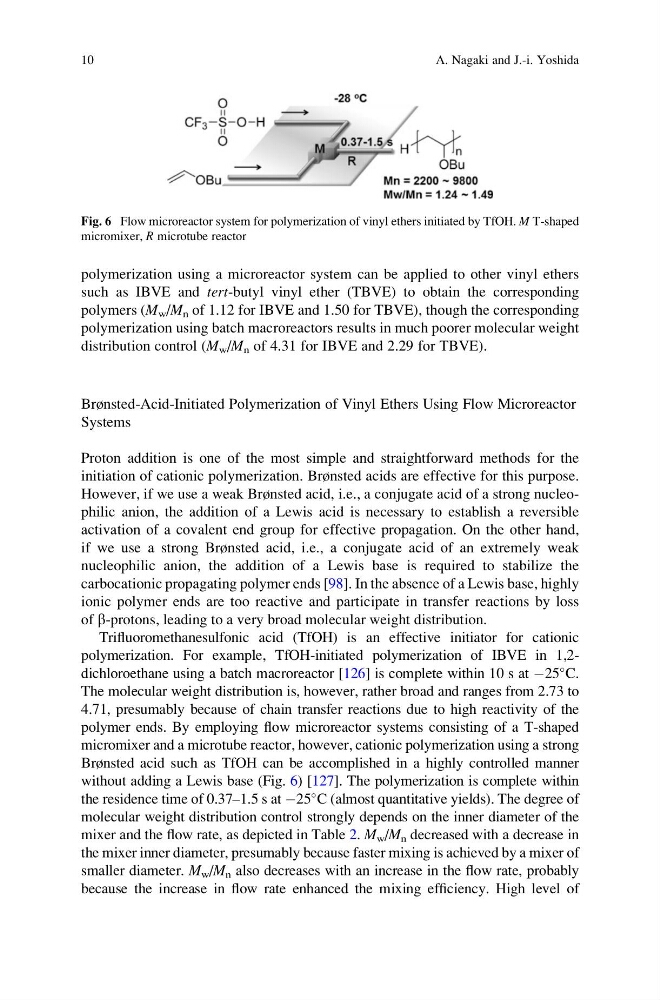
polymer ends. By employing flow microreactor systems consisting of a T-shaped
micromixer and a microtube reactor, however, cationic polymerization using a strong
Brønsted acid such as TfOH can be accomplished in a highly controlled manner
without adding a Lewis base (Fig. 6) [127]. The polymerization is complete within
the residence time of 0.37–1.5 s at À25
C (almost quantitative yields). The degree of
molecular weight distribution control strongly depends on the inner diameter of the
mixer and the flow rate, as depicted in Table 2. M w /M n decreased with a decrease in
the mixer inner diameter, presumably because faster mixing is achieved by a mixer of
smaller diameter. M w /M n also decreases with an increase in the flow rate, probably
because the increase in flow rate enhanced the mixing efficiency. High level of
Fig. 6 Flow microreactor system for polymerization of vinyl ethers initiated by TfOH. M T-shaped
micromixer, R microtube reactor
10
A. Nagaki and J.-i. Yoshida
such as IBVE and tert-butyl vinyl ether (TBVE) to obtain the corresponding
polymers (M w /M n of 1.12 for IBVE and 1.50 for TBVE), though the corresponding
polymerization using batch macroreactors results in much poorer molecular weight
distribution control (M w /M n of 4.31 for IBVE and 2.29 for TBVE).
Brønsted-Acid-Initiated Polymerization of Vinyl Ethers Using Flow Microreactor
Systems
Proton addition is one of the most simple and straightforward methods for the
initiation of cationic polymerization. Brønsted acids are effective for this purpose.
However, if we use a weak Brønsted acid, i.e., a conjugate acid of a strong nucleophilic anion, the addition of a Lewis acid is necessary to establish a reversible
activation of a covalent end group for effective propagation. On the other hand,
if we use a strong Brønsted acid, i.e., a conjugate acid of an extremely weak
nucleophilic anion, the addition of a Lewis base is required to stabilize the
carbocationic propagating polymer ends [98]. In the absence of a Lewis base, highly
ionic polymer ends are too reactive and participate in transfer reactions by loss
of b-protons, leading to a very broad molecular weight distribution.
Trifluoromethanesulfonic acid (TfOH) is an effective initiator for cationic
polymerization. For example, TfOH-initiated polymerization of IBVE in 1,2dichloroethane using a batch macroreactor [126] is complete within 10 s at À25
C.
The molecular weight distribution is, however, rather broad and ranges from 2.73 to
4.71, presumably because of chain transfer reactions due to high reactivity of the
polymer ends. By employing flow microreactor systems consisting of a T-shaped
micromixer and a microtube reactor, however, cationic polymerization using a strong
Brønsted acid such as TfOH can be accomplished in a highly controlled manner
without adding a Lewis base (Fig. 6) [127]. The polymerization is complete within
the residence time of 0.37–1.5 s at À25
C (almost quantitative yields). The degree of
molecular weight distribution control strongly depends on the inner diameter of the
mixer and the flow rate, as depicted in Table 2. M w /M n decreased with a decrease in
the mixer inner diameter, presumably because faster mixing is achieved by a mixer of
smaller diameter. M w /M n also decreases with an increase in the flow rate, probably
because the increase in flow rate enhanced the mixing efficiency. High level of
Fig. 6 Flow microreactor system for polymerization of vinyl ethers initiated by TfOH. M T-shaped
micromixer, R microtube reactor
10
A. Nagaki and J.-i. Yoshida