

reactions with various nucleophiles, 1.2 equiv. of precursor is used when 1.0 equiv. of
N-acyliminium ion is needed for polymerization) and NBVE are introduced to M1 by
the syringe pump technique at À78
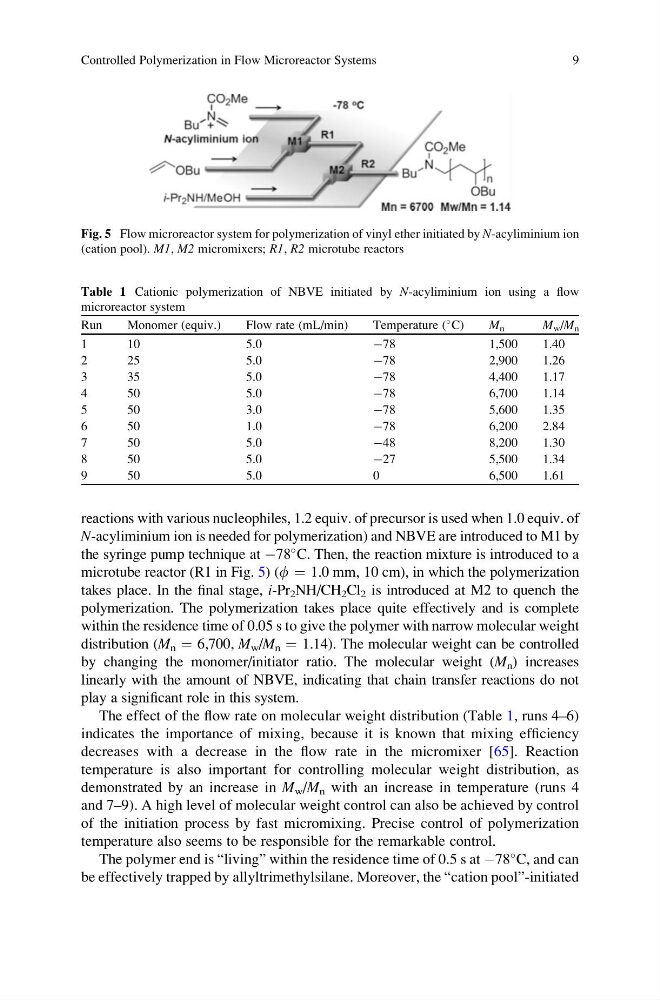
C. Then, the reaction mixture is introduced to a
microtube reactor (R1 in Fig. 5) (f ¼ 1.0 mm, 10 cm), in which the polymerization
takes place. In the final stage, i-Pr 2 NH/CH 2 Cl 2 is introduced at M2 to quench the
polymerization. The polymerization takes place quite effectively and is complete
within the residence time of 0.05 s to give the polymer with narrow molecular weight
distribution (M n ¼ 6,700, M w /M n ¼ 1.14). The molecular weight can be controlled
by changing the monomer/initiator ratio. The molecular weight (M n ) increases
linearly with the amount of NBVE, indicating that chain transfer reactions do not
play a significant role in this system.
The effect of the flow rate on molecular weight distribution (Table 1, runs 4–6)
indicates the importance of mixing, because it is known that mixing efficiency
decreases with a decrease in the flow rate in the micromixer [65]. Reaction
temperature is also important for controlling molecular weight distribution, as
demonstrated by an increase in M w /M n with an increase in temperature (runs 4
and 7–9). A high level of molecular weight control can also be achieved by control
of the initiation process by fast micromixing. Precise control of polymerization
temperature also seems to be responsible for the remarkable control.
The polymer end is “living” within the residence time of 0.5 s at À78
C, and can
be effectively trapped by allyltrimethylsilane. Moreover, the “cation pool”-initiated
Fig. 5 Flow microreactor system for polymerization of vinyl ether initiated by N-acyliminium ion
(cation pool). M1, M2 micromixers; R1, R2 microtube reactors
Table 1 Cationic polymerization of NBVE initiated by N-acyliminium ion using a flow
microreactor system
Run
Monomer (equiv.)
Flow rate (mL/min)
Temperature (
C)
M n
M w /M n
1
10
5.0
À78
1,500
1.40
2
25
5.0
À78
2,900
1.26
3
35
5.0
À78
4,400
1.17
4
50
5.0
À78
6,700
1.14
5
50
3.0
À78
5,600
1.35
6
50
1.0
À78
6,200
2.84
7
50
5.0
À48
8,200
1.30
8
50
5.0
À27
5,500
1.34
9
50
5.0
0
6,500
1.61
Controlled Polymerization in Flow Microreactor Systems
9
N-acyliminium ion is needed for polymerization) and NBVE are introduced to M1 by
the syringe pump technique at À78
C. Then, the reaction mixture is introduced to a
microtube reactor (R1 in Fig. 5) (f ¼ 1.0 mm, 10 cm), in which the polymerization
takes place. In the final stage, i-Pr 2 NH/CH 2 Cl 2 is introduced at M2 to quench the
polymerization. The polymerization takes place quite effectively and is complete
within the residence time of 0.05 s to give the polymer with narrow molecular weight
distribution (M n ¼ 6,700, M w /M n ¼ 1.14). The molecular weight can be controlled
by changing the monomer/initiator ratio. The molecular weight (M n ) increases
linearly with the amount of NBVE, indicating that chain transfer reactions do not
play a significant role in this system.
The effect of the flow rate on molecular weight distribution (Table 1, runs 4–6)
indicates the importance of mixing, because it is known that mixing efficiency
decreases with a decrease in the flow rate in the micromixer [65]. Reaction
temperature is also important for controlling molecular weight distribution, as
demonstrated by an increase in M w /M n with an increase in temperature (runs 4
and 7–9). A high level of molecular weight control can also be achieved by control
of the initiation process by fast micromixing. Precise control of polymerization
temperature also seems to be responsible for the remarkable control.
The polymer end is “living” within the residence time of 0.5 s at À78
C, and can
be effectively trapped by allyltrimethylsilane. Moreover, the “cation pool”-initiated
Fig. 5 Flow microreactor system for polymerization of vinyl ether initiated by N-acyliminium ion
(cation pool). M1, M2 micromixers; R1, R2 microtube reactors
Table 1 Cationic polymerization of NBVE initiated by N-acyliminium ion using a flow
microreactor system
Run
Monomer (equiv.)
Flow rate (mL/min)
Temperature (
C)
M n
M w /M n
1
10
5.0
À78
1,500
1.40
2
25
5.0
À78
2,900
1.26
3
35
5.0
À78
4,400
1.17
4
50
5.0
À78
6,700
1.14
5
50
3.0
À78
5,600
1.35
6
50
1.0
À78
6,200
2.84
7
50
5.0
À48
8,200
1.30
8
50
5.0
À27
5,500
1.34
9
50
5.0
0
6,500
1.61
Controlled Polymerization in Flow Microreactor Systems
9