

1.2.5 Cationic Polymerization of Diisopropenylbenzenes Using Flow
Microreactor Systems
Polyindanes have received significant research interest because of their remarkable
thermal resistance. Extensive work on the synthesis of 1,1,3-trimethyl-substituted
polyindanes by cationic polymerization of 1,4-diisopropenylbenzenes and their
thermal properties has carried out by Nuyken and coworkers [129, 130]. The
polymers of high indane-unit content serve as useful materials because of their
high thermal resistance and low dielectric constants. The use of flow microreactor
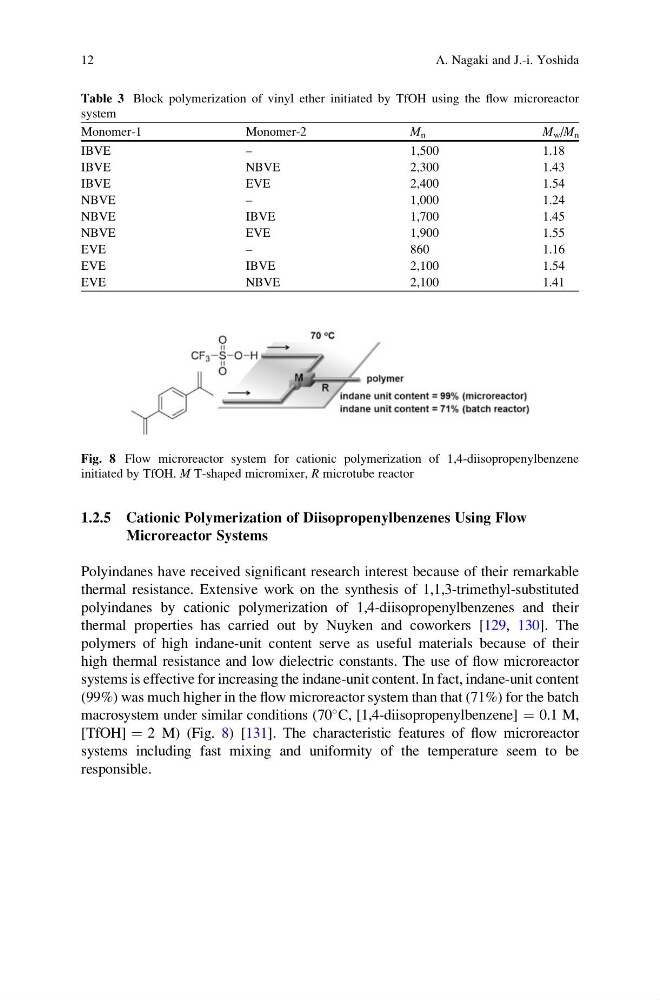
systems is effective for increasing the indane-unit content. In fact, indane-unit content
(99%) was much higher in the flow microreactor system than that (71%) for the batch
macrosystem under similar conditions (70
C, [1,4-diisopropenylbenzene] ¼ 0.1 M,
[TfOH] ¼ 2 M) (Fig. 8) [131]. The characteristic features of flow microreactor
systems including fast mixing and uniformity of the temperature seem to be
responsible.
Table 3 Block polymerization of vinyl ether initiated by TfOH using the flow microreactor
system
Monomer-1
Monomer-2
M n
M w /M n
IBVE
–
1,500
1.18
IBVE
NBVE
2,300
1.43
IBVE
EVE
2,400
1.54
NBVE
–
1,000
1.24
NBVE
IBVE
1,700
1.45
NBVE
EVE
1,900
1.55
EVE
–
860
1.16
EVE
IBVE
2,100
1.54
EVE
NBVE
2,100
1.41
Fig. 8 Flow microreactor system for cationic polymerization of 1,4-diisopropenylbenzene
initiated by TfOH. M T-shaped micromixer, R microtube reactor
12
A. Nagaki and J.-i. Yoshida
Microreactor Systems
Polyindanes have received significant research interest because of their remarkable
thermal resistance. Extensive work on the synthesis of 1,1,3-trimethyl-substituted
polyindanes by cationic polymerization of 1,4-diisopropenylbenzenes and their
thermal properties has carried out by Nuyken and coworkers [129, 130]. The
polymers of high indane-unit content serve as useful materials because of their
high thermal resistance and low dielectric constants. The use of flow microreactor
systems is effective for increasing the indane-unit content. In fact, indane-unit content
(99%) was much higher in the flow microreactor system than that (71%) for the batch
macrosystem under similar conditions (70
C, [1,4-diisopropenylbenzene] ¼ 0.1 M,
[TfOH] ¼ 2 M) (Fig. 8) [131]. The characteristic features of flow microreactor
systems including fast mixing and uniformity of the temperature seem to be
responsible.
Table 3 Block polymerization of vinyl ether initiated by TfOH using the flow microreactor
system
Monomer-1
Monomer-2
M n
M w /M n
IBVE
–
1,500
1.18
IBVE
NBVE
2,300
1.43
IBVE
EVE
2,400
1.54
NBVE
–
1,000
1.24
NBVE
IBVE
1,700
1.45
NBVE
EVE
1,900
1.55
EVE
–
860
1.16
EVE
IBVE
2,100
1.54
EVE
NBVE
2,100
1.41
Fig. 8 Flow microreactor system for cationic polymerization of 1,4-diisopropenylbenzene
initiated by TfOH. M T-shaped micromixer, R microtube reactor
12
A. Nagaki and J.-i. Yoshida