

In both methods the positive charge of the carbocationic center is reduced and
thereby the acidity of the b-proton is reduced to suppress the chain transfer. As a
result, good molecular weight control and molecular weight distribution control are
attained. On the basis of the principles, a number of initiating systems have been
developed for living cationic polymerization [99].
1.2.3 Controlled/Living Cationic Polymerization of Vinyl Ethers Based
on Cation Stabilization Using Flow Microreactor Systems [100]
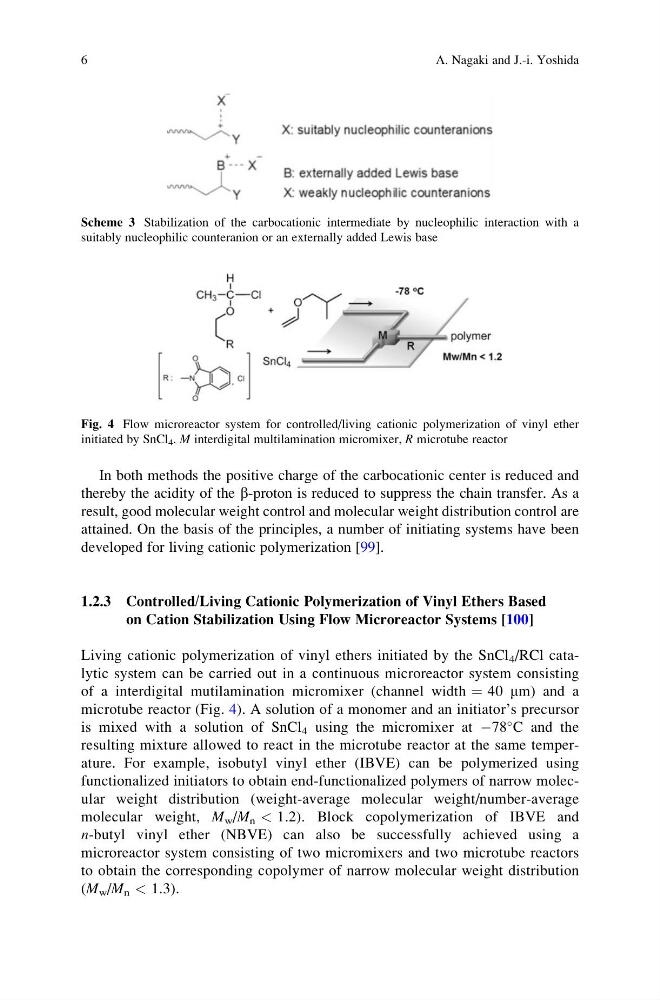
Living cationic polymerization of vinyl ethers initiated by the SnCl 4 /RCl catalytic system can be carried out in a continuous microreactor system consisting
of a interdigital mutilamination micromixer (channel width ¼ 40 mm) and a
microtube reactor (Fig. 4). A solution of a monomer and an initiator’s precursor
is mixed with a solution of SnCl 4 using the micromixer at À78
C and the
resulting mixture allowed to react in the microtube reactor at the same temperature. For example, isobutyl vinyl ether (IBVE) can be polymerized using
functionalized initiators to obtain end-functionalized polymers of narrow molecular weight distribution (weight-average molecular weight/number-average
molecular weight, M w /M n < 1.2). Block copolymerization of IBVE and
n-butyl vinyl ether (NBVE) can also be successfully achieved using a
microreactor system consisting of two micromixers and two microtube reactors
to obtain the corresponding copolymer of narrow molecular weight distribution
(M w /M n < 1.3).
Scheme 3 Stabilization of the carbocationic intermediate by nucleophilic interaction with a
suitably nucleophilic counteranion or an externally added Lewis base
Fig. 4 Flow microreactor system for controlled/living cationic polymerization of vinyl ether
initiated by SnCl 4 . M interdigital multilamination micromixer, R microtube reactor
6
A. Nagaki and J.-i. Yoshida
thereby the acidity of the b-proton is reduced to suppress the chain transfer. As a
result, good molecular weight control and molecular weight distribution control are
attained. On the basis of the principles, a number of initiating systems have been
developed for living cationic polymerization [99].
1.2.3 Controlled/Living Cationic Polymerization of Vinyl Ethers Based
on Cation Stabilization Using Flow Microreactor Systems [100]
Living cationic polymerization of vinyl ethers initiated by the SnCl 4 /RCl catalytic system can be carried out in a continuous microreactor system consisting
of a interdigital mutilamination micromixer (channel width ¼ 40 mm) and a
microtube reactor (Fig. 4). A solution of a monomer and an initiator’s precursor
is mixed with a solution of SnCl 4 using the micromixer at À78
C and the
resulting mixture allowed to react in the microtube reactor at the same temperature. For example, isobutyl vinyl ether (IBVE) can be polymerized using
functionalized initiators to obtain end-functionalized polymers of narrow molecular weight distribution (weight-average molecular weight/number-average
molecular weight, M w /M n < 1.2). Block copolymerization of IBVE and
n-butyl vinyl ether (NBVE) can also be successfully achieved using a
microreactor system consisting of two micromixers and two microtube reactors
to obtain the corresponding copolymer of narrow molecular weight distribution
(M w /M n < 1.3).
Scheme 3 Stabilization of the carbocationic intermediate by nucleophilic interaction with a
suitably nucleophilic counteranion or an externally added Lewis base
Fig. 4 Flow microreactor system for controlled/living cationic polymerization of vinyl ether
initiated by SnCl 4 . M interdigital multilamination micromixer, R microtube reactor
6
A. Nagaki and J.-i. Yoshida