

1.2.4 Controlled/Living Cationic Polymerization of Vinyl Ethers Without
Stabilizing Carbocationic Intermediates Using Flow Microreactor
Systems
One of the major drawbacks of the controlled/living cationic polymerization based on
stabilization of the carbocationic intermediates is slow propagation. Because the
concentration of the active propagating species is very low because of the equilibrium
between active species and dormant species, overall polymerization reactions are
much slower than those without the equilibrium. Another important drawback of the
controlled/living polymerization is the use of additives such as Lewis bases. Such
additives remain in polymer products and are generally rather difficult to remove
from the polymer products.
Recently, it has been demonstrated that good control of molecular weight and
molecular weight distribution can be attained by using microreactor systems without stabilizing the carbocationic intermediates. The concept of this new technology
(flow-microreactor-system-controlled polymerization) is described in the following
section.
Concept of Flow-Microreactor-System-Controlled Polymerization Technology
Control of molecular weight and molecular weight distribution in polymerization
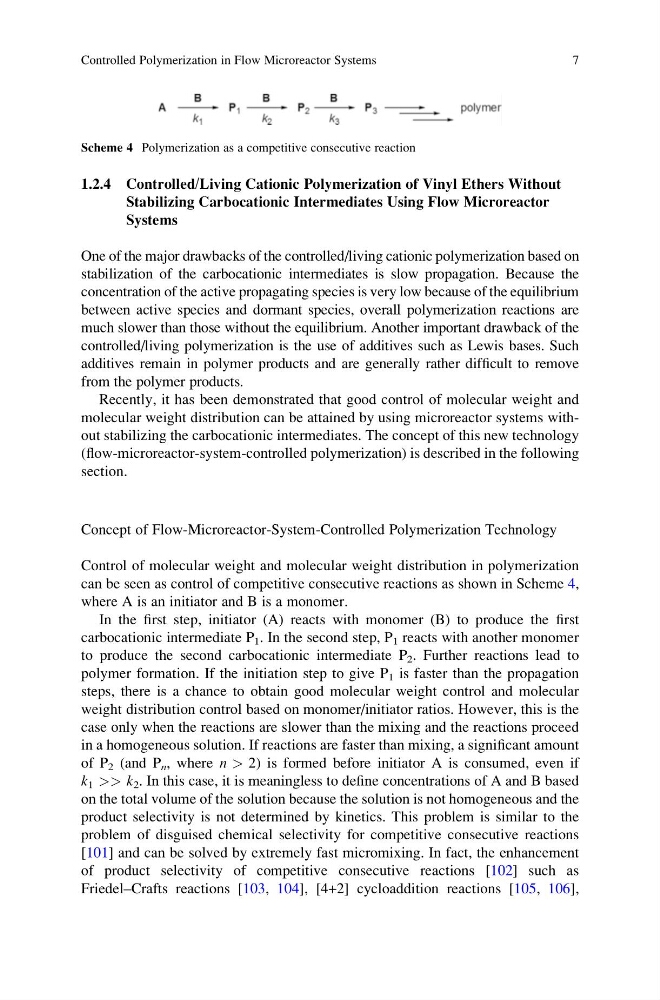
can be seen as control of competitive consecutive reactions as shown in Scheme 4,
where A is an initiator and B is a monomer.
In the first step, initiator (A) reacts with monomer (B) to produce the first
carbocationic intermediate P 1 . In the second step, P 1 reacts with another monomer
to produce the second carbocationic intermediate P 2 . Further reactions lead to
polymer formation. If the initiation step to give P 1 is faster than the propagation
steps, there is a chance to obtain good molecular weight control and molecular
weight distribution control based on monomer/initiator ratios. However, this is the
case only when the reactions are slower than the mixing and the reactions proceed
in a homogeneous solution. If reactions are faster than mixing, a significant amount
of P 2 (and P n , where n > 2) is formed before initiator A is consumed, even if
k 1 >> k 2 . In this case, it is meaningless to define concentrations of A and B based
on the total volume of the solution because the solution is not homogeneous and the
product selectivity is not determined by kinetics. This problem is similar to the
problem of disguised chemical selectivity for competitive consecutive reactions
[101] and can be solved by extremely fast micromixing. In fact, the enhancement
of product selectivity of competitive consecutive reactions [102] such as
Friedel–Crafts reactions [103, 104], [4+2] cycloaddition reactions [105, 106],
Scheme 4 Polymerization as a competitive consecutive reaction
Controlled Polymerization in Flow Microreactor Systems
7
Stabilizing Carbocationic Intermediates Using Flow Microreactor
Systems
One of the major drawbacks of the controlled/living cationic polymerization based on
stabilization of the carbocationic intermediates is slow propagation. Because the
concentration of the active propagating species is very low because of the equilibrium
between active species and dormant species, overall polymerization reactions are
much slower than those without the equilibrium. Another important drawback of the
controlled/living polymerization is the use of additives such as Lewis bases. Such
additives remain in polymer products and are generally rather difficult to remove
from the polymer products.
Recently, it has been demonstrated that good control of molecular weight and
molecular weight distribution can be attained by using microreactor systems without stabilizing the carbocationic intermediates. The concept of this new technology
(flow-microreactor-system-controlled polymerization) is described in the following
section.
Concept of Flow-Microreactor-System-Controlled Polymerization Technology
Control of molecular weight and molecular weight distribution in polymerization
can be seen as control of competitive consecutive reactions as shown in Scheme 4,
where A is an initiator and B is a monomer.
In the first step, initiator (A) reacts with monomer (B) to produce the first
carbocationic intermediate P 1 . In the second step, P 1 reacts with another monomer
to produce the second carbocationic intermediate P 2 . Further reactions lead to
polymer formation. If the initiation step to give P 1 is faster than the propagation
steps, there is a chance to obtain good molecular weight control and molecular
weight distribution control based on monomer/initiator ratios. However, this is the
case only when the reactions are slower than the mixing and the reactions proceed
in a homogeneous solution. If reactions are faster than mixing, a significant amount
of P 2 (and P n , where n > 2) is formed before initiator A is consumed, even if
k 1 >> k 2 . In this case, it is meaningless to define concentrations of A and B based
on the total volume of the solution because the solution is not homogeneous and the
product selectivity is not determined by kinetics. This problem is similar to the
problem of disguised chemical selectivity for competitive consecutive reactions
[101] and can be solved by extremely fast micromixing. In fact, the enhancement
of product selectivity of competitive consecutive reactions [102] such as
Friedel–Crafts reactions [103, 104], [4+2] cycloaddition reactions [105, 106],
Scheme 4 Polymerization as a competitive consecutive reaction
Controlled Polymerization in Flow Microreactor Systems
7