

used as initiators. The carbocationic intermediate thus obtained adds to another
molecule of the monomer to give the next carbocationic intermediate, which adds to
another monomer (propagation step). The carbocationic intermediates are usually
highly reactive and unstable. They undergo a number of side reactions such as chain
transfer and termination. Chain transfer to monomer is the most problematic with
regards control of molecular weight and molecular weight distribution. Namely,
the b-proton of the carbocationic intermediate is inherently acidic because of the
positive charge on the carbon. On the other hand, monomers used in cationic
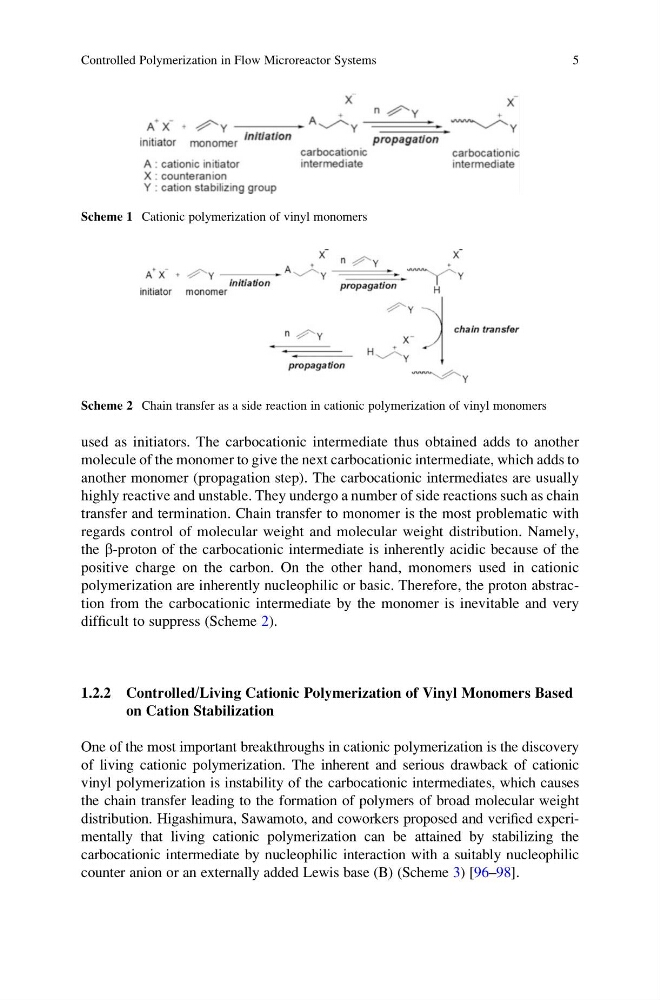
polymerization are inherently nucleophilic or basic. Therefore, the proton abstraction from the carbocationic intermediate by the monomer is inevitable and very
difficult to suppress (Scheme 2).
1.2.2 Controlled/Living Cationic Polymerization of Vinyl Monomers Based
on Cation Stabilization
One of the most important breakthroughs in cationic polymerization is the discovery
of living cationic polymerization. The inherent and serious drawback of cationic
vinyl polymerization is instability of the carbocationic intermediates, which causes
the chain transfer leading to the formation of polymers of broad molecular weight
distribution. Higashimura, Sawamoto, and coworkers proposed and verified experimentally that living cationic polymerization can be attained by stabilizing the
carbocationic intermediate by nucleophilic interaction with a suitably nucleophilic
counter anion or an externally added Lewis base (B) (Scheme 3) [96–98].
Scheme 1 Cationic polymerization of vinyl monomers
Scheme 2 Chain transfer as a side reaction in cationic polymerization of vinyl monomers
Controlled Polymerization in Flow Microreactor Systems
5
molecule of the monomer to give the next carbocationic intermediate, which adds to
another monomer (propagation step). The carbocationic intermediates are usually
highly reactive and unstable. They undergo a number of side reactions such as chain
transfer and termination. Chain transfer to monomer is the most problematic with
regards control of molecular weight and molecular weight distribution. Namely,
the b-proton of the carbocationic intermediate is inherently acidic because of the
positive charge on the carbon. On the other hand, monomers used in cationic
polymerization are inherently nucleophilic or basic. Therefore, the proton abstraction from the carbocationic intermediate by the monomer is inevitable and very
difficult to suppress (Scheme 2).
1.2.2 Controlled/Living Cationic Polymerization of Vinyl Monomers Based
on Cation Stabilization
One of the most important breakthroughs in cationic polymerization is the discovery
of living cationic polymerization. The inherent and serious drawback of cationic
vinyl polymerization is instability of the carbocationic intermediates, which causes
the chain transfer leading to the formation of polymers of broad molecular weight
distribution. Higashimura, Sawamoto, and coworkers proposed and verified experimentally that living cationic polymerization can be attained by stabilizing the
carbocationic intermediate by nucleophilic interaction with a suitably nucleophilic
counter anion or an externally added Lewis base (B) (Scheme 3) [96–98].
Scheme 1 Cationic polymerization of vinyl monomers
Scheme 2 Chain transfer as a side reaction in cationic polymerization of vinyl monomers
Controlled Polymerization in Flow Microreactor Systems
5