

Even though, after mixing and during the course of reaching a randomized mixture of
h- and d-chains at equilibrium, a strict distinction between the originally proteated and
deuterated micelles is lost, one can still write the contrast in terms of a surplus of either
h- or d-chains f(t) in the original micelles. We will use the convention f(t ¼ 0) ¼ 1.
Because the excess contrast is defined under ZAC conditions (ρ 0 % (ρ hh + ρ dd )/2), I
(Q,t)
i must be symmetric around f(t) % 0.5, at least for low Q. For the situation where
the micelles are completely randomized, f(t) % 0.5.
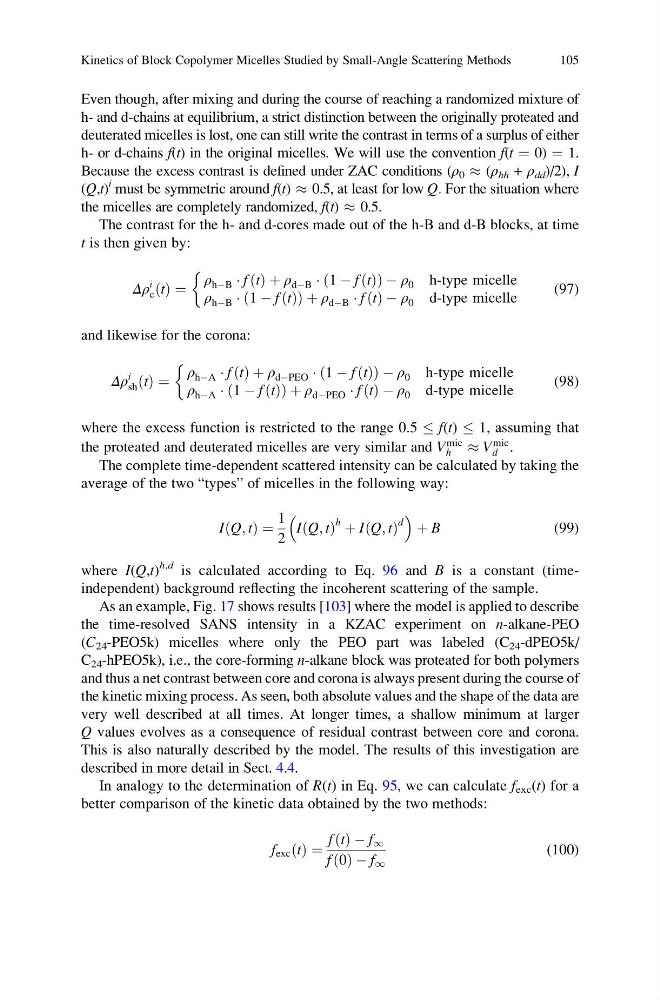
The contrast for the h- and d-cores made out of the h-B and d-B blocks, at time
t is then given by:
Δρ
i
c ðtÞ ¼
ρ hÀB Á f ðtÞ þ ρ dÀB Á 1 À f ðtÞ
ð
ÞÀρ 0 h-type micelle
ρ hÀB Á 1 À f ðtÞ
ð
Þþρ dÀB Á f ðtÞ À ρ 0 d-type micelle
&
(97)
and likewise for the corona:
Δρ
i
sh ðtÞ ¼
ρ hÀA Á f ðtÞ þ ρ dÀPEO Á 1 À f ðtÞ
ð
ÞÀρ 0 h-type micelle
ρ hÀA Á 1 À f ðtÞ
ð
Þþρ dÀPEO Á f ðtÞ À ρ 0 d-type micelle
&
(98)
where the excess function is restricted to the range 0.5 f(t) 1, assuming that
the proteated and deuterated micelles are very similar and V
mic
h
% V
mic
d .
The complete time-dependent scattered intensity can be calculated by taking the
average of the two “types” of micelles in the following way:
IðQ; tÞ ¼
1
2
IðQ; tÞ
h þ IðQ; tÞ
d
þ B
(99)
where I(Q,t)
h,d is calculated according to Eq. 96 and B is a constant (timeindependent) background reflecting the incoherent scattering of the sample.
As an example, Fig. 17 shows results [103] where the model is applied to describe
the time-resolved SANS intensity in a KZAC experiment on n-alkane-PEO
(C 24 -PEO5k) micelles where only the PEO part was labeled (C 24 -dPEO5k/
C 24 -hPEO5k), i.e., the core-forming n-alkane block was proteated for both polymers
and thus a net contrast between core and corona is always present during the course of
the kinetic mixing process. As seen, both absolute values and the shape of the data are
very well described at all times. At longer times, a shallow minimum at larger
Q values evolves as a consequence of residual contrast between core and corona.
This is also naturally described by the model. The results of this investigation are
described in more detail in Sect. 4.4.
In analogy to the determination of R(t) in Eq. 95, we can calculate f exc (t) for a
better comparison of the kinetic data obtained by the two methods:
f exc ðtÞ ¼
f ðtÞ À f 1
f ð0Þ À f 1
(100)
Kinetics of Block Copolymer Micelles Studied by Small-Angle Scattering Methods
105
h- and d-chains at equilibrium, a strict distinction between the originally proteated and
deuterated micelles is lost, one can still write the contrast in terms of a surplus of either
h- or d-chains f(t) in the original micelles. We will use the convention f(t ¼ 0) ¼ 1.
Because the excess contrast is defined under ZAC conditions (ρ 0 % (ρ hh + ρ dd )/2), I
(Q,t)
i must be symmetric around f(t) % 0.5, at least for low Q. For the situation where
the micelles are completely randomized, f(t) % 0.5.
The contrast for the h- and d-cores made out of the h-B and d-B blocks, at time
t is then given by:
Δρ
i
c ðtÞ ¼
ρ hÀB Á f ðtÞ þ ρ dÀB Á 1 À f ðtÞ
ð
ÞÀρ 0 h-type micelle
ρ hÀB Á 1 À f ðtÞ
ð
Þþρ dÀB Á f ðtÞ À ρ 0 d-type micelle
&
(97)
and likewise for the corona:
Δρ
i
sh ðtÞ ¼
ρ hÀA Á f ðtÞ þ ρ dÀPEO Á 1 À f ðtÞ
ð
ÞÀρ 0 h-type micelle
ρ hÀA Á 1 À f ðtÞ
ð
Þþρ dÀPEO Á f ðtÞ À ρ 0 d-type micelle
&
(98)
where the excess function is restricted to the range 0.5 f(t) 1, assuming that
the proteated and deuterated micelles are very similar and V
mic
h
% V
mic
d .
The complete time-dependent scattered intensity can be calculated by taking the
average of the two “types” of micelles in the following way:
IðQ; tÞ ¼
1
2
IðQ; tÞ
h þ IðQ; tÞ
d
þ B
(99)
where I(Q,t)
h,d is calculated according to Eq. 96 and B is a constant (timeindependent) background reflecting the incoherent scattering of the sample.
As an example, Fig. 17 shows results [103] where the model is applied to describe
the time-resolved SANS intensity in a KZAC experiment on n-alkane-PEO
(C 24 -PEO5k) micelles where only the PEO part was labeled (C 24 -dPEO5k/
C 24 -hPEO5k), i.e., the core-forming n-alkane block was proteated for both polymers
and thus a net contrast between core and corona is always present during the course of
the kinetic mixing process. As seen, both absolute values and the shape of the data are
very well described at all times. At longer times, a shallow minimum at larger
Q values evolves as a consequence of residual contrast between core and corona.
This is also naturally described by the model. The results of this investigation are
described in more detail in Sect. 4.4.
In analogy to the determination of R(t) in Eq. 95, we can calculate f exc (t) for a
better comparison of the kinetic data obtained by the two methods:
f exc ðtÞ ¼
f ðtÞ À f 1
f ð0Þ À f 1
(100)
Kinetics of Block Copolymer Micelles Studied by Small-Angle Scattering Methods
105