

As shown in two recent studies [103, 104], both f exc (t) and R(t) give essentially
the same kinetic information and results. It should be mentioned, however, that the
methodology described here only applies to rather low Q. At smaller scales, excess
scattering is expected during the course of mixing as there might be local domains
of either h- or d-type chains.
A similar approach could be used to describe hybridization kinetics after mixing
two different micelles or for processes involving non-equilibrium relaxation
experiments. However, in this case the time dependence of the structural
parameters [P(t), R m (t), etc.] as well as micellar composition must be taken into
account.
Rate Constant From a Two-Component Labeling Experiment
Independently of the evaluation method, a KZAC TR-SANS experiment allows the
kinetics to be evaluated through the decay of either R(t) or f exc (t). The unimer
exchange rate constant in simple labeling experiment will now be discussed.
A kinetic model for unimer exchange mechanism has been presented by Thilo
[105] as well as by Cantu ´ et al. [106]. According to Thilo [105], the following
kinetic scheme can be used. Here, we use the terminology of proteated (H) and
deuterated (D) chains or surfactants because in the present review the focus is on
scattering experiments.
Starting from reservoir I where the micelles only contain proteated chains (H)
and reservoir II with only deuterated chains (D), we define the initial conditions as
f I ¼ 1 and f II ¼ 0 where the subscripts denote micelle I (i ¼ I) or micelle
d /d / [cm
-1
]
10 0
10 1
10 2
10 3
Q [Å
-1
]
10 −2
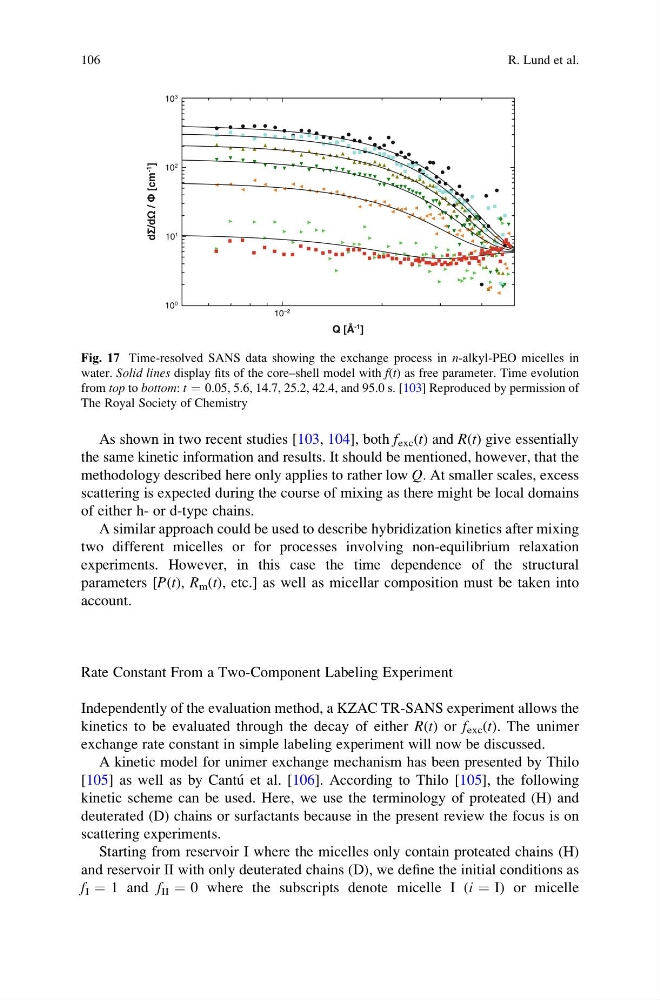
Fig. 17 Time-resolved SANS data showing the exchange process in n-alkyl-PEO micelles in
water. Solid lines display fits of the core–shell model with f(t) as free parameter. Time evolution
from top to bottom: t ¼ 0.05, 5.6, 14.7, 25.2, 42.4, and 95.0 s. [103] Reproduced by permission of
The Royal Society of Chemistry
106
R. Lund et al.
the same kinetic information and results. It should be mentioned, however, that the
methodology described here only applies to rather low Q. At smaller scales, excess
scattering is expected during the course of mixing as there might be local domains
of either h- or d-type chains.
A similar approach could be used to describe hybridization kinetics after mixing
two different micelles or for processes involving non-equilibrium relaxation
experiments. However, in this case the time dependence of the structural
parameters [P(t), R m (t), etc.] as well as micellar composition must be taken into
account.
Rate Constant From a Two-Component Labeling Experiment
Independently of the evaluation method, a KZAC TR-SANS experiment allows the
kinetics to be evaluated through the decay of either R(t) or f exc (t). The unimer
exchange rate constant in simple labeling experiment will now be discussed.
A kinetic model for unimer exchange mechanism has been presented by Thilo
[105] as well as by Cantu ´ et al. [106]. According to Thilo [105], the following
kinetic scheme can be used. Here, we use the terminology of proteated (H) and
deuterated (D) chains or surfactants because in the present review the focus is on
scattering experiments.
Starting from reservoir I where the micelles only contain proteated chains (H)
and reservoir II with only deuterated chains (D), we define the initial conditions as
f I ¼ 1 and f II ¼ 0 where the subscripts denote micelle I (i ¼ I) or micelle
d /d / [cm
-1
]
10 0
10 1
10 2
10 3
Q [Å
-1
]
10 −2
Fig. 17 Time-resolved SANS data showing the exchange process in n-alkyl-PEO micelles in
water. Solid lines display fits of the core–shell model with f(t) as free parameter. Time evolution
from top to bottom: t ¼ 0.05, 5.6, 14.7, 25.2, 42.4, and 95.0 s. [103] Reproduced by permission of
The Royal Society of Chemistry
106
R. Lund et al.