

the excess fraction of the h- or d-chains, i.e.,
ffiffiffiffiffiffiffi
IðtÞ
p
$ ΔρðtÞ $ ðf ðtÞ À 1=2Þρ h þ
ð1=2 À f ðtÞÞρ d ¼ ðf ðtÞ À 1=2Þðρ h À ρ d Þ. In this way, the analysis of the data is
straightforward in comparison to other methods. Hence, using this method the
information on the exchange kinetics is unambiguously given by the relaxation
function, R(t):
RðtÞ ¼
IðtÞ À I 1
Iðt ¼ 0Þ À I 1
1=2
(95)
where IðtÞ ¼
Ð
IðQ; tÞdQ is the integral intensity at a given time and I 1 denotes the
intensity of the fully mixed sample at the final stage of the kinetic process (obtainable by randomly premixing the two block copolymers with ϕ hh ¼ ϕ dd ¼ 0.5. I(0)
is the arithmetic average of the two reservoirs (hh and dd samples) measured
separately. The latter has to be measured at dilute concentrations, where no
structure factor effects are present since S(Q) vanishes under KZAC conditions.
R(t) is the relevant function to be analyzed for extraction of the kinetics. However,
in micellar systems where the micelles are not fully proteated/deuterated or there is
residual contrast between core and shell, nonlinear interference scattering
contributions are present. In order to take this into account, a more accurate description of the time-dependent scattering intensity is necessary. A scattering model,
where the time-dependent hyrogen/deuterium composition of the core and shell of
the micelles is built into a kinetic core–shell model, is described next.
Full Model Fitting Approach
The scattering function describing the time-dependent scattering intensity of micelles
in a KZAC experiment involves a time-dependent core–shell model where the
contrast is a function of the fraction of chains exchanged, f exc . Here, we shall limit
the discussion to cylindrical and spherical structures using simple A-B diblock
copolymers as an example. Inclusion of other structures such as vesicles could be
slightly more complicated because the microscopic composition might be potentially
different in the inner and outer shells.
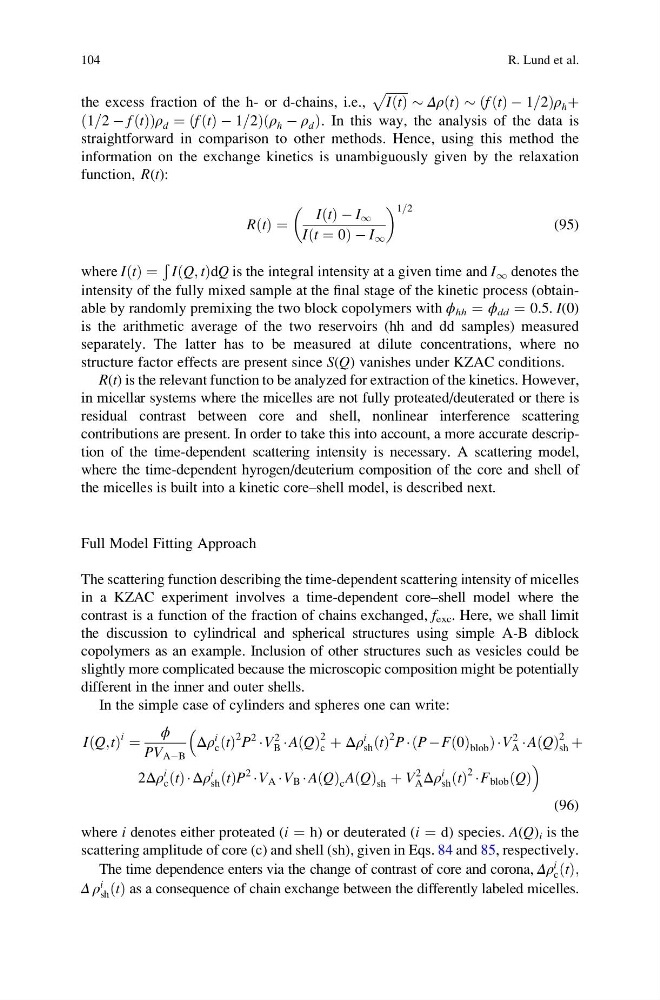
In the simple case of cylinders and spheres one can write:
IðQ;tÞ
i ¼
ϕ
PV AÀB
Δρ
i
c ðtÞ
2 P
2
Á V
2
B Á AðQÞ
2
c þ Δρ
i
sh ðtÞ
2 P Á ðP À Fð0Þ blob Þ ÁV
2
A Á AðQÞ
2
sh þ
2Δρ
i
c ðtÞÁ Δρ
i
sh ðtÞP
2
Á V A Á V B Á AðQÞ c AðQÞ sh þ V
2
A Δρ
i
sh ðtÞ
2 Á F blob ðQÞ
(96)
where i denotes either proteated (i ¼ h) or deuterated (i ¼ d) species. A(Q) i is the
scattering amplitude of core (c) and shell (sh), given in Eqs. 84 and 85, respectively.
The time dependence enters via the change of contrast of core and corona, Δρ
i
c ðtÞ;
Δ ρ
i
sh ðtÞ as a consequence of chain exchange between the differently labeled micelles.
104
R. Lund et al.
ffiffiffiffiffiffiffi
IðtÞ
p
$ ΔρðtÞ $ ðf ðtÞ À 1=2Þρ h þ
ð1=2 À f ðtÞÞρ d ¼ ðf ðtÞ À 1=2Þðρ h À ρ d Þ. In this way, the analysis of the data is
straightforward in comparison to other methods. Hence, using this method the
information on the exchange kinetics is unambiguously given by the relaxation
function, R(t):
RðtÞ ¼
IðtÞ À I 1
Iðt ¼ 0Þ À I 1
1=2
(95)
where IðtÞ ¼
Ð
IðQ; tÞdQ is the integral intensity at a given time and I 1 denotes the
intensity of the fully mixed sample at the final stage of the kinetic process (obtainable by randomly premixing the two block copolymers with ϕ hh ¼ ϕ dd ¼ 0.5. I(0)
is the arithmetic average of the two reservoirs (hh and dd samples) measured
separately. The latter has to be measured at dilute concentrations, where no
structure factor effects are present since S(Q) vanishes under KZAC conditions.
R(t) is the relevant function to be analyzed for extraction of the kinetics. However,
in micellar systems where the micelles are not fully proteated/deuterated or there is
residual contrast between core and shell, nonlinear interference scattering
contributions are present. In order to take this into account, a more accurate description of the time-dependent scattering intensity is necessary. A scattering model,
where the time-dependent hyrogen/deuterium composition of the core and shell of
the micelles is built into a kinetic core–shell model, is described next.
Full Model Fitting Approach
The scattering function describing the time-dependent scattering intensity of micelles
in a KZAC experiment involves a time-dependent core–shell model where the
contrast is a function of the fraction of chains exchanged, f exc . Here, we shall limit
the discussion to cylindrical and spherical structures using simple A-B diblock
copolymers as an example. Inclusion of other structures such as vesicles could be
slightly more complicated because the microscopic composition might be potentially
different in the inner and outer shells.
In the simple case of cylinders and spheres one can write:
IðQ;tÞ
i ¼
ϕ
PV AÀB
Δρ
i
c ðtÞ
2 P
2
Á V
2
B Á AðQÞ
2
c þ Δρ
i
sh ðtÞ
2 P Á ðP À Fð0Þ blob Þ ÁV
2
A Á AðQÞ
2
sh þ
2Δρ
i
c ðtÞÁ Δρ
i
sh ðtÞP
2
Á V A Á V B Á AðQÞ c AðQÞ sh þ V
2
A Δρ
i
sh ðtÞ
2 Á F blob ðQÞ
(96)
where i denotes either proteated (i ¼ h) or deuterated (i ¼ d) species. A(Q) i is the
scattering amplitude of core (c) and shell (sh), given in Eqs. 84 and 85, respectively.
The time dependence enters via the change of contrast of core and corona, Δρ
i
c ðtÞ;
Δ ρ
i
sh ðtÞ as a consequence of chain exchange between the differently labeled micelles.
104
R. Lund et al.