

proteated and deuterated chains, f and 1 À f respectively: ρ m ¼ fρ h + (1 À f )ρ d
where ρ h and ρ d are the scattering length densities of the proteated and deuterated
(in this section referred to as h- and d-) chains. Because in ZAC conditions we have
ρ 0 ¼ (ρ h + ρ d )/2, we see that the square root of I(t) is linearly proportional to
Deuterated
Proteated
Exchange
Final state
minimum intensity
maximum intensity
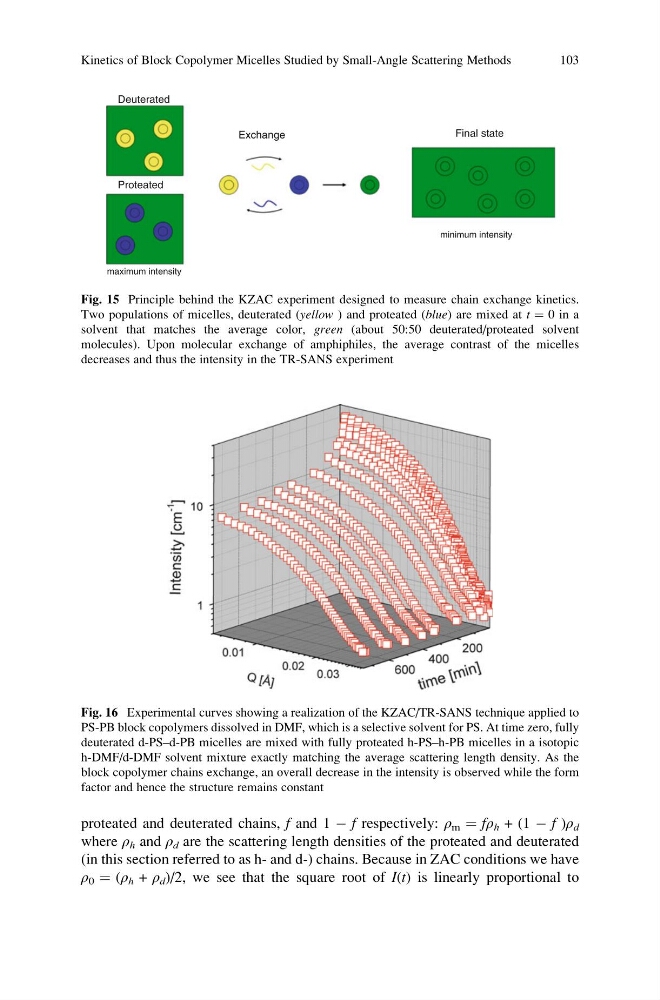
Fig. 15 Principle behind the KZAC experiment designed to measure chain exchange kinetics.
Two populations of micelles, deuterated (yellow ) and proteated (blue) are mixed at t ¼ 0 in a
solvent that matches the average color, green (about 50:50 deuterated/proteated solvent
molecules). Upon molecular exchange of amphiphiles, the average contrast of the micelles
decreases and thus the intensity in the TR-SANS experiment
Fig. 16 Experimental curves showing a realization of the KZAC/TR-SANS technique applied to
PS-PB block copolymers dissolved in DMF, which is a selective solvent for PS. At time zero, fully
deuterated d-PS–d-PB micelles are mixed with fully proteated h-PS–h-PB micelles in a isotopic
h-DMF/d-DMF solvent mixture exactly matching the average scattering length density. As the
block copolymer chains exchange, an overall decrease in the intensity is observed while the form
factor and hence the structure remains constant
Kinetics of Block Copolymer Micelles Studied by Small-Angle Scattering Methods
103
where ρ h and ρ d are the scattering length densities of the proteated and deuterated
(in this section referred to as h- and d-) chains. Because in ZAC conditions we have
ρ 0 ¼ (ρ h + ρ d )/2, we see that the square root of I(t) is linearly proportional to
Deuterated
Proteated
Exchange
Final state
minimum intensity
maximum intensity
Fig. 15 Principle behind the KZAC experiment designed to measure chain exchange kinetics.
Two populations of micelles, deuterated (yellow ) and proteated (blue) are mixed at t ¼ 0 in a
solvent that matches the average color, green (about 50:50 deuterated/proteated solvent
molecules). Upon molecular exchange of amphiphiles, the average contrast of the micelles
decreases and thus the intensity in the TR-SANS experiment
Fig. 16 Experimental curves showing a realization of the KZAC/TR-SANS technique applied to
PS-PB block copolymers dissolved in DMF, which is a selective solvent for PS. At time zero, fully
deuterated d-PS–d-PB micelles are mixed with fully proteated h-PS–h-PB micelles in a isotopic
h-DMF/d-DMF solvent mixture exactly matching the average scattering length density. As the
block copolymer chains exchange, an overall decrease in the intensity is observed while the form
factor and hence the structure remains constant
Kinetics of Block Copolymer Micelles Studied by Small-Angle Scattering Methods
103