

Often the delay time (X-rays), or the acquisition time (neutrons), is set to follow a
geometrical progression to avoid oversampling and improve statistics at longer times
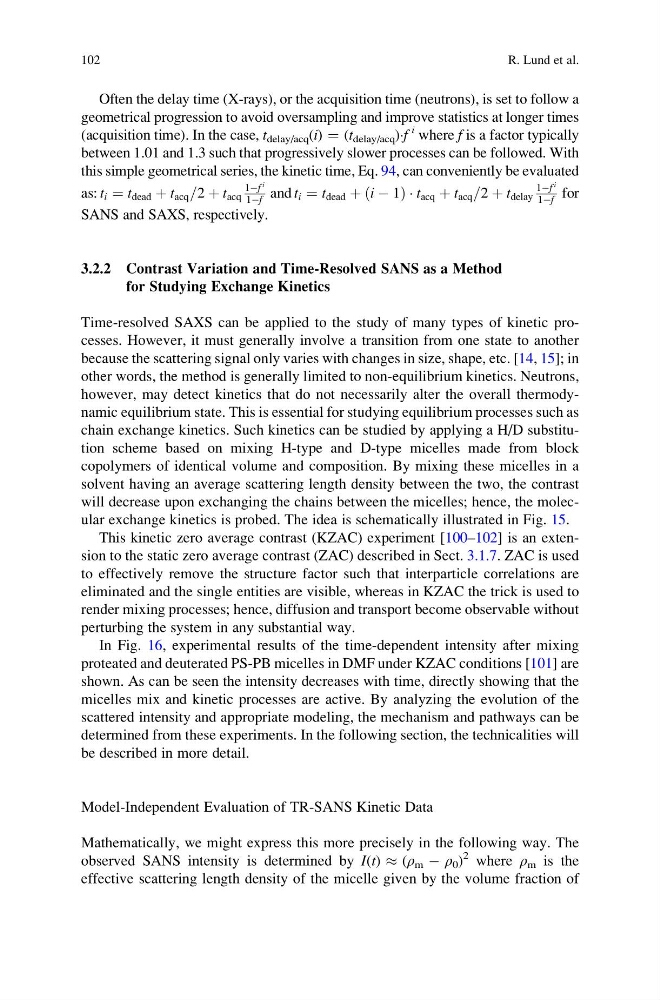
(acquisition time). In the case, t delay/acq (i) ¼ (t delay/acq )Áf
i where f is a factor typically
between 1.01 and 1.3 such that progressively slower processes can be followed. With
this simple geometrical series, the kinetic time, Eq. 94, can conveniently be evaluated
as: t i ¼ t dead þ t acq =2 þ t acq
1Àf
i
1Àf and t i ¼ t dead þ ði À 1Þ Á t acq þ t acq =2 þ t delay
1Àf
i
1Àf for
SANS and SAXS, respectively.
3.2.2 Contrast Variation and Time-Resolved SANS as a Method
for Studying Exchange Kinetics
Time-resolved SAXS can be applied to the study of many types of kinetic processes. However, it must generally involve a transition from one state to another
because the scattering signal only varies with changes in size, shape, etc. [14, 15]; in
other words, the method is generally limited to non-equilibrium kinetics. Neutrons,
however, may detect kinetics that do not necessarily alter the overall thermodynamic equilibrium state. This is essential for studying equilibrium processes such as
chain exchange kinetics. Such kinetics can be studied by applying a H/D substitution scheme based on mixing H-type and D-type micelles made from block
copolymers of identical volume and composition. By mixing these micelles in a
solvent having an average scattering length density between the two, the contrast
will decrease upon exchanging the chains between the micelles; hence, the molecular exchange kinetics is probed. The idea is schematically illustrated in Fig. 15.
This kinetic zero average contrast (KZAC) experiment [100–102] is an extension to the static zero average contrast (ZAC) described in Sect. 3.1.7. ZAC is used
to effectively remove the structure factor such that interparticle correlations are
eliminated and the single entities are visible, whereas in KZAC the trick is used to
render mixing processes; hence, diffusion and transport become observable without
perturbing the system in any substantial way.
In Fig. 16, experimental results of the time-dependent intensity after mixing
proteated and deuterated PS-PB micelles in DMF under KZAC conditions [101] are
shown. As can be seen the intensity decreases with time, directly showing that the
micelles mix and kinetic processes are active. By analyzing the evolution of the
scattered intensity and appropriate modeling, the mechanism and pathways can be
determined from these experiments. In the following section, the technicalities will
be described in more detail.
Model-Independent Evaluation of TR-SANS Kinetic Data
Mathematically, we might express this more precisely in the following way. The
observed SANS intensity is determined by I(t) % (ρ m À ρ 0 )
2 where ρ m is the
effective scattering length density of the micelle given by the volume fraction of
102
R. Lund et al.
geometrical progression to avoid oversampling and improve statistics at longer times
(acquisition time). In the case, t delay/acq (i) ¼ (t delay/acq )Áf
i where f is a factor typically
between 1.01 and 1.3 such that progressively slower processes can be followed. With
this simple geometrical series, the kinetic time, Eq. 94, can conveniently be evaluated
as: t i ¼ t dead þ t acq =2 þ t acq
1Àf
i
1Àf and t i ¼ t dead þ ði À 1Þ Á t acq þ t acq =2 þ t delay
1Àf
i
1Àf for
SANS and SAXS, respectively.
3.2.2 Contrast Variation and Time-Resolved SANS as a Method
for Studying Exchange Kinetics
Time-resolved SAXS can be applied to the study of many types of kinetic processes. However, it must generally involve a transition from one state to another
because the scattering signal only varies with changes in size, shape, etc. [14, 15]; in
other words, the method is generally limited to non-equilibrium kinetics. Neutrons,
however, may detect kinetics that do not necessarily alter the overall thermodynamic equilibrium state. This is essential for studying equilibrium processes such as
chain exchange kinetics. Such kinetics can be studied by applying a H/D substitution scheme based on mixing H-type and D-type micelles made from block
copolymers of identical volume and composition. By mixing these micelles in a
solvent having an average scattering length density between the two, the contrast
will decrease upon exchanging the chains between the micelles; hence, the molecular exchange kinetics is probed. The idea is schematically illustrated in Fig. 15.
This kinetic zero average contrast (KZAC) experiment [100–102] is an extension to the static zero average contrast (ZAC) described in Sect. 3.1.7. ZAC is used
to effectively remove the structure factor such that interparticle correlations are
eliminated and the single entities are visible, whereas in KZAC the trick is used to
render mixing processes; hence, diffusion and transport become observable without
perturbing the system in any substantial way.
In Fig. 16, experimental results of the time-dependent intensity after mixing
proteated and deuterated PS-PB micelles in DMF under KZAC conditions [101] are
shown. As can be seen the intensity decreases with time, directly showing that the
micelles mix and kinetic processes are active. By analyzing the evolution of the
scattered intensity and appropriate modeling, the mechanism and pathways can be
determined from these experiments. In the following section, the technicalities will
be described in more detail.
Model-Independent Evaluation of TR-SANS Kinetic Data
Mathematically, we might express this more precisely in the following way. The
observed SANS intensity is determined by I(t) % (ρ m À ρ 0 )
2 where ρ m is the
effective scattering length density of the micelle given by the volume fraction of
102
R. Lund et al.