

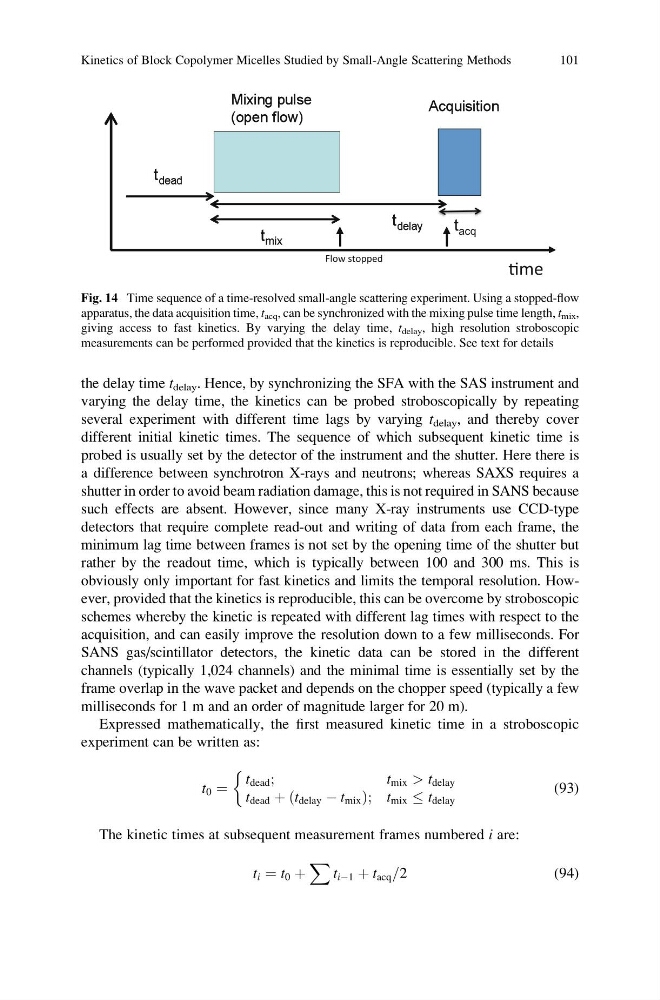
the delay time t delay . Hence, by synchronizing the SFA with the SAS instrument and
varying the delay time, the kinetics can be probed stroboscopically by repeating
several experiment with different time lags by varying t delay , and thereby cover
different initial kinetic times. The sequence of which subsequent kinetic time is
probed is usually set by the detector of the instrument and the shutter. Here there is
a difference between synchrotron X-rays and neutrons; whereas SAXS requires a
shutter in order to avoid beam radiation damage, this is not required in SANS because
such effects are absent. However, since many X-ray instruments use CCD-type
detectors that require complete read-out and writing of data from each frame, the
minimum lag time between frames is not set by the opening time of the shutter but
rather by the readout time, which is typically between 100 and 300 ms. This is
obviously only important for fast kinetics and limits the temporal resolution. However, provided that the kinetics is reproducible, this can be overcome by stroboscopic
schemes whereby the kinetic is repeated with different lag times with respect to the
acquisition, and can easily improve the resolution down to a few milliseconds. For
SANS gas/scintillator detectors, the kinetic data can be stored in the different
channels (typically 1,024 channels) and the minimal time is essentially set by the
frame overlap in the wave packet and depends on the chopper speed (typically a few
milliseconds for 1 m and an order of magnitude larger for 20 m).
Expressed mathematically, the first measured kinetic time in a stroboscopic
experiment can be written as:
t 0 ¼
t dead ;
t mix > t delay
t dead þ ðt delay À t mix Þ; t mix t delay
&
(93)
The kinetic times at subsequent measurement frames numbered i are:
t i ¼ t 0 þ
X
t iÀ1 þ t acq =2
(94)
t acq
Fig. 14 Time sequence of a time-resolved small-angle scattering experiment. Using a stopped-flow
apparatus, the data acquisition time, t acq , can be synchronized with the mixing pulse time length, t mix ,
giving access to fast kinetics. By varying the delay time, t delay , high resolution stroboscopic
measurements can be performed provided that the kinetics is reproducible. See text for details
Kinetics of Block Copolymer Micelles Studied by Small-Angle Scattering Methods
101
varying the delay time, the kinetics can be probed stroboscopically by repeating
several experiment with different time lags by varying t delay , and thereby cover
different initial kinetic times. The sequence of which subsequent kinetic time is
probed is usually set by the detector of the instrument and the shutter. Here there is
a difference between synchrotron X-rays and neutrons; whereas SAXS requires a
shutter in order to avoid beam radiation damage, this is not required in SANS because
such effects are absent. However, since many X-ray instruments use CCD-type
detectors that require complete read-out and writing of data from each frame, the
minimum lag time between frames is not set by the opening time of the shutter but
rather by the readout time, which is typically between 100 and 300 ms. This is
obviously only important for fast kinetics and limits the temporal resolution. However, provided that the kinetics is reproducible, this can be overcome by stroboscopic
schemes whereby the kinetic is repeated with different lag times with respect to the
acquisition, and can easily improve the resolution down to a few milliseconds. For
SANS gas/scintillator detectors, the kinetic data can be stored in the different
channels (typically 1,024 channels) and the minimal time is essentially set by the
frame overlap in the wave packet and depends on the chopper speed (typically a few
milliseconds for 1 m and an order of magnitude larger for 20 m).
Expressed mathematically, the first measured kinetic time in a stroboscopic
experiment can be written as:
t 0 ¼
t dead ;
t mix > t delay
t dead þ ðt delay À t mix Þ; t mix t delay
&
(93)
The kinetic times at subsequent measurement frames numbered i are:
t i ¼ t 0 þ
X
t iÀ1 þ t acq =2
(94)
t acq
Fig. 14 Time sequence of a time-resolved small-angle scattering experiment. Using a stopped-flow
apparatus, the data acquisition time, t acq , can be synchronized with the mixing pulse time length, t mix ,
giving access to fast kinetics. By varying the delay time, t delay , high resolution stroboscopic
measurements can be performed provided that the kinetics is reproducible. See text for details
Kinetics of Block Copolymer Micelles Studied by Small-Angle Scattering Methods
101