

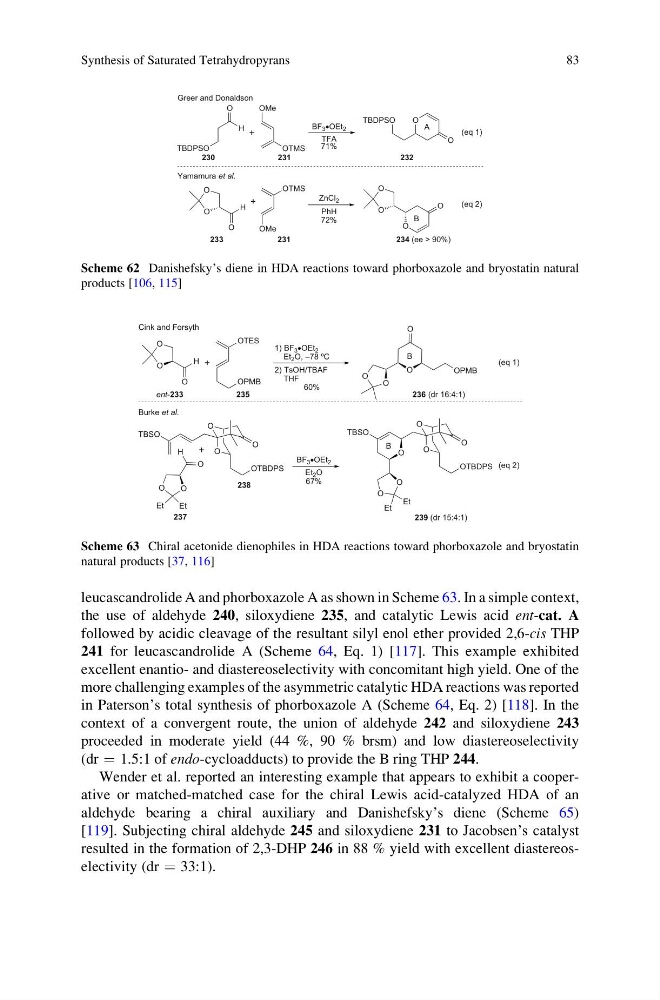
leucascandrolide A and phorboxazole A as shown in Scheme 63. In a simple context,
the use of aldehyde 240, siloxydiene 235, and catalytic Lewis acid ent-cat. A
followed by acidic cleavage of the resultant silyl enol ether provided 2,6-cis THP
241 for leucascandrolide A (Scheme 64, Eq. 1) [117]. This example exhibited
excellent enantio- and diastereoselectivity with concomitant high yield. One of the
more challenging examples of the asymmetric catalytic HDA reactions was reported
in Paterson’s total synthesis of phorboxazole A (Scheme 64, Eq. 2) [118]. In the
context of a convergent route, the union of aldehyde 242 and siloxydiene 243
proceeded in moderate yield (44 %, 90 % brsm) and low diastereoselectivity
(dr ¼ 1.5:1 of endo-cycloadducts) to provide the B ring THP 244.
Wender et al. reported an interesting example that appears to exhibit a cooperative or matched-matched case for the chiral Lewis acid-catalyzed HDA of an
aldehyde bearing a chiral auxiliary and Danishefsky’s diene (Scheme 65)
[119]. Subjecting chiral aldehyde 245 and siloxydiene 231 to Jacobsen’s catalyst
resulted in the formation of 2,3-DHP 246 in 88 % yield with excellent diastereoselectivity (dr ¼ 33:1).
O
O
OPMB
OTES
O
O
O
O
OPMB
O
+
O
O
O
OTBDPS
TBSO
O
O
Et
Et
O
O
O
O
OTBDPS
TBSO
O
O
O
Et
Et
Et 2 O
67%
1) BF 3 ·OEt 2
Et 2 O, –78 ºC
2) TsOH/TBAF
THF
60%
BF 3 ·OEt 2
B
B
ent-233
235
236 (dr 16:4:1)
238
237
239 (dr 15:4:1)
+
(eq 1)
(eq 2)
Burke et al.
Cink and Forsyth
H
H
Scheme 63 Chiral acetonide dienophiles in HDA reactions toward phorboxazole and bryostatin
natural products [37, 116]
O
OTMS
OMe
TBDPSO
TFA
71%
O
O
TBDPSO
O
O
O
OTMS
OMe
O
O
O
O
ZnCl 2
BF 3 ·OEt 2
PhH
72%
A
B
230
231
232
233
231
234 (ee > 90%)
(eq 1)
(eq 2)
+
+
Yamamura et al.
Greer and Donaldson
H
H
Scheme 62 Danishefsky’s diene in HDA reactions toward phorboxazole and bryostatin natural
products [106, 115]
Synthesis of Saturated Tetrahydropyrans
83
the use of aldehyde 240, siloxydiene 235, and catalytic Lewis acid ent-cat. A
followed by acidic cleavage of the resultant silyl enol ether provided 2,6-cis THP
241 for leucascandrolide A (Scheme 64, Eq. 1) [117]. This example exhibited
excellent enantio- and diastereoselectivity with concomitant high yield. One of the
more challenging examples of the asymmetric catalytic HDA reactions was reported
in Paterson’s total synthesis of phorboxazole A (Scheme 64, Eq. 2) [118]. In the
context of a convergent route, the union of aldehyde 242 and siloxydiene 243
proceeded in moderate yield (44 %, 90 % brsm) and low diastereoselectivity
(dr ¼ 1.5:1 of endo-cycloadducts) to provide the B ring THP 244.
Wender et al. reported an interesting example that appears to exhibit a cooperative or matched-matched case for the chiral Lewis acid-catalyzed HDA of an
aldehyde bearing a chiral auxiliary and Danishefsky’s diene (Scheme 65)
[119]. Subjecting chiral aldehyde 245 and siloxydiene 231 to Jacobsen’s catalyst
resulted in the formation of 2,3-DHP 246 in 88 % yield with excellent diastereoselectivity (dr ¼ 33:1).
O
O
OPMB
OTES
O
O
O
O
OPMB
O
+
O
O
O
OTBDPS
TBSO
O
O
Et
Et
O
O
O
O
OTBDPS
TBSO
O
O
O
Et
Et
Et 2 O
67%
1) BF 3 ·OEt 2
Et 2 O, –78 ºC
2) TsOH/TBAF
THF
60%
BF 3 ·OEt 2
B
B
ent-233
235
236 (dr 16:4:1)
238
237
239 (dr 15:4:1)
+
(eq 1)
(eq 2)
Burke et al.
Cink and Forsyth
H
H
Scheme 63 Chiral acetonide dienophiles in HDA reactions toward phorboxazole and bryostatin
natural products [37, 116]
O
OTMS
OMe
TBDPSO
TFA
71%
O
O
TBDPSO
O
O
O
OTMS
OMe
O
O
O
O
ZnCl 2
BF 3 ·OEt 2
PhH
72%
A
B
230
231
232
233
231
234 (ee > 90%)
(eq 1)
(eq 2)
+
+
Yamamura et al.
Greer and Donaldson
H
H
Scheme 62 Danishefsky’s diene in HDA reactions toward phorboxazole and bryostatin natural
products [106, 115]
Synthesis of Saturated Tetrahydropyrans
83