

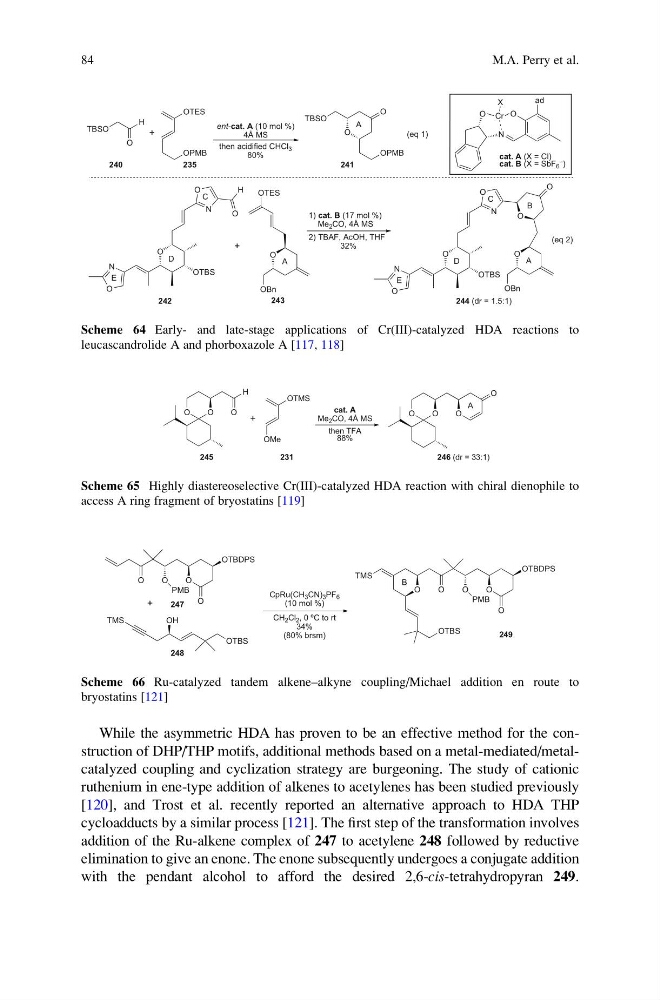
While the asymmetric HDA has proven to be an effective method for the construction of DHP/THP motifs, additional methods based on a metal-mediated/metalcatalyzed coupling and cyclization strategy are burgeoning. The study of cationic
ruthenium in ene-type addition of alkenes to acetylenes has been studied previously
[120], and Trost et al. recently reported an alternative approach to HDA THP
cycloadducts by a similar process [121]. The first step of the transformation involves
addition of the Ru-alkene complex of 247 to acetylene 248 followed by reductive
elimination to give an enone. The enone subsequently undergoes a conjugate addition
with the pendant alcohol to afford the desired 2,6-cis-tetrahydropyran 249.
O
TBSO
OPMB
OTES
ent-cat. A (10 mol %)
4Å MS
then acidified CHCl 3
80%
O
O
OPMB
TBSO
+
1) cat. B (17 mol %)
Me 2 CO, 4Å MS
2) TBAF, AcOH, THF
32%
A
O
N
O
O
OTBS
OBn
O
N
O
D
A
B
C
E
O
O
N
O
O
OTBS
OBn
O
N
O
D
A
C
E
OTES
O Cr
N
O
ad
X
cat. A (X = Cl)
cat. B (X = SbF 6
– )
240
235
241
242
243
244 (dr = 1.5:1)
+
(eq 1)
(eq 2)
H
H
Scheme 64 Early- and late-stage applications of Cr(III)-catalyzed HDA reactions to
leucascandrolide A and phorboxazole A [117, 118]
O
O
O
OTMS
OMe
O
O
O
O
cat. A
Me 2 CO, 4Å MS
then TFA
88%
A
245
231
246 (dr = 33:1)
+
H
Scheme 65 Highly diastereoselective Cr(III)-catalyzed HDA reaction with chiral dienophile to
access A ring fragment of bryostatins [119]
OTBS
TMS
OH
O
O
O
O
OTBDPS
O
O
O
O
OTBDPS
O
TMS
OTBS
CpRu(CH 3 CN) 3 PF 6
(10 mol %)
CH 2 Cl 2 , 0 ºC to rt
34%
(80% brsm)
B
PMB
PMB
247
248
249
+
Scheme 66 Ru-catalyzed tandem alkene–alkyne coupling/Michael addition en route to
bryostatins [121]
84
M.A. Perry et al.
ruthenium in ene-type addition of alkenes to acetylenes has been studied previously
[120], and Trost et al. recently reported an alternative approach to HDA THP
cycloadducts by a similar process [121]. The first step of the transformation involves
addition of the Ru-alkene complex of 247 to acetylene 248 followed by reductive
elimination to give an enone. The enone subsequently undergoes a conjugate addition
with the pendant alcohol to afford the desired 2,6-cis-tetrahydropyran 249.
O
TBSO
OPMB
OTES
ent-cat. A (10 mol %)
4Å MS
then acidified CHCl 3
80%
O
O
OPMB
TBSO
+
1) cat. B (17 mol %)
Me 2 CO, 4Å MS
2) TBAF, AcOH, THF
32%
A
O
N
O
O
OTBS
OBn
O
N
O
D
A
B
C
E
O
O
N
O
O
OTBS
OBn
O
N
O
D
A
C
E
OTES
O Cr
N
O
ad
X
cat. A (X = Cl)
cat. B (X = SbF 6
– )
240
235
241
242
243
244 (dr = 1.5:1)
+
(eq 1)
(eq 2)
H
H
Scheme 64 Early- and late-stage applications of Cr(III)-catalyzed HDA reactions to
leucascandrolide A and phorboxazole A [117, 118]
O
O
O
OTMS
OMe
O
O
O
O
cat. A
Me 2 CO, 4Å MS
then TFA
88%
A
245
231
246 (dr = 33:1)
+
H
Scheme 65 Highly diastereoselective Cr(III)-catalyzed HDA reaction with chiral dienophile to
access A ring fragment of bryostatins [119]
OTBS
TMS
OH
O
O
O
O
OTBDPS
O
O
O
O
OTBDPS
O
TMS
OTBS
CpRu(CH 3 CN) 3 PF 6
(10 mol %)
CH 2 Cl 2 , 0 ºC to rt
34%
(80% brsm)
B
PMB
PMB
247
248
249
+
Scheme 66 Ru-catalyzed tandem alkene–alkyne coupling/Michael addition en route to
bryostatins [121]
84
M.A. Perry et al.