

5.1 Hetero-Diels–Alder (HDA) Reactions
Danishefsky’s diene [114] has found use in DHP synthesis but is limited by the loss
of stereochemistry from formation of the enone double bond. In the absence of
chirality, the Lewis acid-activated HDA reaction of 230 and 231 leads to
(Æ)-dihydropyrone 232 as reported in Greer and Donaldson’s synthesis of
phorboxazole A (Scheme 62, Eq. 1) [106]. This particular method is useful for
subsequent DHP elaboration (e.g., conjugate addition regioselective α-substitution
of the enone) but fails to capitalize on the ability of the HDA reaction to install
multiple stereogenic centers in a convergent, stereoselective fashion. Similarly,
Yamamura et al. reported the use of enantioenriched aldehyde 233 and diene 231
provided the B ring of bryostatin 3 in good yield (72 %) and high enantioselectivity
(ee > 90 %) (Scheme 62, Eq. 2) [115].
Chiral acetonides and siloxydienes allow for the synthesis of 2,6-cis THP rings.
Cink and Forsyth reported a convergent HDA in the synthesis of phorboxazole A
(Scheme 63, Eq. 1) [37]. Use of ent-233 with diene 235 followed by cleavage of the
resultant silyl enol ether provided the desired tetrahydropyrone 236 as the major
diastereomer (dr ¼ 16:4:1) in 60 % yield over two steps. Burke and coworkers later
capitalized on this strategy in the synthesis of the bryostatin 1 B ring (Scheme 63,
Eq. 2) [116]. Subjecting chiral acetonide 237 and the complex diene 238 to Lewis
acidic conditions provided the 2,6-cis DHP 239 in 67 % yield with a dr of 15:4:1.
The desired major product was easily separated and taken forward to the natural
product. This complex example shows the utility and functional group compatibility of the HDA reaction.
Chiral Lewis acid-catalyzed HDA reactions have found application in the asymmetric synthesis of THP-containing natural products. Chiral chromium complexes,
especially the adamantyl-Cr(III) complexes discovered by Jacobsen et al., have been
applied to the use of unactivated aldehyde dienophiles with various diene partners
[111]. Paterson and coworkers employed this variation in the synthesis of
O
R"
O
R
Normal
R'
R or R' = EDG
R
R"
R'
endo-226
exo-226
+
O
R"
O
O
Inverse
R = EWG
R
R"
R
R"
R'
endo-229
exo-229
+
R
R" = EDG
R'
R'
O
R"
R
R'
H
O
H
R
R'
R"
O
H
R'
R
R"
O
R"
R'
R
H
227
224
225
228
3
6
1
2
3
6
‡
‡
‡
‡
TS-A
TS-B
TS-C
TS-D
O
R
R"
R'
1
2
3
6
(eq 1)
(eq 2)
1
2
H
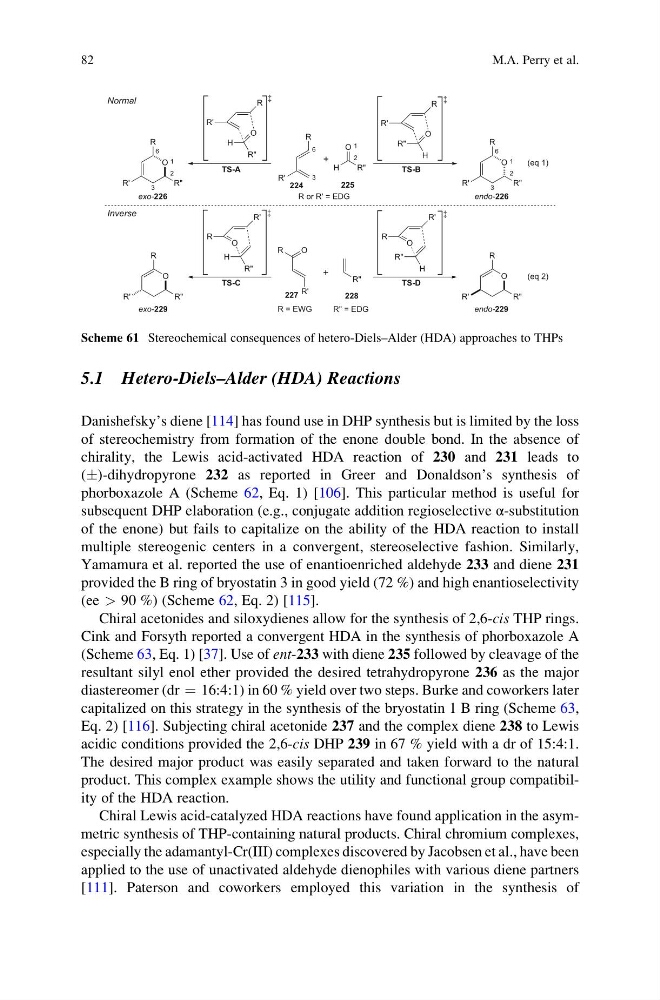
Scheme 61 Stereochemical consequences of hetero-Diels–Alder (HDA) approaches to THPs
82
M.A. Perry et al.
Danishefsky’s diene [114] has found use in DHP synthesis but is limited by the loss
of stereochemistry from formation of the enone double bond. In the absence of
chirality, the Lewis acid-activated HDA reaction of 230 and 231 leads to
(Æ)-dihydropyrone 232 as reported in Greer and Donaldson’s synthesis of
phorboxazole A (Scheme 62, Eq. 1) [106]. This particular method is useful for
subsequent DHP elaboration (e.g., conjugate addition regioselective α-substitution
of the enone) but fails to capitalize on the ability of the HDA reaction to install
multiple stereogenic centers in a convergent, stereoselective fashion. Similarly,
Yamamura et al. reported the use of enantioenriched aldehyde 233 and diene 231
provided the B ring of bryostatin 3 in good yield (72 %) and high enantioselectivity
(ee > 90 %) (Scheme 62, Eq. 2) [115].
Chiral acetonides and siloxydienes allow for the synthesis of 2,6-cis THP rings.
Cink and Forsyth reported a convergent HDA in the synthesis of phorboxazole A
(Scheme 63, Eq. 1) [37]. Use of ent-233 with diene 235 followed by cleavage of the
resultant silyl enol ether provided the desired tetrahydropyrone 236 as the major
diastereomer (dr ¼ 16:4:1) in 60 % yield over two steps. Burke and coworkers later
capitalized on this strategy in the synthesis of the bryostatin 1 B ring (Scheme 63,
Eq. 2) [116]. Subjecting chiral acetonide 237 and the complex diene 238 to Lewis
acidic conditions provided the 2,6-cis DHP 239 in 67 % yield with a dr of 15:4:1.
The desired major product was easily separated and taken forward to the natural
product. This complex example shows the utility and functional group compatibility of the HDA reaction.
Chiral Lewis acid-catalyzed HDA reactions have found application in the asymmetric synthesis of THP-containing natural products. Chiral chromium complexes,
especially the adamantyl-Cr(III) complexes discovered by Jacobsen et al., have been
applied to the use of unactivated aldehyde dienophiles with various diene partners
[111]. Paterson and coworkers employed this variation in the synthesis of
O
R"
O
R
Normal
R'
R or R' = EDG
R
R"
R'
endo-226
exo-226
+
O
R"
O
O
Inverse
R = EWG
R
R"
R
R"
R'
endo-229
exo-229
+
R
R" = EDG
R'
R'
O
R"
R
R'
H
O
H
R
R'
R"
O
H
R'
R
R"
O
R"
R'
R
H
227
224
225
228
3
6
1
2
3
6
‡
‡
‡
‡
TS-A
TS-B
TS-C
TS-D
O
R
R"
R'
1
2
3
6
(eq 1)
(eq 2)
1
2
H
Scheme 61 Stereochemical consequences of hetero-Diels–Alder (HDA) approaches to THPs
82
M.A. Perry et al.