

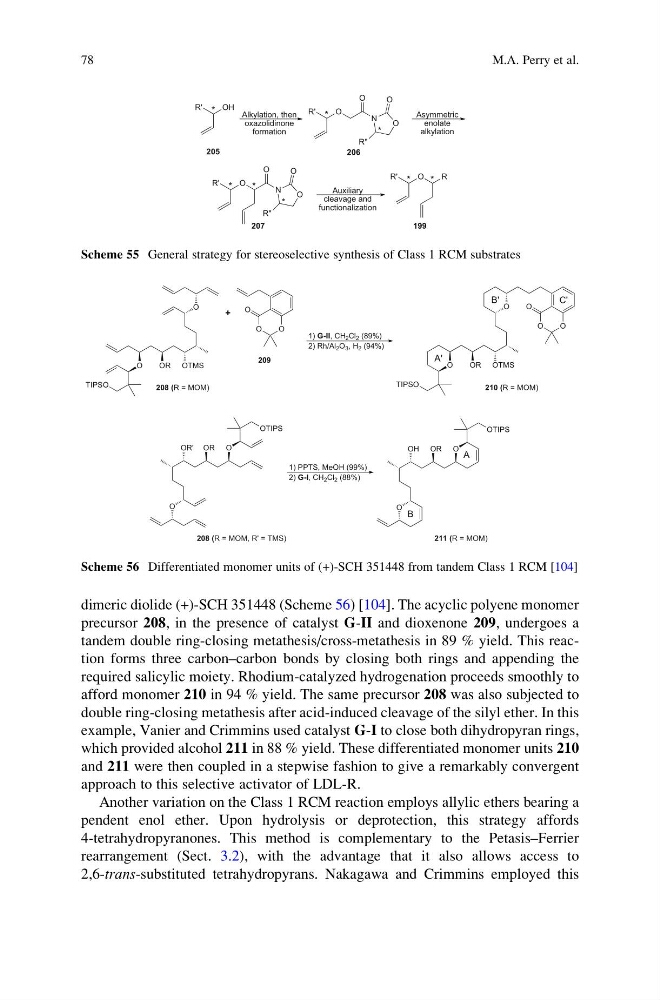
dimeric diolide (+)-SCH 351448 (Scheme 56) [104]. The acyclic polyene monomer
precursor 208, in the presence of catalyst G-II and dioxenone 209, undergoes a
tandem double ring-closing metathesis/cross-metathesis in 89 % yield. This reaction forms three carbon–carbon bonds by closing both rings and appending the
required salicylic moiety. Rhodium-catalyzed hydrogenation proceeds smoothly to
afford monomer 210 in 94 % yield. The same precursor 208 was also subjected to
double ring-closing metathesis after acid-induced cleavage of the silyl ether. In this
example, Vanier and Crimmins used catalyst G-I to close both dihydropyran rings,
which provided alcohol 211 in 88 % yield. These differentiated monomer units 210
and 211 were then coupled in a stepwise fashion to give a remarkably convergent
approach to this selective activator of LDL-R.
Another variation on the Class 1 RCM reaction employs allylic ethers bearing a
pendent enol ether. Upon hydrolysis or deprotection, this strategy affords
4-tetrahydropyranones. This method is complementary to the Petasis–Ferrier
rearrangement (Sect. 3.2), with the advantage that it also allows access to
2,6-trans-substituted tetrahydropyrans. Nakagawa and Crimmins employed this
R'
OH
*
R'
O
*
O
N
O
O
R"
*
R'
O
*
O
N
O
O
R"
*
R'
O
*
R
*
Alkylation, then
oxazolidinone
formation
Asymmetric
enolate
alkylation
Auxiliary
cleavage and
functionalization
*
205
206
207
199
Scheme 55 General strategy for stereoselective synthesis of Class 1 RCM substrates
O
OTMS
OR
O
TIPSO
O
OTMS
OR
O
TIPSO
1) G-II, CH 2 Cl 2 (89%)
O
O
O
O
O
O
+
O
OH OR O
OTIPS
O
OR' OR O
OTIPS
1) PPTS, MeOH (99%)
208 (R = MOM)
209
A'
B'
C'
A
B
2) Rh/Al 2 O 3 , H 2 (94%)
2) G-I, CH 2 Cl 2 (88%)
210 (R = MOM)
208 (R = MOM, R' = TMS)
211 (R = MOM)
Scheme 56 Differentiated monomer units of (+)-SCH 351448 from tandem Class 1 RCM [104]
78
M.A. Perry et al.
precursor 208, in the presence of catalyst G-II and dioxenone 209, undergoes a
tandem double ring-closing metathesis/cross-metathesis in 89 % yield. This reaction forms three carbon–carbon bonds by closing both rings and appending the
required salicylic moiety. Rhodium-catalyzed hydrogenation proceeds smoothly to
afford monomer 210 in 94 % yield. The same precursor 208 was also subjected to
double ring-closing metathesis after acid-induced cleavage of the silyl ether. In this
example, Vanier and Crimmins used catalyst G-I to close both dihydropyran rings,
which provided alcohol 211 in 88 % yield. These differentiated monomer units 210
and 211 were then coupled in a stepwise fashion to give a remarkably convergent
approach to this selective activator of LDL-R.
Another variation on the Class 1 RCM reaction employs allylic ethers bearing a
pendent enol ether. Upon hydrolysis or deprotection, this strategy affords
4-tetrahydropyranones. This method is complementary to the Petasis–Ferrier
rearrangement (Sect. 3.2), with the advantage that it also allows access to
2,6-trans-substituted tetrahydropyrans. Nakagawa and Crimmins employed this
R'
OH
*
R'
O
*
O
N
O
O
R"
*
R'
O
*
O
N
O
O
R"
*
R'
O
*
R
*
Alkylation, then
oxazolidinone
formation
Asymmetric
enolate
alkylation
Auxiliary
cleavage and
functionalization
*
205
206
207
199
Scheme 55 General strategy for stereoselective synthesis of Class 1 RCM substrates
O
OTMS
OR
O
TIPSO
O
OTMS
OR
O
TIPSO
1) G-II, CH 2 Cl 2 (89%)
O
O
O
O
O
O
+
O
OH OR O
OTIPS
O
OR' OR O
OTIPS
1) PPTS, MeOH (99%)
208 (R = MOM)
209
A'
B'
C'
A
B
2) Rh/Al 2 O 3 , H 2 (94%)
2) G-I, CH 2 Cl 2 (88%)
210 (R = MOM)
208 (R = MOM, R' = TMS)
211 (R = MOM)
Scheme 56 Differentiated monomer units of (+)-SCH 351448 from tandem Class 1 RCM [104]
78
M.A. Perry et al.