

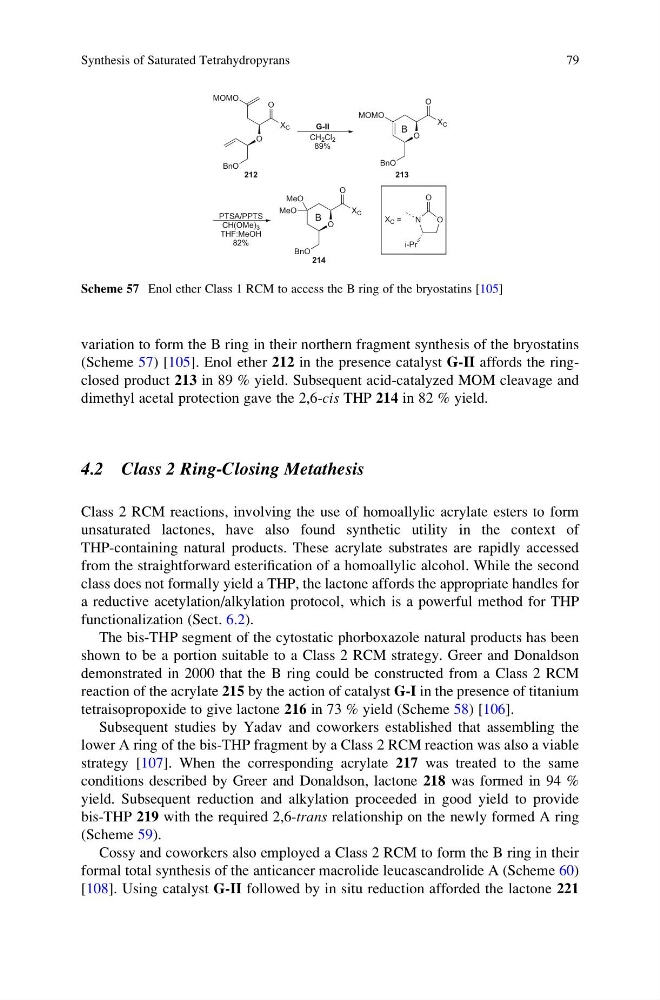
variation to form the B ring in their northern fragment synthesis of the bryostatins
(Scheme 57) [105]. Enol ether 212 in the presence catalyst G-II affords the ringclosed product 213 in 89 % yield. Subsequent acid-catalyzed MOM cleavage and
dimethyl acetal protection gave the 2,6-cis THP 214 in 82 % yield.
4.2 Class 2 Ring-Closing Metathesis
Class 2 RCM reactions, involving the use of homoallylic acrylate esters to form
unsaturated lactones, have also found synthetic utility in the context of
THP-containing natural products. These acrylate substrates are rapidly accessed
from the straightforward esterification of a homoallylic alcohol. While the second
class does not formally yield a THP, the lactone affords the appropriate handles for
a reductive acetylation/alkylation protocol, which is a powerful method for THP
functionalization (Sect. 6.2).
The bis-THP segment of the cytostatic phorboxazole natural products has been
shown to be a portion suitable to a Class 2 RCM strategy. Greer and Donaldson
demonstrated in 2000 that the B ring could be constructed from a Class 2 RCM
reaction of the acrylate 215 by the action of catalyst G-I in the presence of titanium
tetraisopropoxide to give lactone 216 in 73 % yield (Scheme 58) [106].
Subsequent studies by Yadav and coworkers established that assembling the
lower A ring of the bis-THP fragment by a Class 2 RCM reaction was also a viable
strategy [107]. When the corresponding acrylate 217 was treated to the same
conditions described by Greer and Donaldson, lactone 218 was formed in 94 %
yield. Subsequent reduction and alkylation proceeded in good yield to provide
bis-THP 219 with the required 2,6-trans relationship on the newly formed A ring
(Scheme 59).
Cossy and coworkers also employed a Class 2 RCM to form the B ring in their
formal total synthesis of the anticancer macrolide leucascandrolide A (Scheme 60)
[108]. Using catalyst G-II followed by in situ reduction afforded the lactone 221
O
X C
O
BnO
MOMO
O
X C
O
BnO
MOMO
O
N
O
i-Pr
CH 2 Cl 2
89%
X C =
B
O
X C
O
BnO
MeO
MeO
B
PTSA/PPTS
CH(OMe) 3
THF:MeOH
82%
212
213
214
G-II
Scheme 57 Enol ether Class 1 RCM to access the B ring of the bryostatins [105]
Synthesis of Saturated Tetrahydropyrans
79
(Scheme 57) [105]. Enol ether 212 in the presence catalyst G-II affords the ringclosed product 213 in 89 % yield. Subsequent acid-catalyzed MOM cleavage and
dimethyl acetal protection gave the 2,6-cis THP 214 in 82 % yield.
4.2 Class 2 Ring-Closing Metathesis
Class 2 RCM reactions, involving the use of homoallylic acrylate esters to form
unsaturated lactones, have also found synthetic utility in the context of
THP-containing natural products. These acrylate substrates are rapidly accessed
from the straightforward esterification of a homoallylic alcohol. While the second
class does not formally yield a THP, the lactone affords the appropriate handles for
a reductive acetylation/alkylation protocol, which is a powerful method for THP
functionalization (Sect. 6.2).
The bis-THP segment of the cytostatic phorboxazole natural products has been
shown to be a portion suitable to a Class 2 RCM strategy. Greer and Donaldson
demonstrated in 2000 that the B ring could be constructed from a Class 2 RCM
reaction of the acrylate 215 by the action of catalyst G-I in the presence of titanium
tetraisopropoxide to give lactone 216 in 73 % yield (Scheme 58) [106].
Subsequent studies by Yadav and coworkers established that assembling the
lower A ring of the bis-THP fragment by a Class 2 RCM reaction was also a viable
strategy [107]. When the corresponding acrylate 217 was treated to the same
conditions described by Greer and Donaldson, lactone 218 was formed in 94 %
yield. Subsequent reduction and alkylation proceeded in good yield to provide
bis-THP 219 with the required 2,6-trans relationship on the newly formed A ring
(Scheme 59).
Cossy and coworkers also employed a Class 2 RCM to form the B ring in their
formal total synthesis of the anticancer macrolide leucascandrolide A (Scheme 60)
[108]. Using catalyst G-II followed by in situ reduction afforded the lactone 221
O
X C
O
BnO
MOMO
O
X C
O
BnO
MOMO
O
N
O
i-Pr
CH 2 Cl 2
89%
X C =
B
O
X C
O
BnO
MeO
MeO
B
PTSA/PPTS
CH(OMe) 3
THF:MeOH
82%
212
213
214
G-II
Scheme 57 Enol ether Class 1 RCM to access the B ring of the bryostatins [105]
Synthesis of Saturated Tetrahydropyrans
79