

4.1 Class 1 Ring-Closing Metathesis
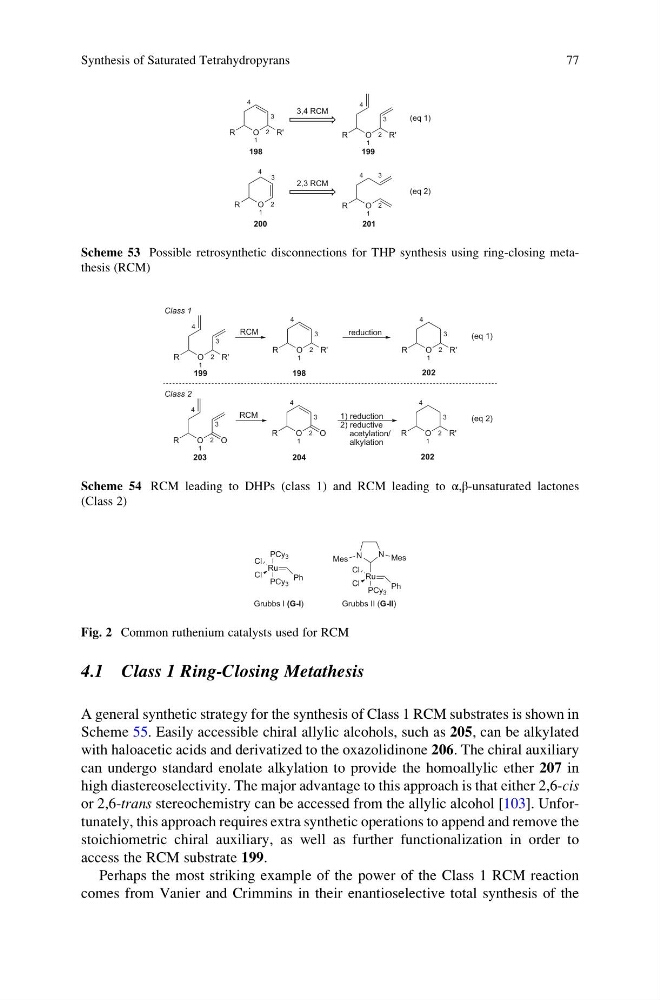
A general synthetic strategy for the synthesis of Class 1 RCM substrates is shown in
Scheme 55. Easily accessible chiral allylic alcohols, such as 205, can be alkylated
with haloacetic acids and derivatized to the oxazolidinone 206. The chiral auxiliary
can undergo standard enolate alkylation to provide the homoallylic ether 207 in
high diastereoselectivity. The major advantage to this approach is that either 2,6-cis
or 2,6-trans stereochemistry can be accessed from the allylic alcohol [103]. Unfortunately, this approach requires extra synthetic operations to append and remove the
stoichiometric chiral auxiliary, as well as further functionalization in order to
access the RCM substrate 199.
Perhaps the most striking example of the power of the Class 1 RCM reaction
comes from Vanier and Crimmins in their enantioselective total synthesis of the
R
O
O
1
2
3
4
RCM
R
O
O
1
2
3
4
1) reduction
2) reductive
acetylation/
alkylation
R
O
1
2
3
4
R'
R
O
R'
1
2
3
4
RCM
R
O
R'
1
2
3
4
reduction
R
O
1
2
3
4
R'
Class 1
Class 2
199
198
202
203
204
202
(eq 1)
(eq 2)
Scheme 54 RCM leading to DHPs (class 1) and RCM leading to α,β-unsaturated lactones
(Class 2)
PCy 3
Ru
PCy 3
Cl
Cl
Ph
N
N
Ru
Mes
Mes
PCy 3
Cl
Cl
Ph
Grubbs I (G-I)
G r u b b s I I ( G-II)
Fig. 2 Common ruthenium catalysts used for RCM
R
O
1
2
3
4
2,3 RCM
R
O
1
2
3
4
R
O
R'
1
2
3
4
3,4 RCM
R
O
R'
1
2
3
4
198
199
200
201
(eq 1)
(eq 2)
Scheme 53 Possible retrosynthetic disconnections for THP synthesis using ring-closing metathesis (RCM)
Synthesis of Saturated Tetrahydropyrans
77
A general synthetic strategy for the synthesis of Class 1 RCM substrates is shown in
Scheme 55. Easily accessible chiral allylic alcohols, such as 205, can be alkylated
with haloacetic acids and derivatized to the oxazolidinone 206. The chiral auxiliary
can undergo standard enolate alkylation to provide the homoallylic ether 207 in
high diastereoselectivity. The major advantage to this approach is that either 2,6-cis
or 2,6-trans stereochemistry can be accessed from the allylic alcohol [103]. Unfortunately, this approach requires extra synthetic operations to append and remove the
stoichiometric chiral auxiliary, as well as further functionalization in order to
access the RCM substrate 199.
Perhaps the most striking example of the power of the Class 1 RCM reaction
comes from Vanier and Crimmins in their enantioselective total synthesis of the
R
O
O
1
2
3
4
RCM
R
O
O
1
2
3
4
1) reduction
2) reductive
acetylation/
alkylation
R
O
1
2
3
4
R'
R
O
R'
1
2
3
4
RCM
R
O
R'
1
2
3
4
reduction
R
O
1
2
3
4
R'
Class 1
Class 2
199
198
202
203
204
202
(eq 1)
(eq 2)
Scheme 54 RCM leading to DHPs (class 1) and RCM leading to α,β-unsaturated lactones
(Class 2)
PCy 3
Ru
PCy 3
Cl
Cl
Ph
N
N
Ru
Mes
Mes
PCy 3
Cl
Cl
Ph
Grubbs I (G-I)
G r u b b s I I ( G-II)
Fig. 2 Common ruthenium catalysts used for RCM
R
O
1
2
3
4
2,3 RCM
R
O
1
2
3
4
R
O
R'
1
2
3
4
3,4 RCM
R
O
R'
1
2
3
4
198
199
200
201
(eq 1)
(eq 2)
Scheme 53 Possible retrosynthetic disconnections for THP synthesis using ring-closing metathesis (RCM)
Synthesis of Saturated Tetrahydropyrans
77