

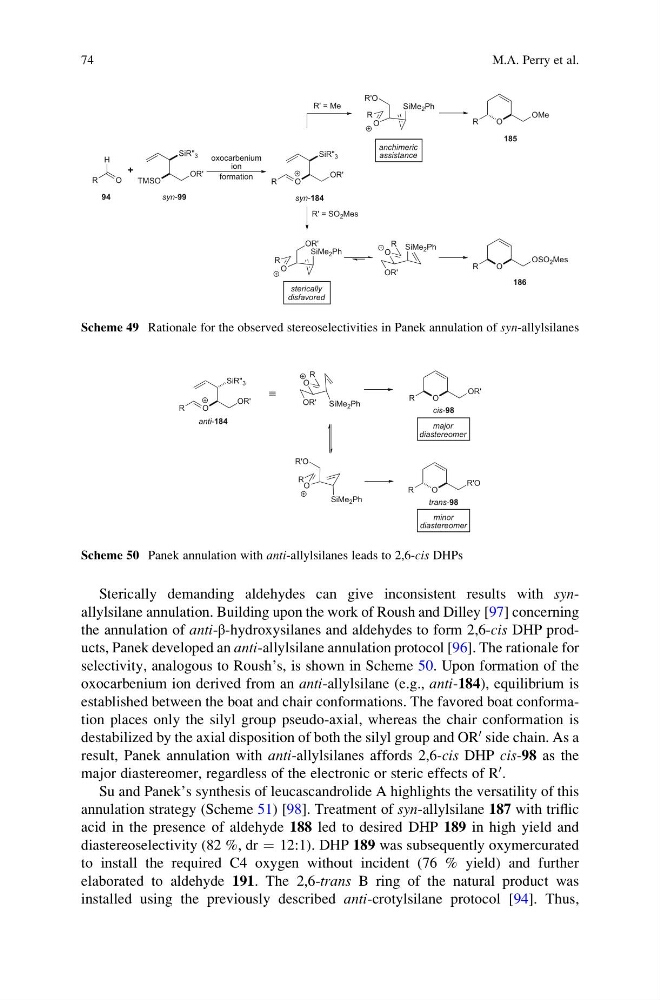
Sterically demanding aldehydes can give inconsistent results with synallylsilane annulation. Building upon the work of Roush and Dilley [97] concerning
the annulation of anti-β-hydroxysilanes and aldehydes to form 2,6-cis DHP products, Panek developed an anti-allylsilane annulation protocol [96]. The rationale for
selectivity, analogous to Roush’s, is shown in Scheme 50. Upon formation of the
oxocarbenium ion derived from an anti-allylsilane (e.g., anti-184), equilibrium is
established between the boat and chair conformations. The favored boat conformation places only the silyl group pseudo-axial, whereas the chair conformation is
destabilized by the axial disposition of both the silyl group and OR
0 side chain. As a
result, Panek annulation with anti-allylsilanes affords 2,6-cis DHP cis-98 as the
major diastereomer, regardless of the electronic or steric effects of R
0 .
Su and Panek’s synthesis of leucascandrolide A highlights the versatility of this
annulation strategy (Scheme 51) [98]. Treatment of syn-allylsilane 187 with triflic
acid in the presence of aldehyde 188 led to desired DHP 189 in high yield and
diastereoselectivity (82 %, dr ¼ 12:1). DHP 189 was subsequently oxymercurated
to install the required C4 oxygen without incident (76 % yield) and further
elaborated to aldehyde 191. The 2,6-trans B ring of the natural product was
installed using the previously described anti-crotylsilane protocol [94]. Thus,
O
R
OR'
SiMe 2 Ph
O
R
R'O
SiMe 2 Ph
O
R
SiMe 2 Ph
OR'
oxocarbenium
ion
formation
O
R
OR'
SiR" 3
O
R
OMe
O
R
OSO 2 Mes
anchimeric
assistance
sterically
disfavored
R' = Me
R' = SO 2 Mes
185
186
syn-184
TMSO
OR'
SiR" 3
O
R
+
94
syn-99
H
Scheme 49 Rationale for the observed stereoselectivities in Panek annulation of syn-allylsilanes
O
R
OR'
SiR" 3
O
R
OR'
O
R
R'O
major
diastereomer
O
O
R
OR'
SiMe 2 Ph
SiMe 2 Ph
R
R'O
minor
diastereomer
anti-184
º
cis-98
trans-98
Scheme 50 Panek annulation with anti-allylsilanes leads to 2,6-cis DHPs
74
M.A. Perry et al.
the annulation of anti-β-hydroxysilanes and aldehydes to form 2,6-cis DHP products, Panek developed an anti-allylsilane annulation protocol [96]. The rationale for
selectivity, analogous to Roush’s, is shown in Scheme 50. Upon formation of the
oxocarbenium ion derived from an anti-allylsilane (e.g., anti-184), equilibrium is
established between the boat and chair conformations. The favored boat conformation places only the silyl group pseudo-axial, whereas the chair conformation is
destabilized by the axial disposition of both the silyl group and OR
0 side chain. As a
result, Panek annulation with anti-allylsilanes affords 2,6-cis DHP cis-98 as the
major diastereomer, regardless of the electronic or steric effects of R
0 .
Su and Panek’s synthesis of leucascandrolide A highlights the versatility of this
annulation strategy (Scheme 51) [98]. Treatment of syn-allylsilane 187 with triflic
acid in the presence of aldehyde 188 led to desired DHP 189 in high yield and
diastereoselectivity (82 %, dr ¼ 12:1). DHP 189 was subsequently oxymercurated
to install the required C4 oxygen without incident (76 % yield) and further
elaborated to aldehyde 191. The 2,6-trans B ring of the natural product was
installed using the previously described anti-crotylsilane protocol [94]. Thus,
O
R
OR'
SiMe 2 Ph
O
R
R'O
SiMe 2 Ph
O
R
SiMe 2 Ph
OR'
oxocarbenium
ion
formation
O
R
OR'
SiR" 3
O
R
OMe
O
R
OSO 2 Mes
anchimeric
assistance
sterically
disfavored
R' = Me
R' = SO 2 Mes
185
186
syn-184
TMSO
OR'
SiR" 3
O
R
+
94
syn-99
H
Scheme 49 Rationale for the observed stereoselectivities in Panek annulation of syn-allylsilanes
O
R
OR'
SiR" 3
O
R
OR'
O
R
R'O
major
diastereomer
O
O
R
OR'
SiMe 2 Ph
SiMe 2 Ph
R
R'O
minor
diastereomer
anti-184
º
cis-98
trans-98
Scheme 50 Panek annulation with anti-allylsilanes leads to 2,6-cis DHPs
74
M.A. Perry et al.