

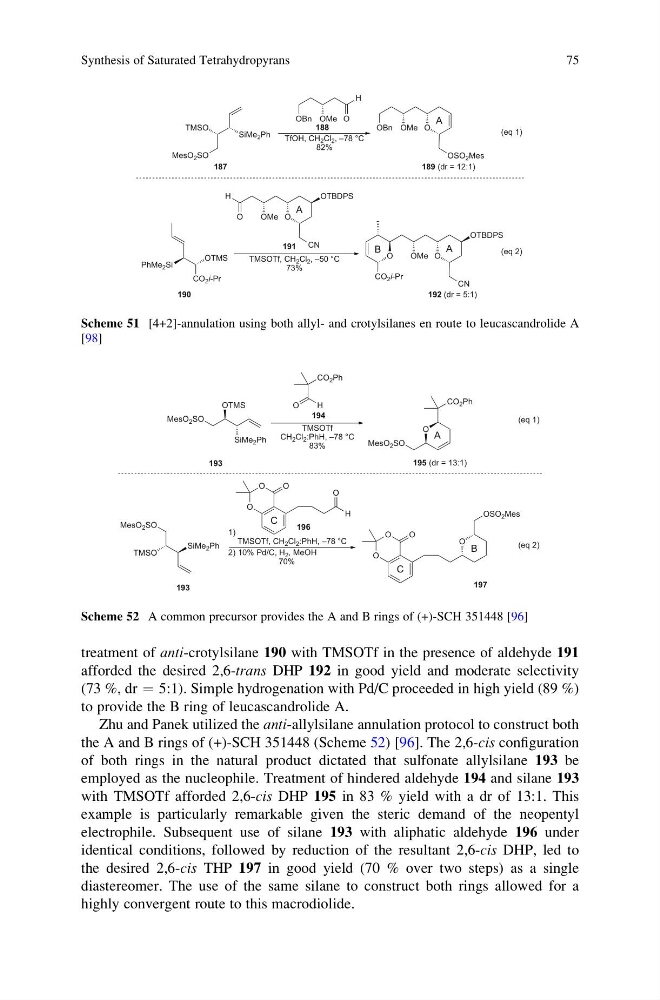
treatment of anti-crotylsilane 190 with TMSOTf in the presence of aldehyde 191
afforded the desired 2,6-trans DHP 192 in good yield and moderate selectivity
(73 %, dr ¼ 5:1). Simple hydrogenation with Pd/C proceeded in high yield (89 %)
to provide the B ring of leucascandrolide A.
Zhu and Panek utilized the anti-allylsilane annulation protocol to construct both
the A and B rings of (+)-SCH 351448 (Scheme 52) [96]. The 2,6-cis configuration
of both rings in the natural product dictated that sulfonate allylsilane 193 be
employed as the nucleophile. Treatment of hindered aldehyde 194 and silane 193
with TMSOTf afforded 2,6-cis DHP 195 in 83 % yield with a dr of 13:1. This
example is particularly remarkable given the steric demand of the neopentyl
electrophile. Subsequent use of silane 193 with aliphatic aldehyde 196 under
identical conditions, followed by reduction of the resultant 2,6-cis DHP, led to
the desired 2,6-cis THP 197 in good yield (70 % over two steps) as a single
diastereomer. The use of the same silane to construct both rings allowed for a
highly convergent route to this macrodiolide.
O
OMe O
OTBDPS
A
B
CN
CO 2 i-Pr
MesO 2 SO
TMSO
SiMe 2 Ph
187
O
OMe O
OTBDPS
A
CN
OBn OMe O
A
OSO 2 Mes
OBn OMe O
TfOH, CH 2 Cl 2 , –78 °C
82%
188
189 (dr = 12:1)
PhMe 2 Si
CO 2 i-Pr
OTMS
TMSOTf, CH 2 Cl 2 , –50 °C
73%
191
190
192 (dr = 5:1)
(eq 1)
(eq 2)
H
H
Scheme 51 [4+2]-annulation using both allyl- and crotylsilanes en route to leucascandrolide A
[98]
MesO 2 SO
O
CO 2 Ph
A
O
CO 2 Ph
TMSOTf
CH 2 Cl 2 :PhH, –78 °C
83%
MesO 2 SO
OTMS
SiMe 2 Ph
O
O
O
O
C
O
O
O
O
B
C
OSO 2 Mes
MesO 2 SO
TMSO
SiMe 2 Ph
1)
TMSOTf, CH 2 Cl 2 :PhH, –78 °C
2) 10% Pd/C, H 2 , MeOH
70%
193
194
195 (dr = 13:1)
193
196
197
(eq 1)
(eq 2)
H
H
Scheme 52 A common precursor provides the A and B rings of (+)-SCH 351448 [96]
Synthesis of Saturated Tetrahydropyrans
75
afforded the desired 2,6-trans DHP 192 in good yield and moderate selectivity
(73 %, dr ¼ 5:1). Simple hydrogenation with Pd/C proceeded in high yield (89 %)
to provide the B ring of leucascandrolide A.
Zhu and Panek utilized the anti-allylsilane annulation protocol to construct both
the A and B rings of (+)-SCH 351448 (Scheme 52) [96]. The 2,6-cis configuration
of both rings in the natural product dictated that sulfonate allylsilane 193 be
employed as the nucleophile. Treatment of hindered aldehyde 194 and silane 193
with TMSOTf afforded 2,6-cis DHP 195 in 83 % yield with a dr of 13:1. This
example is particularly remarkable given the steric demand of the neopentyl
electrophile. Subsequent use of silane 193 with aliphatic aldehyde 196 under
identical conditions, followed by reduction of the resultant 2,6-cis DHP, led to
the desired 2,6-cis THP 197 in good yield (70 % over two steps) as a single
diastereomer. The use of the same silane to construct both rings allowed for a
highly convergent route to this macrodiolide.
O
OMe O
OTBDPS
A
B
CN
CO 2 i-Pr
MesO 2 SO
TMSO
SiMe 2 Ph
187
O
OMe O
OTBDPS
A
CN
OBn OMe O
A
OSO 2 Mes
OBn OMe O
TfOH, CH 2 Cl 2 , –78 °C
82%
188
189 (dr = 12:1)
PhMe 2 Si
CO 2 i-Pr
OTMS
TMSOTf, CH 2 Cl 2 , –50 °C
73%
191
190
192 (dr = 5:1)
(eq 1)
(eq 2)
H
H
Scheme 51 [4+2]-annulation using both allyl- and crotylsilanes en route to leucascandrolide A
[98]
MesO 2 SO
O
CO 2 Ph
A
O
CO 2 Ph
TMSOTf
CH 2 Cl 2 :PhH, –78 °C
83%
MesO 2 SO
OTMS
SiMe 2 Ph
O
O
O
O
C
O
O
O
O
B
C
OSO 2 Mes
MesO 2 SO
TMSO
SiMe 2 Ph
1)
TMSOTf, CH 2 Cl 2 :PhH, –78 °C
2) 10% Pd/C, H 2 , MeOH
70%
193
194
195 (dr = 13:1)
193
196
197
(eq 1)
(eq 2)
H
H
Scheme 52 A common precursor provides the A and B rings of (+)-SCH 351448 [96]
Synthesis of Saturated Tetrahydropyrans
75