

rearrangement occurred in excellent yield (99 %) to afford ketone 181. This product
was further elaborated to the 2,3,5,6-tetrasubstituted THP by substrate-controlled
stereoselective lithium enolate alkylation with methyl iodide to set the 3,5-trans
relationship.
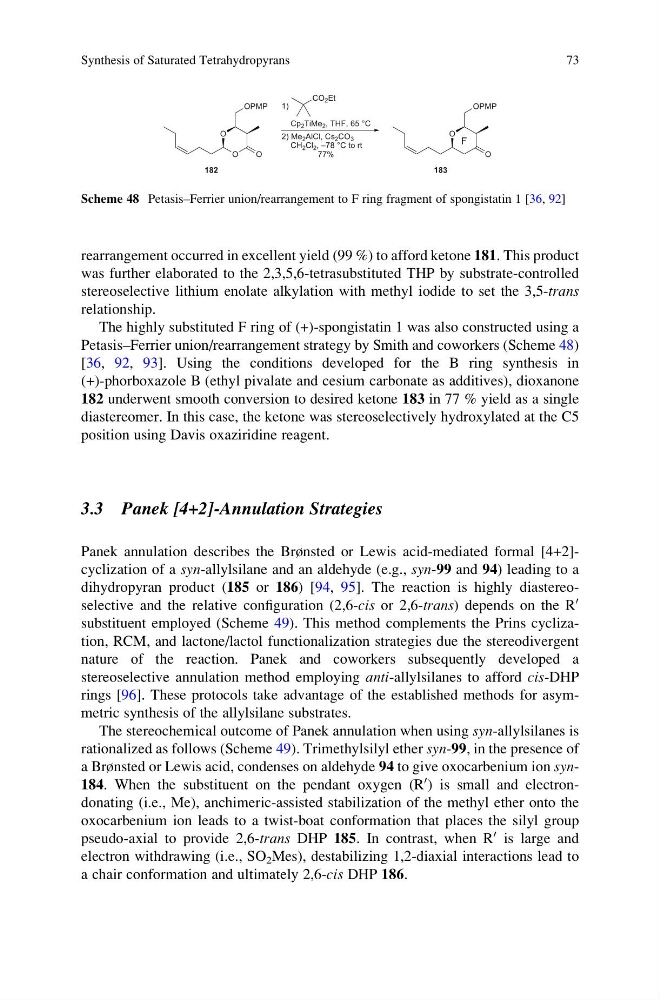
The highly substituted F ring of (+)-spongistatin 1 was also constructed using a
Petasis–Ferrier union/rearrangement strategy by Smith and coworkers (Scheme 48)
[36, 92, 93]. Using the conditions developed for the B ring synthesis in
(+)-phorboxazole B (ethyl pivalate and cesium carbonate as additives), dioxanone
182 underwent smooth conversion to desired ketone 183 in 77 % yield as a single
diastereomer. In this case, the ketone was stereoselectively hydroxylated at the C5
position using Davis oxaziridine reagent.
3.3 Panek [4+2]-Annulation Strategies
Panek annulation describes the Brønsted or Lewis acid-mediated formal [4+2]cyclization of a syn-allylsilane and an aldehyde (e.g., syn-99 and 94) leading to a
dihydropyran product (185 or 186) [94, 95]. The reaction is highly diastereoselective and the relative configuration (2,6-cis or 2,6-trans) depends on the R
0
substituent employed (Scheme 49). This method complements the Prins cyclization, RCM, and lactone/lactol functionalization strategies due the stereodivergent
nature of the reaction. Panek and coworkers subsequently developed a
stereoselective annulation method employing anti-allylsilanes to afford cis-DHP
rings [96]. These protocols take advantage of the established methods for asymmetric synthesis of the allylsilane substrates.
The stereochemical outcome of Panek annulation when using syn-allylsilanes is
rationalized as follows (Scheme 49). Trimethylsilyl ether syn-99, in the presence of
a Brønsted or Lewis acid, condenses on aldehyde 94 to give oxocarbenium ion syn184. When the substituent on the pendant oxygen (R
0 ) is small and electrondonating (i.e., Me), anchimeric-assisted stabilization of the methyl ether onto the
oxocarbenium ion leads to a twist-boat conformation that places the silyl group
pseudo-axial to provide 2,6-trans DHP 185. In contrast, when R
0 is large and
electron withdrawing (i.e., SO 2 Mes), destabilizing 1,2-diaxial interactions lead to
a chair conformation and ultimately 2,6-cis DHP 186.
O
O
O
OPMP
O
O
F
OPMP
1)
Cp 2 TiMe 2 , THF, 65 °C
2) Me 2 AlCl, Cs 2 CO 3
CH 2 Cl 2 , –78 °C to rt
77%
CO 2 Et
182
183
Scheme 48 Petasis–Ferrier union/rearrangement to F ring fragment of spongistatin 1 [36, 92]
Synthesis of Saturated Tetrahydropyrans
73
was further elaborated to the 2,3,5,6-tetrasubstituted THP by substrate-controlled
stereoselective lithium enolate alkylation with methyl iodide to set the 3,5-trans
relationship.
The highly substituted F ring of (+)-spongistatin 1 was also constructed using a
Petasis–Ferrier union/rearrangement strategy by Smith and coworkers (Scheme 48)
[36, 92, 93]. Using the conditions developed for the B ring synthesis in
(+)-phorboxazole B (ethyl pivalate and cesium carbonate as additives), dioxanone
182 underwent smooth conversion to desired ketone 183 in 77 % yield as a single
diastereomer. In this case, the ketone was stereoselectively hydroxylated at the C5
position using Davis oxaziridine reagent.
3.3 Panek [4+2]-Annulation Strategies
Panek annulation describes the Brønsted or Lewis acid-mediated formal [4+2]cyclization of a syn-allylsilane and an aldehyde (e.g., syn-99 and 94) leading to a
dihydropyran product (185 or 186) [94, 95]. The reaction is highly diastereoselective and the relative configuration (2,6-cis or 2,6-trans) depends on the R
0
substituent employed (Scheme 49). This method complements the Prins cyclization, RCM, and lactone/lactol functionalization strategies due the stereodivergent
nature of the reaction. Panek and coworkers subsequently developed a
stereoselective annulation method employing anti-allylsilanes to afford cis-DHP
rings [96]. These protocols take advantage of the established methods for asymmetric synthesis of the allylsilane substrates.
The stereochemical outcome of Panek annulation when using syn-allylsilanes is
rationalized as follows (Scheme 49). Trimethylsilyl ether syn-99, in the presence of
a Brønsted or Lewis acid, condenses on aldehyde 94 to give oxocarbenium ion syn184. When the substituent on the pendant oxygen (R
0 ) is small and electrondonating (i.e., Me), anchimeric-assisted stabilization of the methyl ether onto the
oxocarbenium ion leads to a twist-boat conformation that places the silyl group
pseudo-axial to provide 2,6-trans DHP 185. In contrast, when R
0 is large and
electron withdrawing (i.e., SO 2 Mes), destabilizing 1,2-diaxial interactions lead to
a chair conformation and ultimately 2,6-cis DHP 186.
O
O
O
OPMP
O
O
F
OPMP
1)
Cp 2 TiMe 2 , THF, 65 °C
2) Me 2 AlCl, Cs 2 CO 3
CH 2 Cl 2 , –78 °C to rt
77%
CO 2 Et
182
183
Scheme 48 Petasis–Ferrier union/rearrangement to F ring fragment of spongistatin 1 [36, 92]
Synthesis of Saturated Tetrahydropyrans
73