

and D rings) and (+)-spongistatin 2 (the F ring). The resulting ketone moiety on the
THP ring allows for subsequent functionalization by standard enolate chemistries.
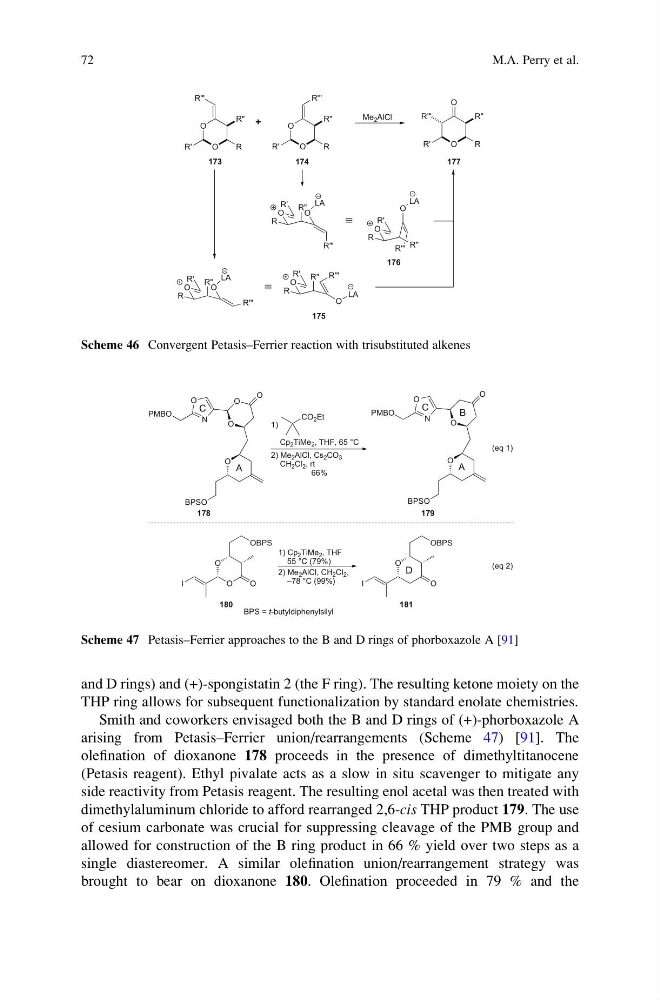
Smith and coworkers envisaged both the B and D rings of (+)-phorboxazole A
arising from Petasis–Ferrier union/rearrangements (Scheme 47) [91]. The
olefination of dioxanone 178 proceeds in the presence of dimethyltitanocene
(Petasis reagent). Ethyl pivalate acts as a slow in situ scavenger to mitigate any
side reactivity from Petasis reagent. The resulting enol acetal was then treated with
dimethylaluminum chloride to afford rearranged 2,6-cis THP product 179. The use
of cesium carbonate was crucial for suppressing cleavage of the PMB group and
allowed for construction of the B ring product in 66 % yield over two steps as a
single diastereomer. A similar olefination union/rearrangement strategy was
brought to bear on dioxanone 180. Olefination proceeded in 79 % and the
O
R
R'
O
R"
O
R
R'
O
R"
R'"
R'"
O
R
R'
O
R"
R'"
O
O
R'
R
O
R'
R
O
LA
LA
º
R"
R'"
R" R'"
O
O
R'
R
LA
º
R"
R'"
O
R'
R
R"
O
R'"
LA
+
Me 2 AlCl
173
174
177
175
176
Scheme 46 Convergent Petasis–Ferrier reaction with trisubstituted alkenes
N
O
O
O
O
A
C
PMBO
BPSO
O
1)
Cp 2 TiMe 2 , THF, 65 °C
2) Me 2 AlCl, Cs 2 CO 3
CH 2 Cl 2 , rt
66%
CO 2 Et
N
O
O
O
A
B
C
PMBO
BPSO
O
O
O
D
OBPS
I
O
O
O
OBPS
I
1) Cp 2 TiMe 2 , THF
55 °C (79%)
2) Me 2 AlCl, CH 2 Cl 2 ,
–78 °C (99%)
178
179
180
181
(eq 1)
(eq 2)
BPS = t-butyldiphenylsilyl
Scheme 47 Petasis–Ferrier approaches to the B and D rings of phorboxazole A [91]
72
M.A. Perry et al.
THP ring allows for subsequent functionalization by standard enolate chemistries.
Smith and coworkers envisaged both the B and D rings of (+)-phorboxazole A
arising from Petasis–Ferrier union/rearrangements (Scheme 47) [91]. The
olefination of dioxanone 178 proceeds in the presence of dimethyltitanocene
(Petasis reagent). Ethyl pivalate acts as a slow in situ scavenger to mitigate any
side reactivity from Petasis reagent. The resulting enol acetal was then treated with
dimethylaluminum chloride to afford rearranged 2,6-cis THP product 179. The use
of cesium carbonate was crucial for suppressing cleavage of the PMB group and
allowed for construction of the B ring product in 66 % yield over two steps as a
single diastereomer. A similar olefination union/rearrangement strategy was
brought to bear on dioxanone 180. Olefination proceeded in 79 % and the
O
R
R'
O
R"
O
R
R'
O
R"
R'"
R'"
O
R
R'
O
R"
R'"
O
O
R'
R
O
R'
R
O
LA
LA
º
R"
R'"
R" R'"
O
O
R'
R
LA
º
R"
R'"
O
R'
R
R"
O
R'"
LA
+
Me 2 AlCl
173
174
177
175
176
Scheme 46 Convergent Petasis–Ferrier reaction with trisubstituted alkenes
N
O
O
O
O
A
C
PMBO
BPSO
O
1)
Cp 2 TiMe 2 , THF, 65 °C
2) Me 2 AlCl, Cs 2 CO 3
CH 2 Cl 2 , rt
66%
CO 2 Et
N
O
O
O
A
B
C
PMBO
BPSO
O
O
O
D
OBPS
I
O
O
O
OBPS
I
1) Cp 2 TiMe 2 , THF
55 °C (79%)
2) Me 2 AlCl, CH 2 Cl 2 ,
–78 °C (99%)
178
179
180
181
(eq 1)
(eq 2)
BPS = t-butyldiphenylsilyl
Scheme 47 Petasis–Ferrier approaches to the B and D rings of phorboxazole A [91]
72
M.A. Perry et al.