

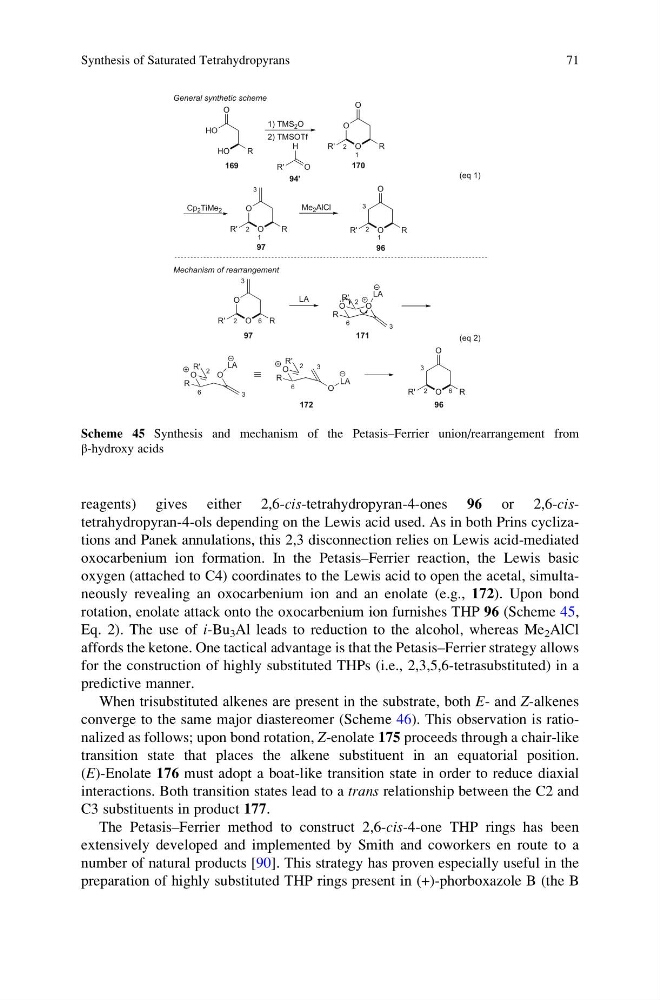
reagents) gives either 2,6-cis-tetrahydropyran-4-ones 96 or 2,6-cistetrahydropyran-4-ols depending on the Lewis acid used. As in both Prins cyclizations and Panek annulations, this 2,3 disconnection relies on Lewis acid-mediated
oxocarbenium ion formation. In the Petasis–Ferrier reaction, the Lewis basic
oxygen (attached to C4) coordinates to the Lewis acid to open the acetal, simultaneously revealing an oxocarbenium ion and an enolate (e.g., 172). Upon bond
rotation, enolate attack onto the oxocarbenium ion furnishes THP 96 (Scheme 45,
Eq. 2). The use of i-Bu 3 Al leads to reduction to the alcohol, whereas Me 2 AlCl
affords the ketone. One tactical advantage is that the Petasis–Ferrier strategy allows
for the construction of highly substituted THPs (i.e., 2,3,5,6-tetrasubstituted) in a
predictive manner.
When trisubstituted alkenes are present in the substrate, both E- and Z-alkenes
converge to the same major diastereomer (Scheme 46). This observation is rationalized as follows; upon bond rotation, Z-enolate 175 proceeds through a chair-like
transition state that places the alkene substituent in an equatorial position.
(E)-Enolate 176 must adopt a boat-like transition state in order to reduce diaxial
interactions. Both transition states lead to a trans relationship between the C2 and
C3 substituents in product 177.
The Petasis–Ferrier method to construct 2,6-cis-4-one THP rings has been
extensively developed and implemented by Smith and coworkers en route to a
number of natural products [90]. This strategy has proven especially useful in the
preparation of highly substituted THP rings present in (+)-phorboxazole B (the B
HO
R
HO
O
1) TMS 2 O
2) TMSOTf
O
R'
O
R
R'
1
2
O
O
Cp 2 TiMe 2
O
R
R'
1
2
O
3
O
R
R'
1
2
3
O
Me 2 AlCl
O
R
R'
6
2
O
3
O
R
R'
3
O
LA
O
O
R
R'
LA
O
O
R'
R
O
R'
R
O
LA
LA
º
2
3
6
2
3
6
2
3
6
6
2
169
170
97
96
97
171
172
96
General synthetic scheme
Mechanism of rearrangement
94'
(eq 1)
(eq 2)
H
Scheme 45 Synthesis and mechanism of the Petasis–Ferrier union/rearrangement from
β-hydroxy acids
Synthesis of Saturated Tetrahydropyrans
71
oxocarbenium ion formation. In the Petasis–Ferrier reaction, the Lewis basic
oxygen (attached to C4) coordinates to the Lewis acid to open the acetal, simultaneously revealing an oxocarbenium ion and an enolate (e.g., 172). Upon bond
rotation, enolate attack onto the oxocarbenium ion furnishes THP 96 (Scheme 45,
Eq. 2). The use of i-Bu 3 Al leads to reduction to the alcohol, whereas Me 2 AlCl
affords the ketone. One tactical advantage is that the Petasis–Ferrier strategy allows
for the construction of highly substituted THPs (i.e., 2,3,5,6-tetrasubstituted) in a
predictive manner.
When trisubstituted alkenes are present in the substrate, both E- and Z-alkenes
converge to the same major diastereomer (Scheme 46). This observation is rationalized as follows; upon bond rotation, Z-enolate 175 proceeds through a chair-like
transition state that places the alkene substituent in an equatorial position.
(E)-Enolate 176 must adopt a boat-like transition state in order to reduce diaxial
interactions. Both transition states lead to a trans relationship between the C2 and
C3 substituents in product 177.
The Petasis–Ferrier method to construct 2,6-cis-4-one THP rings has been
extensively developed and implemented by Smith and coworkers en route to a
number of natural products [90]. This strategy has proven especially useful in the
preparation of highly substituted THP rings present in (+)-phorboxazole B (the B
HO
R
HO
O
1) TMS 2 O
2) TMSOTf
O
R'
O
R
R'
1
2
O
O
Cp 2 TiMe 2
O
R
R'
1
2
O
3
O
R
R'
1
2
3
O
Me 2 AlCl
O
R
R'
6
2
O
3
O
R
R'
3
O
LA
O
O
R
R'
LA
O
O
R'
R
O
R'
R
O
LA
LA
º
2
3
6
2
3
6
2
3
6
6
2
169
170
97
96
97
171
172
96
General synthetic scheme
Mechanism of rearrangement
94'
(eq 1)
(eq 2)
H
Scheme 45 Synthesis and mechanism of the Petasis–Ferrier union/rearrangement from
β-hydroxy acids
Synthesis of Saturated Tetrahydropyrans
71