

TES-protected alcohol, which underwent Prins cyclization to form the B ring in
20-membered macrocycle 164 in 65 % yield. This advanced intermediate was
carried forward to bryostatin 9 in four synthetic steps. These convergent strategies
represent concise approaches to the bryostatin family of natural products and
highlight the utility of Prins cyclizations in complex settings.
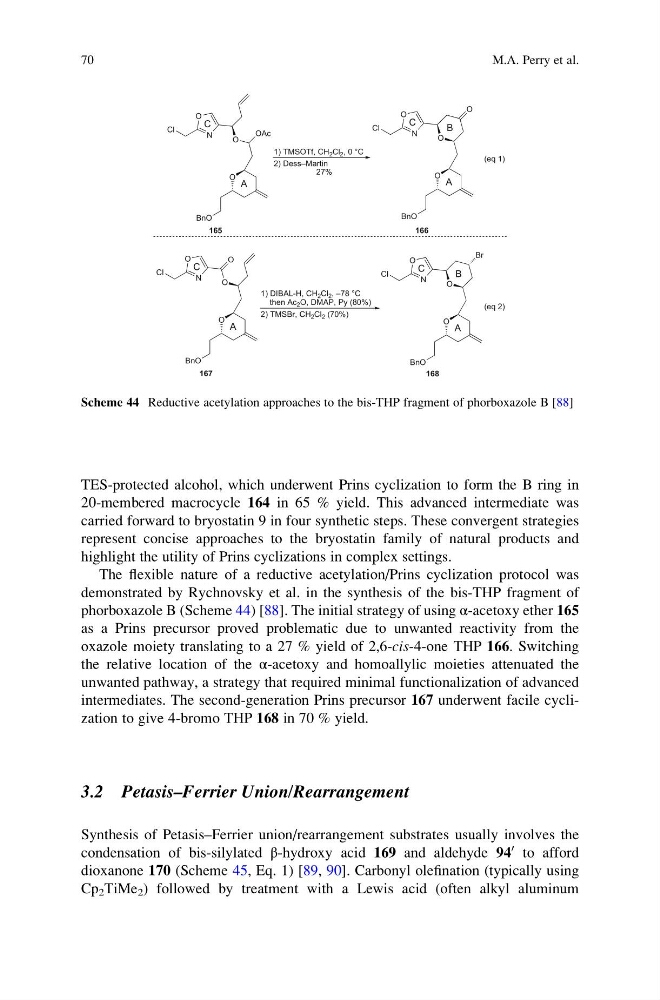
The flexible nature of a reductive acetylation/Prins cyclization protocol was
demonstrated by Rychnovsky et al. in the synthesis of the bis-THP fragment of
phorboxazole B (Scheme 44) [88]. The initial strategy of using α-acetoxy ether 165
as a Prins precursor proved problematic due to unwanted reactivity from the
oxazole moiety translating to a 27 % yield of 2,6-cis-4-one THP 166. Switching
the relative location of the α-acetoxy and homoallylic moieties attenuated the
unwanted pathway, a strategy that required minimal functionalization of advanced
intermediates. The second-generation Prins precursor 167 underwent facile cyclization to give 4-bromo THP 168 in 70 % yield.
3.2 Petasis–Ferrier Union/Rearrangement
Synthesis of Petasis–Ferrier union/rearrangement substrates usually involves the
condensation of bis-silylated β-hydroxy acid 169 and aldehyde 94
0 to afford
dioxanone 170 (Scheme 45, Eq. 1) [89, 90]. Carbonyl olefination (typically using
Cp 2 TiMe 2 ) followed by treatment with a Lewis acid (often alkyl aluminum
N
O
O
BnO
O
A
B
C
Cl
O
N
O
O
OAc
BnO
O
A
C
Cl
N
O
O
O
BnO
O
A
C
Cl
N
O
O
BnO
O
A
B
C
Cl
Br
1) TMSOTf, CH 2 Cl 2 , 0 °C
2) Dess–Martin
27%
1) DIBAL-H, CH 2 Cl 2 , –78 °C
then Ac 2 O, DMAP, Py (80%)
2) TMSBr, CH 2 Cl 2 (70%)
165
166
167
168
(eq 1)
(eq 2)
Scheme 44 Reductive acetylation approaches to the bis-THP fragment of phorboxazole B [88]
70
M.A. Perry et al.
20-membered macrocycle 164 in 65 % yield. This advanced intermediate was
carried forward to bryostatin 9 in four synthetic steps. These convergent strategies
represent concise approaches to the bryostatin family of natural products and
highlight the utility of Prins cyclizations in complex settings.
The flexible nature of a reductive acetylation/Prins cyclization protocol was
demonstrated by Rychnovsky et al. in the synthesis of the bis-THP fragment of
phorboxazole B (Scheme 44) [88]. The initial strategy of using α-acetoxy ether 165
as a Prins precursor proved problematic due to unwanted reactivity from the
oxazole moiety translating to a 27 % yield of 2,6-cis-4-one THP 166. Switching
the relative location of the α-acetoxy and homoallylic moieties attenuated the
unwanted pathway, a strategy that required minimal functionalization of advanced
intermediates. The second-generation Prins precursor 167 underwent facile cyclization to give 4-bromo THP 168 in 70 % yield.
3.2 Petasis–Ferrier Union/Rearrangement
Synthesis of Petasis–Ferrier union/rearrangement substrates usually involves the
condensation of bis-silylated β-hydroxy acid 169 and aldehyde 94
0 to afford
dioxanone 170 (Scheme 45, Eq. 1) [89, 90]. Carbonyl olefination (typically using
Cp 2 TiMe 2 ) followed by treatment with a Lewis acid (often alkyl aluminum
N
O
O
BnO
O
A
B
C
Cl
O
N
O
O
OAc
BnO
O
A
C
Cl
N
O
O
O
BnO
O
A
C
Cl
N
O
O
BnO
O
A
B
C
Cl
Br
1) TMSOTf, CH 2 Cl 2 , 0 °C
2) Dess–Martin
27%
1) DIBAL-H, CH 2 Cl 2 , –78 °C
then Ac 2 O, DMAP, Py (80%)
2) TMSBr, CH 2 Cl 2 (70%)
165
166
167
168
(eq 1)
(eq 2)
Scheme 44 Reductive acetylation approaches to the bis-THP fragment of phorboxazole B [88]
70
M.A. Perry et al.