

occur with the use of benzylic homoallylic alcohols (Scheme 33, Eq. 2). In these
cases, solvolysis of benzylic alcohol (À)-109 leads to the formation of stable
benzylic carbocation 112 and loss of chiral information [67]. Electron-donating
aromatic groups are particularly problematic due to the increased stabilization of
the resultant carbocation. THP rings that are generated by Prins cyclization can also
undergo racemization through a sequence of equilibrating condensation, hydrolysis, and oxonia-Cope rearrangement pathways (Scheme 33, Eq. 3) [69]. The mechanism for racemization relies on an allyl transfer process. Alcohol (À)-115 can
condense with aldehyde 94 to generate oxocarbenium ion 116 with liberation of a
molecule of water. Oxocarbenium ion 116 can then undergo a 2-oxonia-Cope
rearrangement to afford oxocarbenium ion 117. Addition of water to oxocarbenium
ion 117 leads to a fragmentation process generating aldehyde 94
0 and alcohol (+)-118.
The formation of 94
0 now permits a symmetric 2-oxonia-Cope rearrangement to
occur. Alcohol (À)-115 can condense with aldehyde 94
0 , undergo a 2-oxonia-Cope
rearrangement, and fragment by addition of water to provide epimeric (+)-115.
Similarly, alcohol (+)-118 can react with aldehyde 94 to generate epimeric
(À)-118. This pathway is largely dictated by the reaction conditions such as solvent
and temperature. Structural features (e.g., electron-withdrawing groups, alkene substitution) can reduce the reversibility of the 2-oxonia-Cope rearrangement, thereby
eliminating racemization in the Prins cyclization.
R'
O
R
H
Nu
O
R
R'
Nu
O
R
R'
Nu
O
R
R'
Nu
Equatorial nucleophilic attack for dissociated ion pairs (i.e. SnBr 5 )
Axial nucleophilic attack for tight ions pairs (i.e. Br )
101
103
102
93
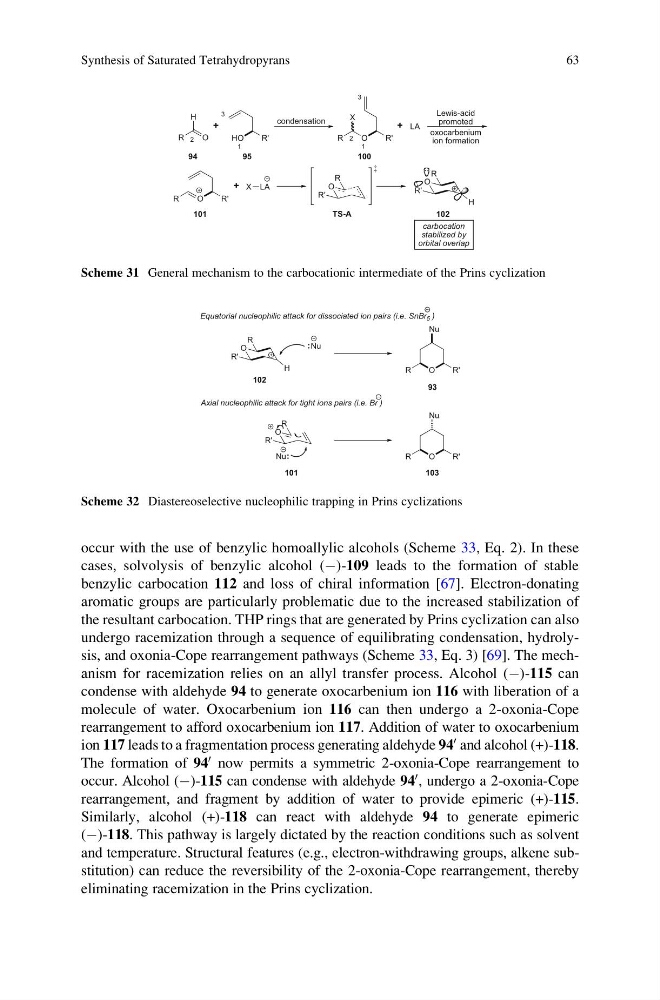
Scheme 32 Diastereoselective nucleophilic trapping in Prins cyclizations
R'
O
R'
Lewis-acid
promoted
oxocarbenium
ion formation
+ X LA
HO
R'
1
O
R
+
3
2
O
R'
R
+
1
2
X
LA
O
R
R'
O
R
H
carbocation
stabilized by
orbital overlap
R
3
condensation
101
94
95
100
102
TS-A
‡
H
Scheme 31 General mechanism to the carbocationic intermediate of the Prins cyclization
Synthesis of Saturated Tetrahydropyrans
63
cases, solvolysis of benzylic alcohol (À)-109 leads to the formation of stable
benzylic carbocation 112 and loss of chiral information [67]. Electron-donating
aromatic groups are particularly problematic due to the increased stabilization of
the resultant carbocation. THP rings that are generated by Prins cyclization can also
undergo racemization through a sequence of equilibrating condensation, hydrolysis, and oxonia-Cope rearrangement pathways (Scheme 33, Eq. 3) [69]. The mechanism for racemization relies on an allyl transfer process. Alcohol (À)-115 can
condense with aldehyde 94 to generate oxocarbenium ion 116 with liberation of a
molecule of water. Oxocarbenium ion 116 can then undergo a 2-oxonia-Cope
rearrangement to afford oxocarbenium ion 117. Addition of water to oxocarbenium
ion 117 leads to a fragmentation process generating aldehyde 94
0 and alcohol (+)-118.
The formation of 94
0 now permits a symmetric 2-oxonia-Cope rearrangement to
occur. Alcohol (À)-115 can condense with aldehyde 94
0 , undergo a 2-oxonia-Cope
rearrangement, and fragment by addition of water to provide epimeric (+)-115.
Similarly, alcohol (+)-118 can react with aldehyde 94 to generate epimeric
(À)-118. This pathway is largely dictated by the reaction conditions such as solvent
and temperature. Structural features (e.g., electron-withdrawing groups, alkene substitution) can reduce the reversibility of the 2-oxonia-Cope rearrangement, thereby
eliminating racemization in the Prins cyclization.
R'
O
R
H
Nu
O
R
R'
Nu
O
R
R'
Nu
O
R
R'
Nu
Equatorial nucleophilic attack for dissociated ion pairs (i.e. SnBr 5 )
Axial nucleophilic attack for tight ions pairs (i.e. Br )
101
103
102
93
Scheme 32 Diastereoselective nucleophilic trapping in Prins cyclizations
R'
O
R'
Lewis-acid
promoted
oxocarbenium
ion formation
+ X LA
HO
R'
1
O
R
+
3
2
O
R'
R
+
1
2
X
LA
O
R
R'
O
R
H
carbocation
stabilized by
orbital overlap
R
3
condensation
101
94
95
100
102
TS-A
‡
H
Scheme 31 General mechanism to the carbocationic intermediate of the Prins cyclization
Synthesis of Saturated Tetrahydropyrans
63