

3.1 Prins Cyclization Strategies
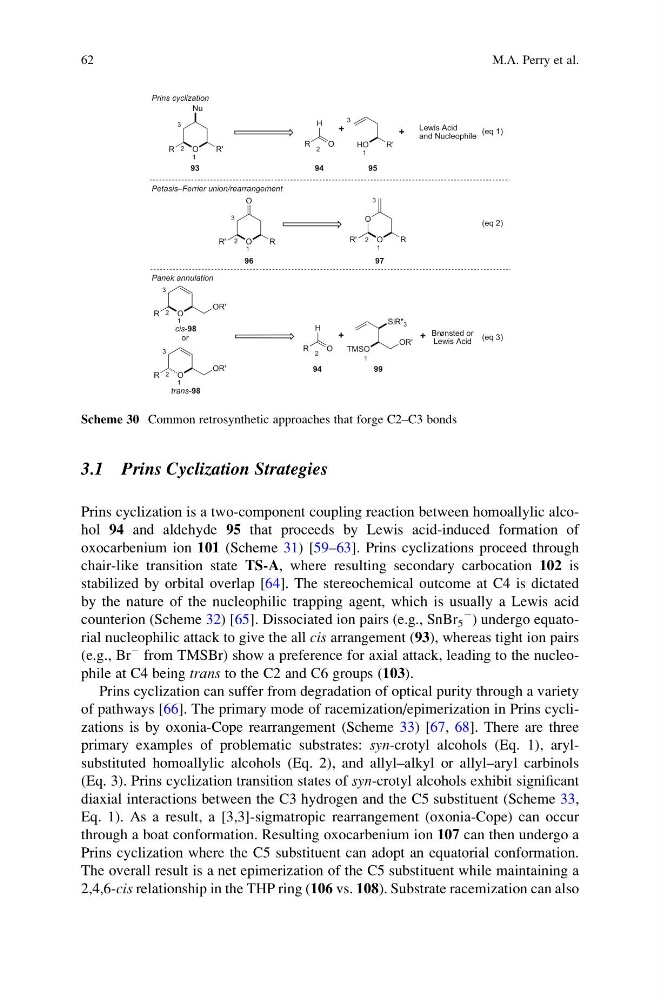
Prins cyclization is a two-component coupling reaction between homoallylic alcohol 94 and aldehyde 95 that proceeds by Lewis acid-induced formation of
oxocarbenium ion 101 (Scheme 31) [59–63]. Prins cyclizations proceed through
chair-like transition state TS-A, where resulting secondary carbocation 102 is
stabilized by orbital overlap [64]. The stereochemical outcome at C4 is dictated
by the nature of the nucleophilic trapping agent, which is usually a Lewis acid
counterion (Scheme 32) [65]. Dissociated ion pairs (e.g., SnBr 5
À ) undergo equatorial nucleophilic attack to give the all cis arrangement (93), whereas tight ion pairs
(e.g., Br
À from TMSBr) show a preference for axial attack, leading to the nucleophile at C4 being trans to the C2 and C6 groups (103).
Prins cyclization can suffer from degradation of optical purity through a variety
of pathways [66]. The primary mode of racemization/epimerization in Prins cyclizations is by oxonia-Cope rearrangement (Scheme 33) [67, 68]. There are three
primary examples of problematic substrates: syn-crotyl alcohols (Eq. 1), arylsubstituted homoallylic alcohols (Eq. 2), and allyl–alkyl or allyl–aryl carbinols
(Eq. 3). Prins cyclization transition states of syn-crotyl alcohols exhibit significant
diaxial interactions between the C3 hydrogen and the C5 substituent (Scheme 33,
Eq. 1). As a result, a [3,3]-sigmatropic rearrangement (oxonia-Cope) can occur
through a boat conformation. Resulting oxocarbenium ion 107 can then undergo a
Prins cyclization where the C5 substituent can adopt an equatorial conformation.
The overall result is a net epimerization of the C5 substituent while maintaining a
2,4,6-cis relationship in the THP ring (106 vs. 108). Substrate racemization can also
O
R'
R
HO
R'
Lewis Acid
and Nucleophile
+
1
2
1
O
R
+
3
2
Nu
3
O
R
R'
1
2
3
O
O
R
R'
1
2
O
3
93
94
95
96
97
O
1
2
3
Brønsted or
Lewis Acid
OR'
TMSO
1
OR'
SiR" 3
O
R 2
O
R
1
2
3
OR'
+
+
or
cis-98
trans-98
94
99
R
(eq 1)
(eq 2)
(eq 3)
Prins cyclization
Petasis–Ferrier union/rearrangement
Panek annulation
H
H
Scheme 30 Common retrosynthetic approaches that forge C2–C3 bonds
62
M.A. Perry et al.
Prins cyclization is a two-component coupling reaction between homoallylic alcohol 94 and aldehyde 95 that proceeds by Lewis acid-induced formation of
oxocarbenium ion 101 (Scheme 31) [59–63]. Prins cyclizations proceed through
chair-like transition state TS-A, where resulting secondary carbocation 102 is
stabilized by orbital overlap [64]. The stereochemical outcome at C4 is dictated
by the nature of the nucleophilic trapping agent, which is usually a Lewis acid
counterion (Scheme 32) [65]. Dissociated ion pairs (e.g., SnBr 5
À ) undergo equatorial nucleophilic attack to give the all cis arrangement (93), whereas tight ion pairs
(e.g., Br
À from TMSBr) show a preference for axial attack, leading to the nucleophile at C4 being trans to the C2 and C6 groups (103).
Prins cyclization can suffer from degradation of optical purity through a variety
of pathways [66]. The primary mode of racemization/epimerization in Prins cyclizations is by oxonia-Cope rearrangement (Scheme 33) [67, 68]. There are three
primary examples of problematic substrates: syn-crotyl alcohols (Eq. 1), arylsubstituted homoallylic alcohols (Eq. 2), and allyl–alkyl or allyl–aryl carbinols
(Eq. 3). Prins cyclization transition states of syn-crotyl alcohols exhibit significant
diaxial interactions between the C3 hydrogen and the C5 substituent (Scheme 33,
Eq. 1). As a result, a [3,3]-sigmatropic rearrangement (oxonia-Cope) can occur
through a boat conformation. Resulting oxocarbenium ion 107 can then undergo a
Prins cyclization where the C5 substituent can adopt an equatorial conformation.
The overall result is a net epimerization of the C5 substituent while maintaining a
2,4,6-cis relationship in the THP ring (106 vs. 108). Substrate racemization can also
O
R'
R
HO
R'
Lewis Acid
and Nucleophile
+
1
2
1
O
R
+
3
2
Nu
3
O
R
R'
1
2
3
O
O
R
R'
1
2
O
3
93
94
95
96
97
O
1
2
3
Brønsted or
Lewis Acid
OR'
TMSO
1
OR'
SiR" 3
O
R 2
O
R
1
2
3
OR'
+
+
or
cis-98
trans-98
94
99
R
(eq 1)
(eq 2)
(eq 3)
Prins cyclization
Petasis–Ferrier union/rearrangement
Panek annulation
H
H
Scheme 30 Common retrosynthetic approaches that forge C2–C3 bonds
62
M.A. Perry et al.