

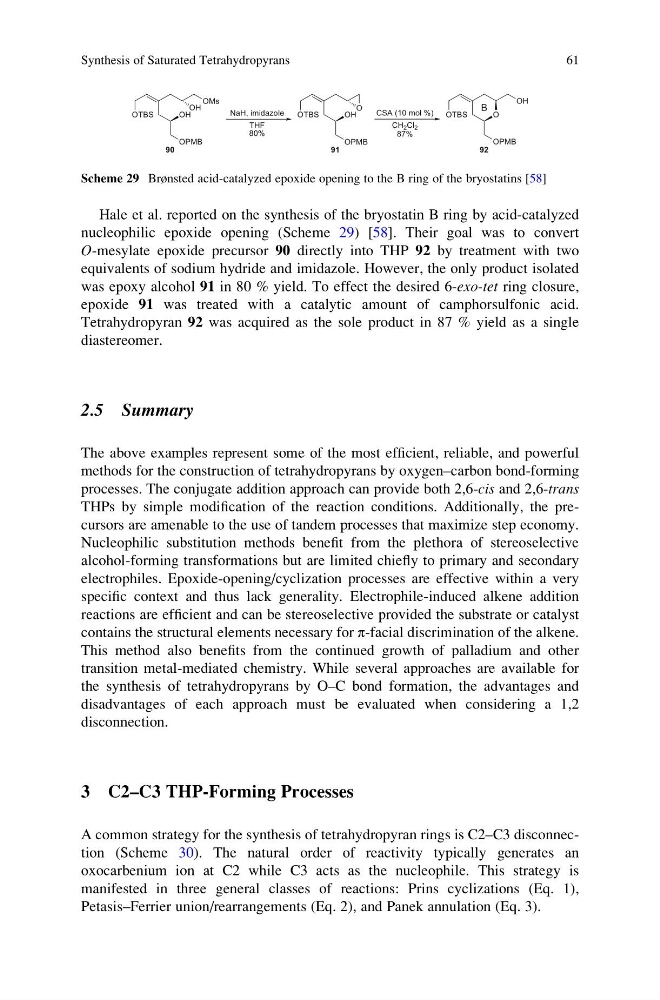
Hale et al. reported on the synthesis of the bryostatin B ring by acid-catalyzed
nucleophilic epoxide opening (Scheme 29) [58]. Their goal was to convert
O-mesylate epoxide precursor 90 directly into THP 92 by treatment with two
equivalents of sodium hydride and imidazole. However, the only product isolated
was epoxy alcohol 91 in 80 % yield. To effect the desired 6-exo-tet ring closure,
epoxide 91 was treated with a catalytic amount of camphorsulfonic acid.
Tetrahydropyran 92 was acquired as the sole product in 87 % yield as a single
diastereomer.
2.5 Summary
The above examples represent some of the most efficient, reliable, and powerful
methods for the construction of tetrahydropyrans by oxygen–carbon bond-forming
processes. The conjugate addition approach can provide both 2,6-cis and 2,6-trans
THPs by simple modification of the reaction conditions. Additionally, the precursors are amenable to the use of tandem processes that maximize step economy.
Nucleophilic substitution methods benefit from the plethora of stereoselective
alcohol-forming transformations but are limited chiefly to primary and secondary
electrophiles. Epoxide-opening/cyclization processes are effective within a very
specific context and thus lack generality. Electrophile-induced alkene addition
reactions are efficient and can be stereoselective provided the substrate or catalyst
contains the structural elements necessary for π-facial discrimination of the alkene.
This method also benefits from the continued growth of palladium and other
transition metal-mediated chemistry. While several approaches are available for
the synthesis of tetrahydropyrans by O–C bond formation, the advantages and
disadvantages of each approach must be evaluated when considering a 1,2
disconnection.
3 C2–C3 THP-Forming Processes
A common strategy for the synthesis of tetrahydropyran rings is C2–C3 disconnection (Scheme 30). The natural order of reactivity typically generates an
oxocarbenium ion at C2 while C3 acts as the nucleophile. This strategy is
manifested in three general classes of reactions: Prins cyclizations (Eq. 1),
Petasis–Ferrier union/rearrangements (Eq. 2), and Panek annulation (Eq. 3).
O
OH
B
OH
OPMB
O
OTBS
OTBS
OPMB
CSA (10 mol %)
CH 2 Cl 2
87%
OH
OPMB
OH
OTBS
NaH, imidazole
THF
80%
OMs
90
91
92
Scheme 29 Brønsted acid-catalyzed epoxide opening to the B ring of the bryostatins [58]
Synthesis of Saturated Tetrahydropyrans
61
nucleophilic epoxide opening (Scheme 29) [58]. Their goal was to convert
O-mesylate epoxide precursor 90 directly into THP 92 by treatment with two
equivalents of sodium hydride and imidazole. However, the only product isolated
was epoxy alcohol 91 in 80 % yield. To effect the desired 6-exo-tet ring closure,
epoxide 91 was treated with a catalytic amount of camphorsulfonic acid.
Tetrahydropyran 92 was acquired as the sole product in 87 % yield as a single
diastereomer.
2.5 Summary
The above examples represent some of the most efficient, reliable, and powerful
methods for the construction of tetrahydropyrans by oxygen–carbon bond-forming
processes. The conjugate addition approach can provide both 2,6-cis and 2,6-trans
THPs by simple modification of the reaction conditions. Additionally, the precursors are amenable to the use of tandem processes that maximize step economy.
Nucleophilic substitution methods benefit from the plethora of stereoselective
alcohol-forming transformations but are limited chiefly to primary and secondary
electrophiles. Epoxide-opening/cyclization processes are effective within a very
specific context and thus lack generality. Electrophile-induced alkene addition
reactions are efficient and can be stereoselective provided the substrate or catalyst
contains the structural elements necessary for π-facial discrimination of the alkene.
This method also benefits from the continued growth of palladium and other
transition metal-mediated chemistry. While several approaches are available for
the synthesis of tetrahydropyrans by O–C bond formation, the advantages and
disadvantages of each approach must be evaluated when considering a 1,2
disconnection.
3 C2–C3 THP-Forming Processes
A common strategy for the synthesis of tetrahydropyran rings is C2–C3 disconnection (Scheme 30). The natural order of reactivity typically generates an
oxocarbenium ion at C2 while C3 acts as the nucleophile. This strategy is
manifested in three general classes of reactions: Prins cyclizations (Eq. 1),
Petasis–Ferrier union/rearrangements (Eq. 2), and Panek annulation (Eq. 3).
O
OH
B
OH
OPMB
O
OTBS
OTBS
OPMB
CSA (10 mol %)
CH 2 Cl 2
87%
OH
OPMB
OH
OTBS
NaH, imidazole
THF
80%
OMs
90
91
92
Scheme 29 Brønsted acid-catalyzed epoxide opening to the B ring of the bryostatins [58]
Synthesis of Saturated Tetrahydropyrans
61