

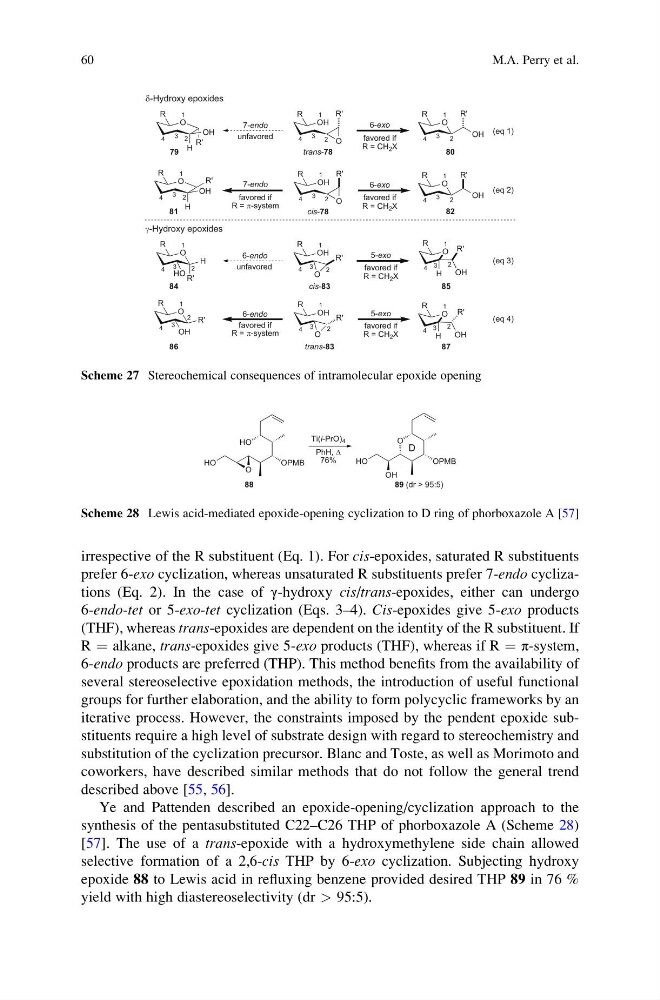
irrespective of the R substituent (Eq. 1). For cis-epoxides, saturated R substituents
prefer 6-exo cyclization, whereas unsaturated R substituents prefer 7-endo cyclizations (Eq. 2). In the case of γ-hydroxy cis/trans-epoxides, either can undergo
6-endo-tet or 5-exo-tet cyclization (Eqs. 3–4). Cis-epoxides give 5-exo products
(THF), whereas trans-epoxides are dependent on the identity of the R substituent. If
R ¼ alkane, trans-epoxides give 5-exo products (THF), whereas if R ¼ π-system,
6-endo products are preferred (THP). This method benefits from the availability of
several stereoselective epoxidation methods, the introduction of useful functional
groups for further elaboration, and the ability to form polycyclic frameworks by an
iterative process. However, the constraints imposed by the pendent epoxide substituents require a high level of substrate design with regard to stereochemistry and
substitution of the cyclization precursor. Blanc and Toste, as well as Morimoto and
coworkers, have described similar methods that do not follow the general trend
described above [55, 56].
Ye and Pattenden described an epoxide-opening/cyclization approach to the
synthesis of the pentasubstituted C22–C26 THP of phorboxazole A (Scheme 28)
[57]. The use of a trans-epoxide with a hydroxymethylene side chain allowed
selective formation of a 2,6-cis THP by 6-exo cyclization. Subjecting hydroxy
epoxide 88 to Lewis acid in refluxing benzene provided desired THP 89 in 76 %
yield with high diastereoselectivity (dr > 95:5).
O
OH
HO
OPMB
HO
HO
OPMB
O
Ti(i-PrO) 4
PhH, D
76%
88
89 (dr > 95:5)
D
Scheme 28 Lewis acid-mediated epoxide-opening cyclization to D ring of phorboxazole A [57]
1
2
3
4
OH
R
R'
1
2
3
4
OH
R
R'
1
2
3
4
O
R
OH
R'
O
O
d-Hydroxy epoxides
1
2
3
4
O
R
R'
OH
H
1
2
3
4
O
R
R'
OH
H
7-endo
7-endo
6-exo
6-exo
unfavored
favored if
R = p
p
-system
favored if
R = CH 2 X
favored if
R = CH 2 X
1
2
3
4
OH
R
R'
1
2
3
4
O
R
1
2
3
4
OH
R
R'
1
2
3
4
O
R
R'
g-Hydroxy epoxides
1
2
3
4
O
R
1
2
3
4
O
R
6-endo
6-endo
5-exo
5-exo
unfavored
favored if
R = -system
favored if
R = CH 2 X
favored if
R = CH 2 X
1
2
3
4
O
R
OH
R'
R'
OH
OH
R'
H
R'
O
O
OH
HO
H
H
trans-78
cis-78
79
81
80
82
cis-83
trans-83
85
87
84
86
(eq 1)
(eq 3)
(eq 2)
(eq 4)
Scheme 27 Stereochemical consequences of intramolecular epoxide opening
60
M.A. Perry et al.
prefer 6-exo cyclization, whereas unsaturated R substituents prefer 7-endo cyclizations (Eq. 2). In the case of γ-hydroxy cis/trans-epoxides, either can undergo
6-endo-tet or 5-exo-tet cyclization (Eqs. 3–4). Cis-epoxides give 5-exo products
(THF), whereas trans-epoxides are dependent on the identity of the R substituent. If
R ¼ alkane, trans-epoxides give 5-exo products (THF), whereas if R ¼ π-system,
6-endo products are preferred (THP). This method benefits from the availability of
several stereoselective epoxidation methods, the introduction of useful functional
groups for further elaboration, and the ability to form polycyclic frameworks by an
iterative process. However, the constraints imposed by the pendent epoxide substituents require a high level of substrate design with regard to stereochemistry and
substitution of the cyclization precursor. Blanc and Toste, as well as Morimoto and
coworkers, have described similar methods that do not follow the general trend
described above [55, 56].
Ye and Pattenden described an epoxide-opening/cyclization approach to the
synthesis of the pentasubstituted C22–C26 THP of phorboxazole A (Scheme 28)
[57]. The use of a trans-epoxide with a hydroxymethylene side chain allowed
selective formation of a 2,6-cis THP by 6-exo cyclization. Subjecting hydroxy
epoxide 88 to Lewis acid in refluxing benzene provided desired THP 89 in 76 %
yield with high diastereoselectivity (dr > 95:5).
O
OH
HO
OPMB
HO
HO
OPMB
O
Ti(i-PrO) 4
PhH, D
76%
88
89 (dr > 95:5)
D
Scheme 28 Lewis acid-mediated epoxide-opening cyclization to D ring of phorboxazole A [57]
1
2
3
4
OH
R
R'
1
2
3
4
OH
R
R'
1
2
3
4
O
R
OH
R'
O
O
d-Hydroxy epoxides
1
2
3
4
O
R
R'
OH
H
1
2
3
4
O
R
R'
OH
H
7-endo
7-endo
6-exo
6-exo
unfavored
favored if
R = p
p
-system
favored if
R = CH 2 X
favored if
R = CH 2 X
1
2
3
4
OH
R
R'
1
2
3
4
O
R
1
2
3
4
OH
R
R'
1
2
3
4
O
R
R'
g-Hydroxy epoxides
1
2
3
4
O
R
1
2
3
4
O
R
6-endo
6-endo
5-exo
5-exo
unfavored
favored if
R = -system
favored if
R = CH 2 X
favored if
R = CH 2 X
1
2
3
4
O
R
OH
R'
R'
OH
OH
R'
H
R'
O
O
OH
HO
H
H
trans-78
cis-78
79
81
80
82
cis-83
trans-83
85
87
84
86
(eq 1)
(eq 3)
(eq 2)
(eq 4)
Scheme 27 Stereochemical consequences of intramolecular epoxide opening
60
M.A. Perry et al.