

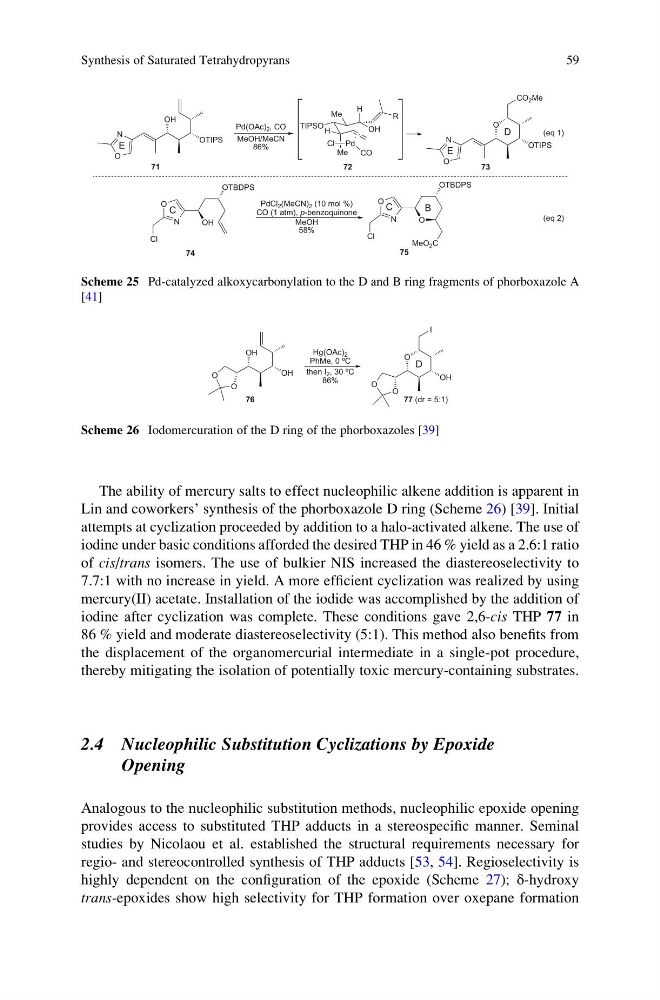
The ability of mercury salts to effect nucleophilic alkene addition is apparent in
Lin and coworkers’ synthesis of the phorboxazole D ring (Scheme 26) [39]. Initial
attempts at cyclization proceeded by addition to a halo-activated alkene. The use of
iodine under basic conditions afforded the desired THP in 46 % yield as a 2.6:1 ratio
of cis/trans isomers. The use of bulkier NIS increased the diastereoselectivity to
7.7:1 with no increase in yield. A more efficient cyclization was realized by using
mercury(II) acetate. Installation of the iodide was accomplished by the addition of
iodine after cyclization was complete. These conditions gave 2,6-cis THP 77 in
86 % yield and moderate diastereoselectivity (5:1). This method also benefits from
the displacement of the organomercurial intermediate in a single-pot procedure,
thereby mitigating the isolation of potentially toxic mercury-containing substrates.
2.4 Nucleophilic Substitution Cyclizations by Epoxide
Opening
Analogous to the nucleophilic substitution methods, nucleophilic epoxide opening
provides access to substituted THP adducts in a stereospecific manner. Seminal
studies by Nicolaou et al. established the structural requirements necessary for
regio- and stereocontrolled synthesis of THP adducts [53, 54]. Regioselectivity is
highly dependent on the configuration of the epoxide (Scheme 27); δ-hydroxy
trans-epoxides show high selectivity for THP formation over oxepane formation
O
I
OH
O
D
OH
OH
Hg(OAc) 2
PhMe, 0 ºC
then I 2 , 30 ºC
86%
O
O
O
76
77 (dr = 5:1)
Scheme 26 Iodomercuration of the D ring of the phorboxazoles [39]
Cl
N
O
OH
C
OTBDPS
Cl
N
O
O
OTBDPS
B
C
MeO 2 C
PdCl 2 (MeCN) 2 (10 mol %)
CO (1 atm), p-benzoquinone
MeOH
58%
O
OTIPS
N
O
D
E
CO 2 Me
OH
OTIPS
N
O
E
Pd(OAc) 2 , CO
MeOH/MeCN
86%
TIPSO
Me
H
OH
H
R
Pd
CO
Cl
Me
71
73
74
75
(eq 1)
(eq 2)
72
Scheme 25 Pd-catalyzed alkoxycarbonylation to the D and B ring fragments of phorboxazole A
[41]
Synthesis of Saturated Tetrahydropyrans
59
Lin and coworkers’ synthesis of the phorboxazole D ring (Scheme 26) [39]. Initial
attempts at cyclization proceeded by addition to a halo-activated alkene. The use of
iodine under basic conditions afforded the desired THP in 46 % yield as a 2.6:1 ratio
of cis/trans isomers. The use of bulkier NIS increased the diastereoselectivity to
7.7:1 with no increase in yield. A more efficient cyclization was realized by using
mercury(II) acetate. Installation of the iodide was accomplished by the addition of
iodine after cyclization was complete. These conditions gave 2,6-cis THP 77 in
86 % yield and moderate diastereoselectivity (5:1). This method also benefits from
the displacement of the organomercurial intermediate in a single-pot procedure,
thereby mitigating the isolation of potentially toxic mercury-containing substrates.
2.4 Nucleophilic Substitution Cyclizations by Epoxide
Opening
Analogous to the nucleophilic substitution methods, nucleophilic epoxide opening
provides access to substituted THP adducts in a stereospecific manner. Seminal
studies by Nicolaou et al. established the structural requirements necessary for
regio- and stereocontrolled synthesis of THP adducts [53, 54]. Regioselectivity is
highly dependent on the configuration of the epoxide (Scheme 27); δ-hydroxy
trans-epoxides show high selectivity for THP formation over oxepane formation
O
I
OH
O
D
OH
OH
Hg(OAc) 2
PhMe, 0 ºC
then I 2 , 30 ºC
86%
O
O
O
76
77 (dr = 5:1)
Scheme 26 Iodomercuration of the D ring of the phorboxazoles [39]
Cl
N
O
OH
C
OTBDPS
Cl
N
O
O
OTBDPS
B
C
MeO 2 C
PdCl 2 (MeCN) 2 (10 mol %)
CO (1 atm), p-benzoquinone
MeOH
58%
O
OTIPS
N
O
D
E
CO 2 Me
OH
OTIPS
N
O
E
Pd(OAc) 2 , CO
MeOH/MeCN
86%
TIPSO
Me
H
OH
H
R
Pd
CO
Cl
Me
71
73
74
75
(eq 1)
(eq 2)
72
Scheme 25 Pd-catalyzed alkoxycarbonylation to the D and B ring fragments of phorboxazole A
[41]
Synthesis of Saturated Tetrahydropyrans
59