

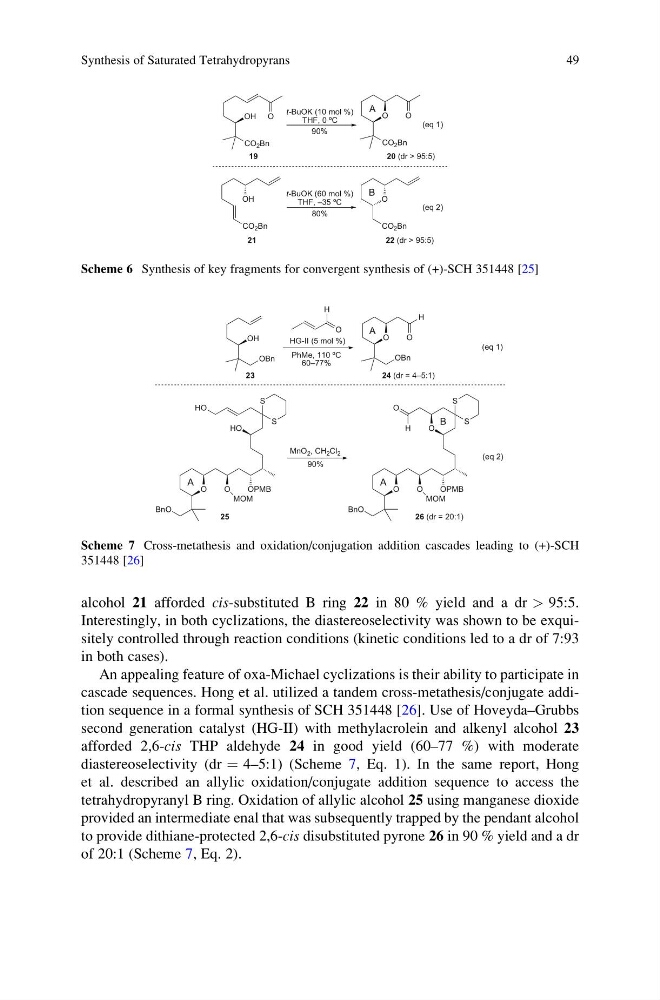
alcohol 21 afforded cis-substituted B ring 22 in 80 % yield and a dr > 95:5.
Interestingly, in both cyclizations, the diastereoselectivity was shown to be exquisitely controlled through reaction conditions (kinetic conditions led to a dr of 7:93
in both cases).
An appealing feature of oxa-Michael cyclizations is their ability to participate in
cascade sequences. Hong et al. utilized a tandem cross-metathesis/conjugate addition sequence in a formal synthesis of SCH 351448 [26]. Use of Hoveyda–Grubbs
second generation catalyst (HG-II) with methylacrolein and alkenyl alcohol 23
afforded 2,6-cis THP aldehyde 24 in good yield (60–77 %) with moderate
diastereoselectivity (dr ¼ 4–5:1) (Scheme 7, Eq. 1). In the same report, Hong
et al. described an allylic oxidation/conjugate addition sequence to access the
tetrahydropyranyl B ring. Oxidation of allylic alcohol 25 using manganese dioxide
provided an intermediate enal that was subsequently trapped by the pendant alcohol
to provide dithiane-protected 2,6-cis disubstituted pyrone 26 in 90 % yield and a dr
of 20:1 (Scheme 7, Eq. 2).
OH
CO 2 Bn
O
O
CO 2 Bn
O
t-BuOK (10 mol %)
THF, 0 ºC
90%
A
CO 2 Bn
OH
t-BuOK (60 mol %)
THF, –35 ºC
80%
CO 2 Bn
O
B
19
20 (dr > 95:5)
21
22 (dr > 95:5)
(eq 1)
(eq 2)
Scheme 6 Synthesis of key fragments for convergent synthesis of (+)-SCH 351448 [25]
OH
O
O
HG-II (5 mol %)
PhMe, 110 ºC
60–77%
A
MnO 2 , CH 2 Cl 2
90%
OBn
OBn
O
O
OPMB
O
O
A
B
O
MOM
BnO
S
S
HO
OPMB
O
O
A
HO
MOM
BnO
S
S
25
26 (dr = 20:1)
24 (dr = 4–5:1)
23
(eq 1)
(eq 2)
H
H
H
Scheme 7 Cross-metathesis and oxidation/conjugation addition cascades leading to (+)-SCH
351448 [26]
Synthesis of Saturated Tetrahydropyrans
49
Interestingly, in both cyclizations, the diastereoselectivity was shown to be exquisitely controlled through reaction conditions (kinetic conditions led to a dr of 7:93
in both cases).
An appealing feature of oxa-Michael cyclizations is their ability to participate in
cascade sequences. Hong et al. utilized a tandem cross-metathesis/conjugate addition sequence in a formal synthesis of SCH 351448 [26]. Use of Hoveyda–Grubbs
second generation catalyst (HG-II) with methylacrolein and alkenyl alcohol 23
afforded 2,6-cis THP aldehyde 24 in good yield (60–77 %) with moderate
diastereoselectivity (dr ¼ 4–5:1) (Scheme 7, Eq. 1). In the same report, Hong
et al. described an allylic oxidation/conjugate addition sequence to access the
tetrahydropyranyl B ring. Oxidation of allylic alcohol 25 using manganese dioxide
provided an intermediate enal that was subsequently trapped by the pendant alcohol
to provide dithiane-protected 2,6-cis disubstituted pyrone 26 in 90 % yield and a dr
of 20:1 (Scheme 7, Eq. 2).
OH
CO 2 Bn
O
O
CO 2 Bn
O
t-BuOK (10 mol %)
THF, 0 ºC
90%
A
CO 2 Bn
OH
t-BuOK (60 mol %)
THF, –35 ºC
80%
CO 2 Bn
O
B
19
20 (dr > 95:5)
21
22 (dr > 95:5)
(eq 1)
(eq 2)
Scheme 6 Synthesis of key fragments for convergent synthesis of (+)-SCH 351448 [25]
OH
O
O
HG-II (5 mol %)
PhMe, 110 ºC
60–77%
A
MnO 2 , CH 2 Cl 2
90%
OBn
OBn
O
O
OPMB
O
O
A
B
O
MOM
BnO
S
S
HO
OPMB
O
O
A
HO
MOM
BnO
S
S
25
26 (dr = 20:1)
24 (dr = 4–5:1)
23
(eq 1)
(eq 2)
H
H
H
Scheme 7 Cross-metathesis and oxidation/conjugation addition cascades leading to (+)-SCH
351448 [26]
Synthesis of Saturated Tetrahydropyrans
49