

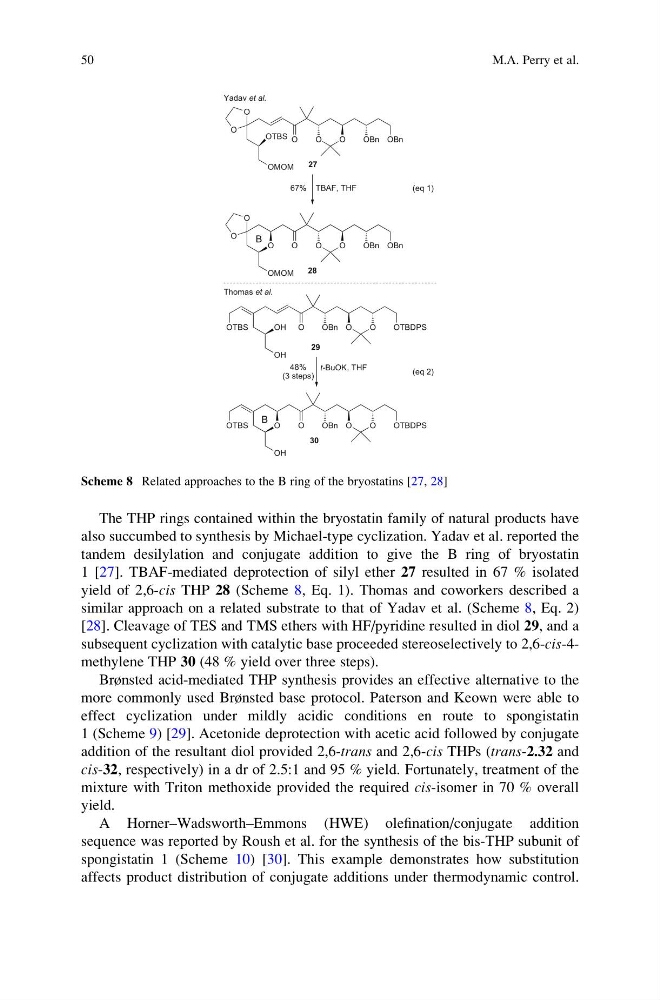
The THP rings contained within the bryostatin family of natural products have
also succumbed to synthesis by Michael-type cyclization. Yadav et al. reported the
tandem desilylation and conjugate addition to give the B ring of bryostatin
1 [27]. TBAF-mediated deprotection of silyl ether 27 resulted in 67 % isolated
yield of 2,6-cis THP 28 (Scheme 8, Eq. 1). Thomas and coworkers described a
similar approach on a related substrate to that of Yadav et al. (Scheme 8, Eq. 2)
[28]. Cleavage of TES and TMS ethers with HF/pyridine resulted in diol 29, and a
subsequent cyclization with catalytic base proceeded stereoselectively to 2,6-cis-4methylene THP 30 (48 % yield over three steps).
Brønsted acid-mediated THP synthesis provides an effective alternative to the
more commonly used Brønsted base protocol. Paterson and Keown were able to
effect cyclization under mildly acidic conditions en route to spongistatin
1 (Scheme 9) [29]. Acetonide deprotection with acetic acid followed by conjugate
addition of the resultant diol provided 2,6-trans and 2,6-cis THPs (trans-2.32 and
cis-32, respectively) in a dr of 2.5:1 and 95 % yield. Fortunately, treatment of the
mixture with Triton methoxide provided the required cis-isomer in 70 % overall
yield.
A Horner–Wadsworth–Emmons (HWE) olefination/conjugate addition
sequence was reported by Roush et al. for the synthesis of the bis-THP subunit of
spongistatin 1 (Scheme 10) [30]. This example demonstrates how substitution
affects product distribution of conjugate additions under thermodynamic control.
OTBS
OTBDPS
OH
OH
O
OBn O
O
OTBS
OTBDPS
O
OH
O
OBn O
O
t-BuOK, THF
B
O
O
OMOM
B
O
O
O
O
OBn OBn
OTBS O
OMOM
O
O
O
O
OBn OBn
67% TBAF, THF
27
28
29
30
48%
(3 steps)
(eq 1)
(eq 2)
Yadav et al.
Thomas et al.
Scheme 8 Related approaches to the B ring of the bryostatins [27, 28]
50
M.A. Perry et al.
also succumbed to synthesis by Michael-type cyclization. Yadav et al. reported the
tandem desilylation and conjugate addition to give the B ring of bryostatin
1 [27]. TBAF-mediated deprotection of silyl ether 27 resulted in 67 % isolated
yield of 2,6-cis THP 28 (Scheme 8, Eq. 1). Thomas and coworkers described a
similar approach on a related substrate to that of Yadav et al. (Scheme 8, Eq. 2)
[28]. Cleavage of TES and TMS ethers with HF/pyridine resulted in diol 29, and a
subsequent cyclization with catalytic base proceeded stereoselectively to 2,6-cis-4methylene THP 30 (48 % yield over three steps).
Brønsted acid-mediated THP synthesis provides an effective alternative to the
more commonly used Brønsted base protocol. Paterson and Keown were able to
effect cyclization under mildly acidic conditions en route to spongistatin
1 (Scheme 9) [29]. Acetonide deprotection with acetic acid followed by conjugate
addition of the resultant diol provided 2,6-trans and 2,6-cis THPs (trans-2.32 and
cis-32, respectively) in a dr of 2.5:1 and 95 % yield. Fortunately, treatment of the
mixture with Triton methoxide provided the required cis-isomer in 70 % overall
yield.
A Horner–Wadsworth–Emmons (HWE) olefination/conjugate addition
sequence was reported by Roush et al. for the synthesis of the bis-THP subunit of
spongistatin 1 (Scheme 10) [30]. This example demonstrates how substitution
affects product distribution of conjugate additions under thermodynamic control.
OTBS
OTBDPS
OH
OH
O
OBn O
O
OTBS
OTBDPS
O
OH
O
OBn O
O
t-BuOK, THF
B
O
O
OMOM
B
O
O
O
O
OBn OBn
OTBS O
OMOM
O
O
O
O
OBn OBn
67% TBAF, THF
27
28
29
30
48%
(3 steps)
(eq 1)
(eq 2)
Yadav et al.
Thomas et al.
Scheme 8 Related approaches to the B ring of the bryostatins [27, 28]
50
M.A. Perry et al.