

and alternative cyclization conditions gave only traces of the DHP (~20 %). This
fragment was later used for a Ferrier-type rearrangement to give the
2,6-disubstituted DHP.
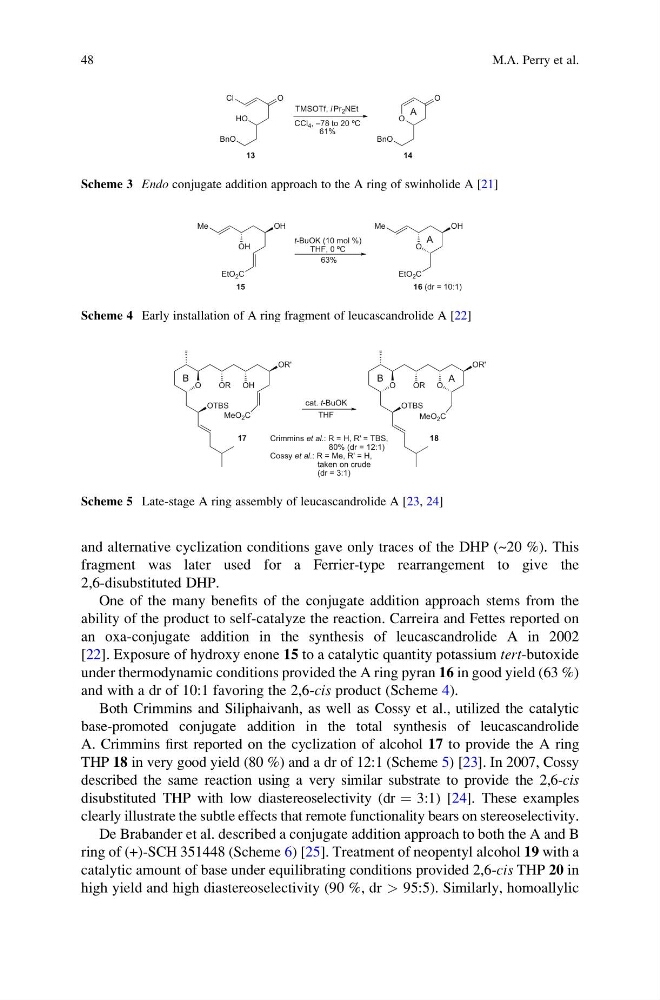
One of the many benefits of the conjugate addition approach stems from the
ability of the product to self-catalyze the reaction. Carreira and Fettes reported on
an oxa-conjugate addition in the synthesis of leucascandrolide A in 2002
[22]. Exposure of hydroxy enone 15 to a catalytic quantity potassium tert-butoxide
under thermodynamic conditions provided the A ring pyran 16 in good yield (63 %)
and with a dr of 10:1 favoring the 2,6-cis product (Scheme 4).
Both Crimmins and Siliphaivanh, as well as Cossy et al., utilized the catalytic
base-promoted conjugate addition in the total synthesis of leucascandrolide
A. Crimmins first reported on the cyclization of alcohol 17 to provide the A ring
THP 18 in very good yield (80 %) and a dr of 12:1 (Scheme 5) [23]. In 2007, Cossy
described the same reaction using a very similar substrate to provide the 2,6-cis
disubstituted THP with low diastereoselectivity (dr ¼ 3:1) [24]. These examples
clearly illustrate the subtle effects that remote functionality bears on stereoselectivity.
De Brabander et al. described a conjugate addition approach to both the A and B
ring of (+)-SCH 351448 (Scheme 6) [25]. Treatment of neopentyl alcohol 19 with a
catalytic amount of base under equilibrating conditions provided 2,6-cis THP 20 in
high yield and high diastereoselectivity (90 %, dr > 95:5). Similarly, homoallylic
HO
BnO
Cl
O
TMSOTf, i Pr 2 NEt
CCl 4 , –78 to 20 ºC
61%
O
BnO
O
A
13
14
Scheme 3 Endo conjugate addition approach to the A ring of swinholide A [21]
t-BuOK (10 mol %)
THF, 0 ºC
63%
Me
O
OH
A
EtO 2 C
Me
OH
OH
EtO 2 C
15
16 (dr = 10:1)
Scheme 4 Early installation of A ring fragment of leucascandrolide A [22]
O
OR O
OR'
A
B
OTBS
MeO 2 C
O
OR OH
OR'
B
OTBS
MeO 2 C
cat. t-BuOK
Crimmins et al.: R = H, R' = TBS,
80% (dr = 12:1)
Cossy et al.: R = Me, R' = H,
taken on crude
(dr = 3:1)
THF
17
18
Scheme 5 Late-stage A ring assembly of leucascandrolide A [23, 24]
48
M.A. Perry et al.
fragment was later used for a Ferrier-type rearrangement to give the
2,6-disubstituted DHP.
One of the many benefits of the conjugate addition approach stems from the
ability of the product to self-catalyze the reaction. Carreira and Fettes reported on
an oxa-conjugate addition in the synthesis of leucascandrolide A in 2002
[22]. Exposure of hydroxy enone 15 to a catalytic quantity potassium tert-butoxide
under thermodynamic conditions provided the A ring pyran 16 in good yield (63 %)
and with a dr of 10:1 favoring the 2,6-cis product (Scheme 4).
Both Crimmins and Siliphaivanh, as well as Cossy et al., utilized the catalytic
base-promoted conjugate addition in the total synthesis of leucascandrolide
A. Crimmins first reported on the cyclization of alcohol 17 to provide the A ring
THP 18 in very good yield (80 %) and a dr of 12:1 (Scheme 5) [23]. In 2007, Cossy
described the same reaction using a very similar substrate to provide the 2,6-cis
disubstituted THP with low diastereoselectivity (dr ¼ 3:1) [24]. These examples
clearly illustrate the subtle effects that remote functionality bears on stereoselectivity.
De Brabander et al. described a conjugate addition approach to both the A and B
ring of (+)-SCH 351448 (Scheme 6) [25]. Treatment of neopentyl alcohol 19 with a
catalytic amount of base under equilibrating conditions provided 2,6-cis THP 20 in
high yield and high diastereoselectivity (90 %, dr > 95:5). Similarly, homoallylic
HO
BnO
Cl
O
TMSOTf, i Pr 2 NEt
CCl 4 , –78 to 20 ºC
61%
O
BnO
O
A
13
14
Scheme 3 Endo conjugate addition approach to the A ring of swinholide A [21]
t-BuOK (10 mol %)
THF, 0 ºC
63%
Me
O
OH
A
EtO 2 C
Me
OH
OH
EtO 2 C
15
16 (dr = 10:1)
Scheme 4 Early installation of A ring fragment of leucascandrolide A [22]
O
OR O
OR'
A
B
OTBS
MeO 2 C
O
OR OH
OR'
B
OTBS
MeO 2 C
cat. t-BuOK
Crimmins et al.: R = H, R' = TBS,
80% (dr = 12:1)
Cossy et al.: R = Me, R' = H,
taken on crude
(dr = 3:1)
THF
17
18
Scheme 5 Late-stage A ring assembly of leucascandrolide A [23, 24]
48
M.A. Perry et al.