

products of this reaction come from readily available starting materials, the reaction
is impressive. For example, the oxidative cyclization of geraniol derivative 184
using a mixture of OsO 4 , NMO, and TFA gave tetrahydrofuran 185 as a single
diastereomer in 88 % yield.
Donohoe et al. has also developed a two-step cyclization sequence to generate
optically active tetrahydrofurans [55]. As illustrated for the their work targeting the
formal total synthesis of (+)-cis-solarin, Donohoe et al. were able to generate optically
active tetrahydrofuran 189 by using an asymmetric Sharpless dihydroxylation to
initially build diol 188 and by then subjecting 188 to their oxidative cyclization
conditions (Scheme 50). Interestingly, the oxidative cyclization reaction of 188 requires
the use of Os(VI) rather than Os(VIII); Donohoe et al. were able to employ catalytic
OsO 4 by including a sacrificial olefin (isoprene) in the reaction.
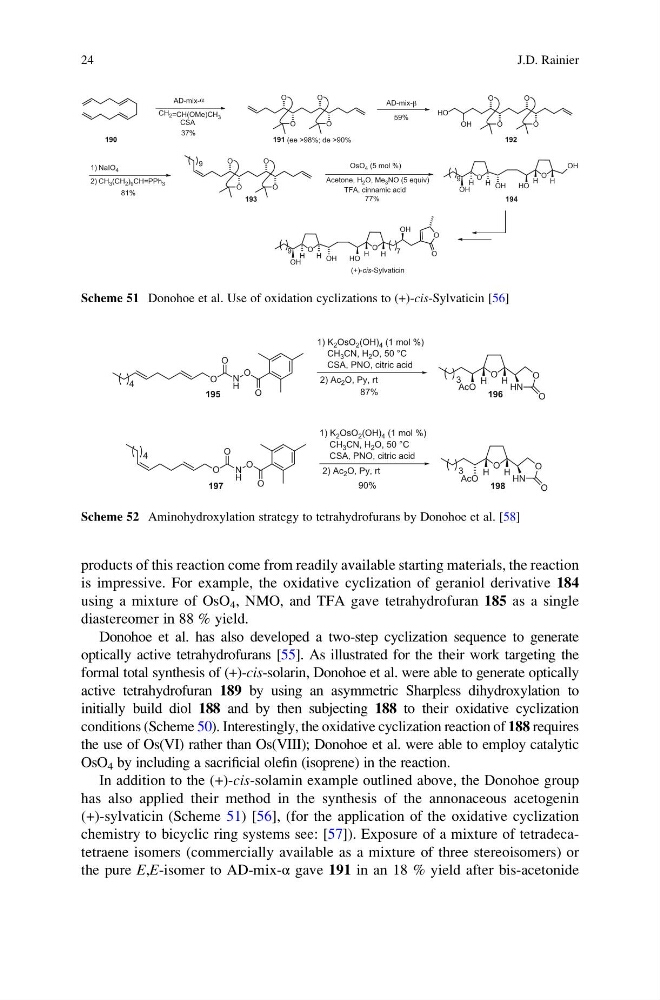
In addition to the (+)-cis-solamin example outlined above, the Donohoe group
has also applied their method in the synthesis of the annonaceous acetogenin
(+)-sylvaticin (Scheme 51) [56], (for the application of the oxidative cyclization
chemistry to bicyclic ring systems see: [57]). Exposure of a mixture of tetradecatetraene isomers (commercially available as a mixture of three stereoisomers) or
the pure E,E-isomer to AD-mix-α gave 191 in an 18 % yield after bis-acetonide
AD-mix-α
CSA
O
O
O
O
AD-mix-β
191 (ee >98%; de >90%
O
O
O
O
OH
HO
59%
1) NaIO 4
2) CH 3 (CH 2 ) 9 CH=PPh 3
81%
O
O
O
O
9
OsO 4 (5 mol %)
Acetone, H 2 O, Me 3 NO (5 equiv)
TFA, cinnamic acid
77%
O
O
OH
OH
9
H
H
HO
OH
H
H
O
O
OH
9
H
H
HO
OH
H
H
O
O
OH
7
(+)-cis-Sylvaticin
190
192
193
194
37%
CH 2=CH(OMe)CH 3
Scheme 51 Donohoe et al. Use of oxidation cyclizations to (+)-cis-Sylvaticin [56]
O
O
N
H
O
O
1) K 2 OsO 2 (OH) 4 (1 mol %)
CH 3 CN, H 2 O, 50 °C
CSA, PNO, citric acid
2) Ac 2 O, Py, rt
O
HN
O
H
H
O
AcO
4
3
87%
O
O
N
H
O
O
1) K 2 OsO 2 (OH) 4 (1 mol %)
CH 3 CN, H 2 O, 50 °C
CSA, PNO, citric acid
2) Ac 2 O, Py, rt
O
HN
O
H
H
O
AcO
3
4
195
196
197
198
90%
Scheme 52 Aminohydroxylation strategy to tetrahydrofurans by Donohoe et al. [58]
24
J.D. Rainier
is impressive. For example, the oxidative cyclization of geraniol derivative 184
using a mixture of OsO 4 , NMO, and TFA gave tetrahydrofuran 185 as a single
diastereomer in 88 % yield.
Donohoe et al. has also developed a two-step cyclization sequence to generate
optically active tetrahydrofurans [55]. As illustrated for the their work targeting the
formal total synthesis of (+)-cis-solarin, Donohoe et al. were able to generate optically
active tetrahydrofuran 189 by using an asymmetric Sharpless dihydroxylation to
initially build diol 188 and by then subjecting 188 to their oxidative cyclization
conditions (Scheme 50). Interestingly, the oxidative cyclization reaction of 188 requires
the use of Os(VI) rather than Os(VIII); Donohoe et al. were able to employ catalytic
OsO 4 by including a sacrificial olefin (isoprene) in the reaction.
In addition to the (+)-cis-solamin example outlined above, the Donohoe group
has also applied their method in the synthesis of the annonaceous acetogenin
(+)-sylvaticin (Scheme 51) [56], (for the application of the oxidative cyclization
chemistry to bicyclic ring systems see: [57]). Exposure of a mixture of tetradecatetraene isomers (commercially available as a mixture of three stereoisomers) or
the pure E,E-isomer to AD-mix-α gave 191 in an 18 % yield after bis-acetonide
AD-mix-α
CSA
O
O
O
O
AD-mix-β
191 (ee >98%; de >90%
O
O
O
O
OH
HO
59%
1) NaIO 4
2) CH 3 (CH 2 ) 9 CH=PPh 3
81%
O
O
O
O
9
OsO 4 (5 mol %)
Acetone, H 2 O, Me 3 NO (5 equiv)
TFA, cinnamic acid
77%
O
O
OH
OH
9
H
H
HO
OH
H
H
O
O
OH
9
H
H
HO
OH
H
H
O
O
OH
7
(+)-cis-Sylvaticin
190
192
193
194
37%
CH 2=CH(OMe)CH 3
Scheme 51 Donohoe et al. Use of oxidation cyclizations to (+)-cis-Sylvaticin [56]
O
O
N
H
O
O
1) K 2 OsO 2 (OH) 4 (1 mol %)
CH 3 CN, H 2 O, 50 °C
CSA, PNO, citric acid
2) Ac 2 O, Py, rt
O
HN
O
H
H
O
AcO
4
3
87%
O
O
N
H
O
O
1) K 2 OsO 2 (OH) 4 (1 mol %)
CH 3 CN, H 2 O, 50 °C
CSA, PNO, citric acid
2) Ac 2 O, Py, rt
O
HN
O
H
H
O
AcO
3
4
195
196
197
198
90%
Scheme 52 Aminohydroxylation strategy to tetrahydrofurans by Donohoe et al. [58]
24
J.D. Rainier